Choosing among grain mills for small businesses means balancing throughput, flour consistency, operating space, and cleanup. The right machine can support fresh flour production without forcing a small shop to invest in oversized processing equipment.
This roundup compares 10 electric and manual models across capacity, motor power, construction, adjustability, and intended workload so you can identify the best fit for your bakery, food stall, farm operation, or specialty-grain business.
Best 10 Grain Mills for Small Businesses Picks for 2026
Compact High-Speed Pick

- 25,000 RPM motor with 50–300 mesh fineness
- 180° swing design and overload protection
- For dry grains, herbs, spices, coffee, and nuts
Best For: Small-batch dry ingredient processing
Large-Batch Electric Pick
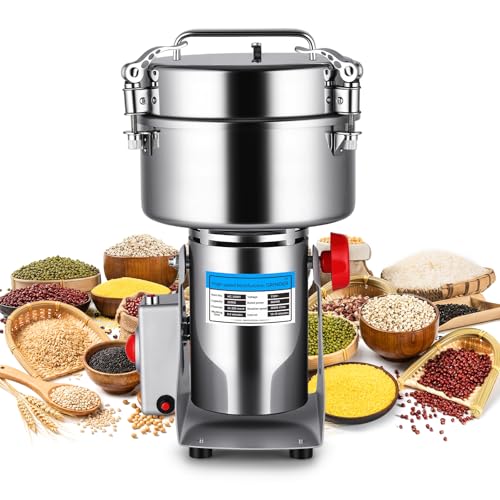
- 3000g chamber for larger dry-ingredient batches
- 3600W motor with 30–300 mesh output
- 270° swing design and overload shutoff
Best For: Higher-volume dry milling in small food businesses
Manual Traditional Pick

- 2400g manual mill with adjustable grind settings
- Clamps to tables 1/2–2 inches thick
- Durable cast iron for grains, corn, coffee, and spices
Best For: Low-volume manual and specialty grinding
Wet-and-Dry Commercial Pick

- Separate discs support wet and dry grinding
- Adjustable thickness and funnel feeding
- Cast-iron body for flour, pulp, starch, and feed
Best For: Versatile small-scale food processing
Best Compact Bread Flour Mill

- 1200-watt motor for hard grains
- Fine bread-flour-focused impact milling
- 8-cup hopper and 12-cup canister
Best For: Small bakeries and frequent bread bakers
Best High-Throughput Grain Grinder
VEVOR 110 lb/H Commercial Mill

- Processes about 110 lb per hour
- 30–300 mesh fineness adjustment
- 1500-watt cast-iron construction
Best For: Large-batch dry grain and spice processing
Best Superfine Batch Mill
OKF 550g Stainless Steel Grinder

- 2000-watt, 28,000-RPM motor
- 70–300 mesh controllable fineness
- 304 stainless-steel construction
Best For: Small-batch dry grains, spices, herbs, and coffee
High-Power Crop Mill
3000W Electric Grain Mill Grinder

- 3000W motor with 110V rated voltage
- Handles wheat, rice, corn, and soybeans
- Not designed for brown sugar, sesame, or peanuts
Best For: Small food businesses processing dry staple crops
Large-Batch Versatility
VEVOR 600W Commercial Grain Pulverizer
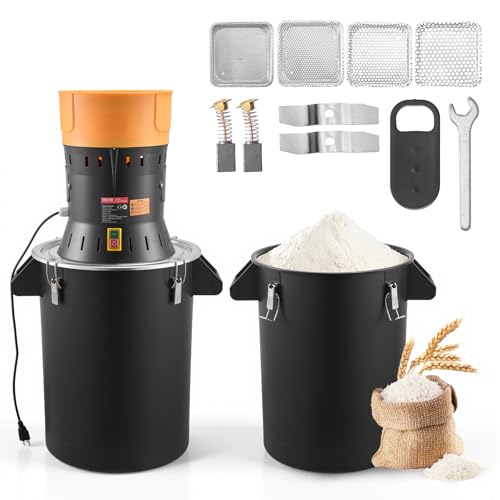
- Five screens support adjustable coarseness
- Grinds dry grains, coffee, and spices
- 53-liter capacity with detachable hopper
Best For: Operations needing flexible, larger-capacity dry grinding
Fine-Powder Control
VEVOR 2100W Swing-Type Grinder

- 28,000 RPM motor with 30–300 mesh fineness
- Timed 5-, 15-, and 30-second grinding options
- 1.8-pound capacity and 110V operation
Best For: Compact batch grinding of dry grains, coffee, and spices
Compact High-Speed Pick – 1000g Electric Grain Grinder
For small businesses needing a compact grinder for dry grains, herbs, spices, or coffee, this 1000g electric model emphasizes speed and flexible powder fineness. Its stainless-steel construction and swing design are useful for small-batch production, though the three-minute operating limit requires planned rest periods.
Best For: Small kitchens, food shops, cafés, and businesses processing dry ingredients in short batches.
Pros:
- 1000g capacity and up to 25,000 RPM for quick small-batch grinding.
- Adjustable 50–300 mesh fineness range and 180° swing design help produce more uniform powder.
- Overload protection, safety lid, timer, and food-grade stainless-steel body support safer operation.
- Handles dry grains, beans, coffee, herbs, spices, nuts, and seeds.
Cons:
- Limited to dry ingredients; wet, oily, or moist materials should not be used.
- Requires a 5–10 minute rest after every three minutes of grinding.
- The grinding chamber should be wiped rather than rinsed directly with water.
This is a practical entry-level option among grain mills for small businesses when capacity needs are moderate and batches can be scheduled around cooling pauses. It is less suitable for continuous production or wet processing.
Large-Batch Electric Pick – 3000g Flour Mill Grinder
This 3000g electric mill is designed for buyers who want more capacity from grain mills for small businesses. Its large chamber, 3600W rating, and 270° swing design can help process dry grains and spices efficiently, while the three-minute run limit still makes it a batch-oriented machine.
Best For: Home-based bakeries, cafés, and small food businesses that need larger batches of dry grain or spice powder.
Pros:
- 3000g capacity accommodates substantially larger batches than compact grinders.
- 270° swing motion and triple-layer stainless-steel blades are intended to improve consistency.
- Produces a stated 30–300 mesh range for flour and powder applications.
- Overload shutoff, reset button, dual side buckles, and stainless-steel construction add practical safeguards.
Cons:
- Designed for dry ingredients only and should not process wet or oily materials.
- Must rest for 5–10 minutes after each three-minute operating session.
- Cleaning requires brushing or wiping rather than rinsing the inner bin with water.
The larger capacity makes this a strong fit when production volume is the priority, but its duty-cycle restriction should be considered before choosing it for high-throughput commercial work.
Manual Traditional Pick – Victoria Cast Iron Grain Mill
The Victoria manual mill offers a non-electric alternative for small businesses seeking dependable, hands-on grain processing. Its cast-iron body, adjustable screw, high hopper, and table clamp make it useful where modest output, portability, or avoiding motor-powered equipment matters more than superfine flour.
Best For: Small-scale corn grinding, home breweries, specialty food preparation, and businesses that prefer manual operation.
Pros:
- Heavy-duty cast-iron construction with erosion-resistant discs and double tin plating.
- Adjustable coarseness and fineness settings support different grinding tasks.
- 2400g capacity, high hopper, table clamp, and non-slip protector improve usability.
- Can process grains, corn, coffee, spices, seeds, nuts, vegetables, and other listed foods.
Cons:
- Manual cranking is less convenient for sustained or high-volume production.
- It cannot produce a superfine texture or fine whole-wheat powder.
- Its limited 90-day manufacturer warranty may be a consideration for business buyers.
This is one of the more straightforward grain mills for small businesses that need flexible, low-tech grinding rather than maximum speed. Choose it when coarse-to-medium results and manual control meet your workflow.
Wet-and-Dry Commercial Pick – VEVOR 3000W Grain Mill
For businesses that need more than dry flour production, this VEVOR model stands out among grain mills for small businesses with its separate dry and wet grinding capability. The heavy-duty cast-iron body, funnel feed, and adjustable thickness make it suited to varied food-processing tasks, including soaked soybeans and rice.
Best For: Small food-production operations making dry flour, rice products, soy pulp, starch, or animal feed.
Pros:
- Supports both dry grinding and wet processing with included cast-iron and sand milling discs.
- 3000W motor and funnel feeding are designed for substantial grinding capability and steadier feeding.
- Adjustable thickness accommodates grains, spices, coffee, cereal, wheat, and nuts.
- Solid cast-iron body and stainless-steel funnel are built for prolonged use.
Cons:
- Its industrial design and roughly 27.56-inch height require significant workspace.
- The supplied notes do not specify a capacity or operating duty cycle.
- Wet and dry processing require the appropriate milling disc and suitable preparation of ingredients.
This is the most versatile option in the group for businesses handling both dry crops and wet mixtures. Its larger footprint makes it better suited to a dedicated work area than a compact countertop setup.
Best Compact Bread Flour Mill – NutriMill Impact Compact
For small businesses that need fresh flour without giving up valuable workspace, the NutriMill Impact Compact is a practical option among grain mills for small businesses. Its 1200-watt motor and impact milling heads are designed for fine bread flour, while the large hopper and canister support frequent, larger-batch baking.
Best For: Small bakeries, bread-focused food businesses, and frequent bakers needing compact flour production.
Pros:
- 1200-watt motor is designed to handle hard grains such as wheat.
- Impact milling heads target a fine, consistent bread-flour texture.
- 8-cup hopper and 12-cup flour canister support larger batches.
- Nesting components and cyclone air filtration help with storage and airflow.
Cons:
- Its bread-flour-focused design may be less versatile than a mill intended for broader commercial materials.
- The supplied notes do not specify an hourly processing rate.
The NutriMill is a strong fit when compact storage and consistent bread flour matter more than maximum industrial throughput. The included canister, hopper, and air filter make it a convenient setup for regular small-batch production.
Best High-Throughput Grain Grinder – VEVOR 110 lb/H Commercial Mill
Businesses processing substantial volumes of dry grains may value the VEVOR commercial grinder’s combination of power, capacity, and adjustable fineness. Among grain mills for small businesses, it stands out for a stated throughput of about 110 pounds per hour and a 30–300 mesh adjustment range.
Best For: Farms, ranches, food businesses, and other operations handling large batches of dry grains, spices, or coffee.
Pros:
- 1500-watt, 1400-RPM motor is designed for fast grinding.
- Rated processing capacity is approximately 110 pounds, or 50 kilograms, per hour.
- Adjustable 30–300 mesh fineness supports coarse crushing through fine powder.
- Cast-iron construction, cooling vents, and anti-slip feet support stable operation.
Cons:
- It is a heavy 47.2-pound machine with a tall 28.15-inch profile.
- Not intended for wet, oily, or sticky materials.
- The industrial design may be more machine than a very small operation needs.
Choose this VEVOR model when throughput and fineness control are central to the workflow. Its dry-material limitation and substantial footprint should be considered before placing it in a compact production area.
Best Superfine Batch Mill – OKF 550g Stainless Steel Grinder
The OKF 550g grinder is a compact, high-speed choice for businesses that need finely processed dry ingredients in controlled batches. Its 304 stainless-steel body, 2000-watt motor, and stated 70–300 mesh range make it a versatile entry among grain mills for small businesses, restaurants, and food-processing workspaces.
Best For: Restaurants, specialty food makers, laboratories, and small operations grinding dry grains, spices, herbs, or coffee in batches.
Pros:
- Food-grade 304 stainless steel provides a durable, easy-to-wipe exterior.
- 2000-watt motor runs at a stated 28,000 RPM for rapid pulverizing.
- Handles dry grains, spices, herbs, and coffee beans.
- Timer-based control lets users adjust grinding time and fineness.
Cons:
- The 550-gram capacity requires smaller, repeated batches for higher-volume work.
- Continuous grinding should not exceed five minutes, followed by a 5–10-minute cooling period.
- The unit should not be rinsed directly with water, so cleaning requires wiping.
This OKF model is best suited to businesses prioritizing superfine results and ingredient flexibility over continuous production. Its compact 7.7-pound form makes it easier to position, but the batch limit and cooling guidance matter for demanding workloads.
High-Power Crop Mill – 3000W Electric Grain Mill Grinder
For small businesses seeking grain mills for small businesses, this 3000W electric grinder is designed for dry crops and food-industry applications. It can process wheat, rice, corn, sorghum, and soybeans into dry powder, making it a straightforward option for businesses that need a powerful 110V machine for staple grains.
Best For: Small food-processing operations milling dry grains, rice flour, corn, and similar crops.
Pros:
- Powerful 3000W motor for demanding dry-grain applications
- Suitable for wheat, rice, corn, sorghum, soybeans, and starch
- Uses a standard 110V rated voltage
Cons:
- Not suitable for brown sugar, sesame, or peanuts
- Product notes specify counterclockwise rotation, which may require setup awareness
This model is a focused choice when your business primarily mills dry staple crops and values motor power over broad ingredient versatility. Confirm that your intended materials fall within its stated fitment limits before buying.
Large-Batch Versatility – VEVOR 600W Commercial Grain Pulverizer
Businesses comparing grain mills for small businesses may appreciate this VEVOR grinder for its broad dry-material coverage and adjustable screens. It handles grains, coffee, and spices, while its 53-liter capacity and included screens support different grinding needs for flour, feed, and spice powders.
Best For: Farms, ranches, and small operations that need flexible dry-grain and spice grinding with larger capacity.
Pros:
- Works with wheat, soybeans, corn, coffee beans, and several spices
- Includes five interchangeable screens from 3 to 8 mm for coarseness control
- 600W motor reaches 15,000 RPM and includes a detachable, washable hopper
- Large 53-liter stated capacity for higher-volume processing
Cons:
- Listed voltage is 220V, so electrical compatibility should be verified
- At 18.3 pounds and over 34 inches tall, it requires dedicated space
Its screen selection and multipurpose design make it one of the more adaptable options here. Before ordering, check your facility’s power supply and available footprint, particularly because the listed dimensions are substantial.
Fine-Powder Control – VEVOR 2100W Swing-Type Grinder
For small businesses evaluating grain mills for small businesses, this compact VEVOR swing-type grinder emphasizes fast fine-powder production and timed operation. Its 2100W, 110V motor reaches 28,000 RPM, while the 30-to-300-mesh range and three timer settings provide useful control for dry grains, coffee, and spices.
Best For: Small kitchens, labs, and specialty operations needing quick, fine grinding in batches up to 1.8 pounds.
Pros:
- High-speed 28,000-RPM motor can produce fine powder in about 30 seconds
- Five-, 15-, and 30-second timer settings simplify repeatable batches
- Stainless-steel housing and triple blades support even grinding
- Compact 8.66-by-7.48-by-14.76-inch footprint and 110V operation
Cons:
- Limited to a stated 1.8-pound capacity per batch
- Not suitable for wet, oily, or sticky materials
- Continuous operation is limited to five minutes followed by a five- to ten-minute rest
This grinder suits businesses prioritizing speed, compact storage, and fine-powder consistency over large batch capacity. Its dry-material restrictions and required rest periods make it less appropriate for continuous heavy-duty production.
How We Picked the Best Grain Mills for Small Businesses
We evaluated the selected mills against the needs of small commercial operators rather than occasional home users. The main considerations were stated motor power, hopper or chamber capacity, milling speed, construction materials, output claims, grind adjustment, portability, and ease of loading and cleaning. We also separated compact high-speed pulverizers from larger commercial machines, since their practical strengths differ.
Product specifications can vary by grain hardness, moisture, batch size, and desired fineness. Treat advertised capacity and speed as reference points, not guaranteed production rates. For a business purchase, confirm voltage, plug requirements, duty cycle, replacement-part availability, and whether the machine is approved for the ingredients you plan to process.
Quick Comparison
| Best for | Look for | Models in this roundup |
|---|---|---|
| Small batches and limited space | Compact housing, manageable chamber, simple controls | NutriMill Compact; 550g model; 1000g model |
| Higher-volume flour production | Large capacity, powerful motor, sturdy base, cooling provisions | 3000g models; 3000W VEVOR; 110 lbs/H VEVOR |
| Ingredient versatility | Adjustable fineness and suitable dry-grinding design | Adjustable VEVOR model; stainless-steel pulverizers |
| No electricity available | Durable manual mechanism and secure mounting | Victoria manual mill |
Key Buying Factors for Grain Mills for Small Businesses
Capacity and Throughput
A larger chamber reduces refilling during busy periods, but it can also increase footprint, noise, and cleaning time. Choose capacity based on your typical batch size and peak demand, not the maximum quantity you might process occasionally.
Motor Power and Duty Cycle
Higher wattage may help with demanding grains, but it does not automatically guarantee better flour or continuous commercial operation. Check cooling requirements and manufacturer guidance before running repeated batches. A lower-powered mill may be more practical for a café or farm stand with intermittent use.
Grind Control and Consistency
Adjustability matters when you produce flour, meal, spice blends, or other dry ingredients with different texture requirements. Fixed high-speed pulverizers can be effective for fine powders, while adjustable designs offer more flexibility. Always confirm that the machine supports the grain types you intend to use.
Construction, Safety, and Cleanup
Stainless steel and cast iron can improve durability, while non-slip feet and a stable base help control vibration. Look for secure lids, overload protection, accessible seals, and removable or easy-to-wipe components. Consider dust management and hearing protection in a commercial workspace.
Electrical Fit and Maintenance
Verify voltage, amperage, outlet type, and available counter space before ordering. Commercial use also makes warranty terms, replacement blades or burrs, lubrication needs, and customer support more important than headline power.
Who Should Buy Which Grain Mills for Small Businesses?
Choose a compact electric model if your business makes smaller batches, has limited counter space, or needs fresh flour alongside other prep tasks. The NutriMill Compact and smaller 550g or 1000g machines are logical starting points for lighter workloads.
Choose a larger high-power pulverizer if you regularly process substantial batches of dry grains and can provide adequate ventilation, electrical capacity, and workspace. The 3000g, 3000W, and higher-output VEVOR options are better suited to demanding production, subject to their operating limits.
Choose an adjustable commercial mill when one machine must handle multiple textures or ingredients. This is useful for businesses that switch between flour, meal, and powdered dry goods.
Choose the Victoria manual mill when electricity is unavailable, backup capability matters, or you prefer a slower, hands-on process. It is less suitable when speed and repeatable high-volume output are priorities.