Making doughnuts for a crowd is easier when your equipment matches the scale of the job. The best doughnut makers for large batches can reduce cooking time, keep portions consistent, and simplify cleanup.
This roundup compares automatic commercial machines, manual batter dispensers, and multi-cavity electric makers so you can choose the right balance of output, control, footprint, and convenience.
Best 10 Doughnut Makers for Large Batches Picks for 2026
Commercial Batch Workhorse

- Up to approximately 240 pieces per hour
- Four rows with automatic flipping
- 3 L hopper and 6.1 L oil tank
Best For: Commercial kitchens needing high-volume ring donuts
Compact Mini-Batch Pick

- Makes 16 bite-sized donuts per batch
- Heats in about three minutes
- Includes piping and decorating accessories
Best For: Home entertaining and family snack batches
Flexible Manual Depositor
VEVOR Large-Capacity Donut Dropper

- 2.4 L hopper for fewer refills
- Six adjustable thickness settings
- 304 stainless steel with detachable design
Best For: Commercial batter portioning with separate frying equipment
Family-Friendly Mini Batches

- Makes 12 mini donuts per cycle
- PFOA-free nonstick cooking surfaces
- Compact design for home countertops
Best For: Families and casual home entertaining
Commercial Even-Bake Pick
6-Hole Commercial Donut Waffle Maker
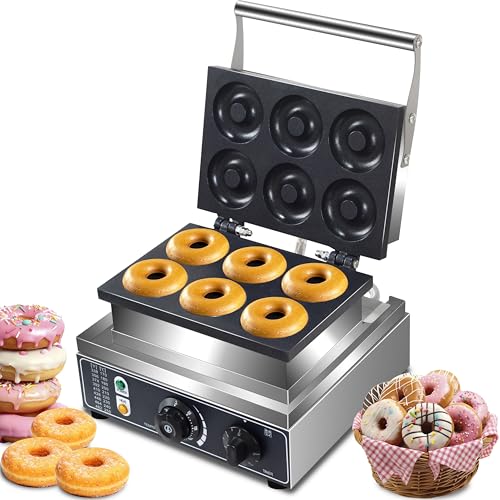
- 1600W dual-sided heating for even baking
- Adjustable temperature and 1–5 minute timer
- Non-stick, PTFE-free surface with stainless steel body
Best For: Commercial baked-doughnut production with controlled recipes
Highest-Throughput Pick
FOHERE Automatic 4-Row Mini Donut Maker

- Automates forming, frying, flipping, and counting
- Rated for up to 250 mini doughnuts per hour
- 304 stainless steel body with safety controls
Best For: High-volume commercial mini-doughnut frying
Home-Baking Pick
CucinaPro 7-Count Mini Donut Maker

- Bakes seven mini doughnuts in minutes
- Oil-free baking with non-stick plates
- Compact upright-storage design for small spaces
Best For: Home batches, parties, and hands-on decorating activities
Commercial Batch Baker
12-Hole Stainless Steel Mini Donut Maker

- Produces 12 mini donuts per batch
- 1550W double-sided heating
- Adjustable 50–300°C temperature control
Best For: Frequent batch baking at home or in small food-service settings
High-Capacity Home Pick
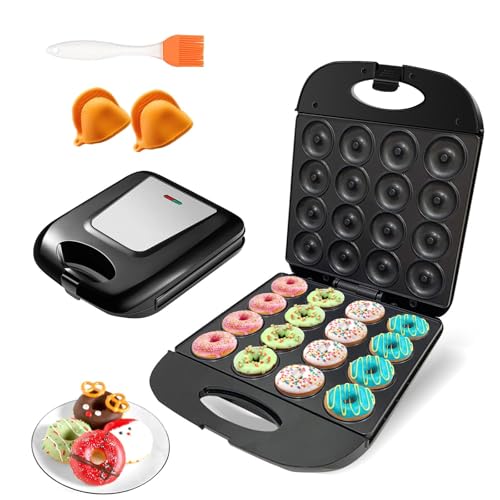
- Makes 16 mini doughnuts per plate
- 1400W double-sided heating
- Includes mitts and an oil brush
Best For: Families and hosts seeking maximum home-batch capacity
Compact Family Favorite

- Makes seven mini donuts per batch
- Lightweight 2.2-pound design
- Includes recipe guide and 1-year warranty
Best For: Casual family baking and kid-friendly snack making
Commercial Batch Workhorse – VEVOR Automatic Donut Machine
For businesses comparing doughnut makers for large batches, this VEVOR model is built around speed and repeatability. Its four rows, automated flipping, 3-liter hopper, and 6.1-liter oil tank support higher-volume production with less hands-on work.
Best For: Cafés, bakeries, and food stands that need automatic production of uniform ring donuts.
Pros:
- Produces up to approximately 240 pieces per hour with four rows.
- Smart controls and automatic flipping simplify consistent cooking.
- 304 stainless-steel construction is designed for easier cleaning and maintenance.
- Creates approximately 50 mm ring donuts with a 25 mm thickness.
Cons:
- Its commercial size and 33.1-pound weight may be excessive for a home kitchen.
- Operation requires access to a 120-volt electrical outlet and frying oil.
This is the strongest fit when throughput matters more than compactness. The automated design and generous hopper and oil capacities can reduce interruptions during busy service.
Compact Mini-Batch Pick – DSP 16-Donut Mini Maker
Among doughnut makers for large batches at home, the DSP stands out for producing 16 bite-sized donuts per cycle. It heats in about three minutes, includes useful piping and decorating accessories, and has a cool-touch exterior for easier handling.
Best For: Home snack stations, brunches, entertaining, and families that prefer small, bite-sized donuts.
Pros:
- Makes 16 mini donuts in a compact countertop format.
- Ready to bake when the indicator signals the target temperature.
- Nonstick surfaces wipe clean, while the cool-touch exterior supports safer handling.
- Includes 100 piping bags, a spatula, whisk, tongs, and cooking brush.
Cons:
- The approximately 1.93-inch donuts are much smaller than standard donuts.
- It is intended for mini-donut batches rather than commercial-scale output.
The DSP is a practical choice when convenience and accessories matter more than maximum throughput. Its 16-donut capacity makes repeated home batches manageable without requiring commercial equipment.
Flexible Manual Depositor – VEVOR Large-Capacity Donut Dropper
For buyers seeking doughnut makers for large batches without an automatic fryer, this manual VEVOR depositor offers a high-capacity way to portion batter efficiently. Its 2.4-liter hopper, one-hand operation, and six thickness settings give commercial kitchens control over batch preparation.
Best For: Restaurants, cafés, bakeries, and food stands that already have a separate frying setup.
Pros:
- Large 2.4-liter capacity reduces the need for frequent refilling.
- Six settings adjust donut width from 55–90 mm and thickness from 20–30 mm.
- One-hand operation and the included stand holder support smoother workflow.
- Detachable 304 stainless-steel construction simplifies cleaning.
Cons:
- It dispenses batter but does not fry or finish the donuts.
- Manual operation requires more hands-on work than an automatic machine.
This depositor is best viewed as a production aid rather than an all-in-one donut maker. It can improve portion consistency and reduce refilling interruptions when paired with suitable cooking equipment.
Family-Friendly Mini Batches – Baker's Friend 12-Donut Maker
For home users comparing doughnut makers for large batches, this Baker’s Friend model delivers 12 mini donuts per cycle in a compact appliance. Its double-sided nonstick surfaces are designed for even cooking and quick cleanup, making it convenient for snacks, breakfasts, and gatherings.
Best For: Families, children’s activities, casual entertaining, and home cooks making bite-sized treats.
Pros:
- Makes 12 mini donuts in a matter of minutes.
- Double-sided PFOA-free nonstick surfaces support even cooking and easier cleanup.
- Works with cake mix, brownie mix, and other batters.
- Compact dimensions take up relatively little countertop space.
Cons:
- It makes mini donuts rather than full-sized donuts.
- Its 12-donut capacity is better suited to home batches than commercial production.
This model favors simplicity and family use over professional throughput. It is a convenient option for producing repeated small batches without taking up much kitchen space.
Commercial Even-Bake Pick – 6-Hole Commercial Donut Waffle Maker
For businesses comparing doughnut makers for large batches, this 1600W electric model focuses on consistent baked output rather than frying. Its six-hole mold, dual-sided heating, and adjustable controls make it a practical choice for bakeries, cafés, and snack shops that need repeatable doughnuts with less oil and straightforward cleanup.
Best For: Bakeries, cafés, restaurants, and snack shops needing compact, controlled baked-doughnut production.
Pros:
- 1600W dual-sided heating supports fast, even baking.
- Adjustable 50°C–300°C temperature and 1–5 minute timer suit different recipes.
- Non-stick, PTFE-free baking surface helps with release and cleanup.
- Stainless steel construction and a 6.8 kg build support stable commercial use.
Cons:
- Produces six doughnuts per cycle, so it is less automated than high-output fryer-style machines.
- Requires operator loading, timing, and removal.
- Its 33 × 32 × 23.5 cm footprint may still need dedicated counter space.
This is a sensible option when you want commercial construction and precise baking controls in a relatively compact appliance. Choose it for baked doughnuts and recipe flexibility; choose an automatic fryer-style unit if maximum hourly throughput is the priority.
Highest-Throughput Pick – FOHERE Automatic 4-Row Mini Donut Maker
Among doughnut makers for large batches, the FOHERE stands out for automating forming, frying, flipping, counting, and collection. Its four-row design, 3L hopper, and stated capacity of up to 250 mini doughnuts per hour make it geared toward busy commercial kitchens that value hands-off consistency.
Best For: Bakeries, cafés, dessert shops, buffets, hotels, and canteens needing high-volume mini-doughnut frying.
Pros:
- Automatic forming, frying, flipping, collecting, counting, and outputting reduce manual work.
- Four rows and a 3L hopper can produce up to 250 mini doughnuts per hour.
- 304 food-grade stainless steel construction is durable, corrosion-resistant, and easy to clean.
- Includes overheating protection, double-switch safety, adjustable speed, and constant temperature control.
Cons:
- It must not be operated without oil in the tank.
- At approximately 21.85 × 14.76 × 14.57 inches and 35.2 pounds, it needs substantial counter space.
- It is designed for 40 mm mini doughnuts rather than full-size doughnuts.
This is the strongest fit for operators who prioritize automated volume and consistent mini-doughnut production. Its oil-based process and larger footprint are trade-offs, but the integrated workflow can significantly reduce hands-on production time.
Home-Baking Pick – CucinaPro 7-Count Mini Donut Maker
The CucinaPro is a compact alternative for smaller batches rather than a commercial production line. It bakes seven mini doughnuts at a time on non-stick plates, making it useful for home cooks, parties, and decorating activities when easy, oil-free baking matters more than maximum throughput.
Best For: Home kitchens, dorms, apartments, RVs, family activities, and small gatherings.
Pros:
- Bakes seven bite-sized doughnuts in minutes.
- Non-stick plates support oil-free baking and quick wipe-down cleanup.
- Compact design stores upright and suits limited counter space.
- Includes a recipe guide with several flavor ideas.
Cons:
- Seven-doughnut capacity per cycle is not suited to commercial large-batch production.
- Its mini format limits the size of the finished doughnuts.
- The supplied notes do not list adjustable temperature or timer controls.
This model is best viewed as an accessible household doughnut maker, not a commercial machine. It makes sense for occasional batches, children’s decorating stations, and low-mess baked treats, but high-volume sellers will need a larger or automated unit.
Commercial Batch Baker – 12-Hole Stainless Steel Mini Donut Maker
For shoppers comparing doughnut makers for large batches, this 12-hole commercial-style machine emphasizes output, fast heating, and adjustable controls. Its 1550-watt system and double-sided heating are designed to produce bite-sized donuts efficiently for gatherings, busy households, or small food-service settings.
Best For: Home entertainers, cafes, tea shops, and anyone who wants 12 mini donuts per batch with more control over time and temperature.
Pros:
- Bakes 12 bite-sized donuts at once.
- 1550-watt heating system reaches baking temperature in approximately 1–5 minutes per batch.
- Independent temperature and time knobs offer adjustable control from 50–300°C.
- Non-stick plates and stainless steel/aluminum construction support easier cleanup and durability.
Cons:
- At 19.8 pounds, it is substantially heavier than compact home models.
- Its commercial-style size may require more counter and storage space.
- It is designed for 110-volt power, so outlet compatibility should be checked.
This is the strongest production-oriented choice of the three when batch size and adjustable operation matter most. It is less convenient for shoppers seeking a lightweight appliance, but its 12-donut capacity and high wattage are well suited to frequent baking.
High-Capacity Home Pick – 16-Hole Mini Doughnut Maker
If your priority is maximum output in a compact home appliance, this 16-hole model is a practical contender among doughnut makers for large batches. The 1400-watt unit uses double-sided heating and a 1–5-minute baking window, while the included mitts and oil brush add useful starter accessories.
Best For: Families, hosts, and home bakers who want the highest stated donut capacity per plate in this roundup without moving to a heavier commercial-style machine.
Pros:
- Produces 16 mini doughnuts per plate, the largest capacity listed here.
- Double-sided heating supports quick, evenly colored results.
- Includes mini oven mitts, an oil brush, and a user guide.
- Non-stick, scratch-resistant surface is intended to simplify release and cleanup.
Cons:
- Each donut is approximately 1.97 inches in diameter, so the portions are mini-sized.
- The supplied dimensions are listed inconsistently, so shoppers should verify available counter space.
- The notes do not specify adjustable temperature settings.
With 16 cavities, this model offers the best listed throughput for entertaining or family baking. Its compact positioning and included accessories make it approachable, though buyers wanting detailed temperature control may prefer the commercial-style alternative.
Compact Family Favorite – Dash 7-Donut Mini Maker
The Dash Mini Donut Maker is a smaller, simpler option for shoppers who want quick treats rather than maximum throughput. It makes seven mini donuts at a time, has a non-stick surface, and weighs just 2.2 pounds, making it easy to store and approachable for family baking.
Best For: Families, children, casual snack makers, and shoppers who value a lightweight appliance over the largest possible batch size.
Pros:
- Makes seven mini donuts in minutes.
- Lightweight 2.2-pound design takes up relatively little counter space.
- Non-stick surface supports easier cleanup.
- Includes a recipe guide and access to a recipe database, plus a 1-year manufacturer warranty.
Cons:
- Seven donuts per batch is the lowest capacity among these three models.
- The 760-watt motor is less powerful than the other listed machines.
- It has one setting, offering less control than models with adjustable time or temperature controls.
This Dash model is best viewed as a convenient family appliance rather than a high-volume production tool. It is a sensible pick for occasional baking, kids’ activities, and small servings, but larger gatherings will require more batches.
How We Picked the Best Doughnut Makers for Large Batches
We focused on the factors that matter most when producing multiple batches: cavity count, stated hourly output, heating power, temperature or timer controls, batter capacity, construction, and ease of cleaning. The selection includes high-throughput commercial fryers for events and food businesses, as well as countertop machines that can handle family gatherings and repeated home batches.
Because advertised capacity can vary by dough size, recipe, and operator speed, treat output claims as useful comparisons rather than guaranteed results. For manual equipment, the practical workflow also depends on how quickly you can portion batter and manage frying or baking.
Quick Comparison
| Best For | Look For | Typical Advantage |
|---|---|---|
| Commercial production | Automatic feed, multiple rows, large hopper | Fast, consistent output |
| Events and catering | High wattage, adjustable controls, stainless steel | Reliable repeated batches |
| Home entertaining | 12–16 cavities and nonstick plates | More doughnuts per cycle |
| Small kitchens | Compact seven-cavity design | Easy storage and simple operation |
| Maximum portion control | Adjustable manual depositor | Flexible batter dispensing |
Key Buying Factors for Doughnut Makers for Large Batches
Capacity and Real-World Speed
Start with the number of doughnuts you need per hour, not just the cavity count. Automatic four-row machines are better suited to commercial demand, while 12- or 16-cavity countertop units can be more practical for occasional large family batches.
Heating Performance and Controls
Higher wattage can support faster recovery between cycles, but temperature stability matters just as much. Adjustable temperature and timer controls help prevent undercooked centers or overbrowned exteriors when recipes change.
Construction and Cleanup
Stainless-steel bodies are useful for frequent service because they resist wear and are easy to wipe down. Nonstick cooking surfaces simplify release and cleanup, but they still require non-abrasive tools and careful handling to preserve the coating.
Workflow, Footprint, and Safety
Check counter depth, electrical requirements, hopper size, cool-touch features, and whether the machine needs a dedicated outlet. Commercial fryers may require more ventilation, oil management, and storage space than enclosed electric bakers.
Who Should Buy Which Doughnut Makers for Large Batches?
Choose an automatic commercial machine if you run a café, concession stand, market stall, or catering operation and need repeatable high-volume production. A large hopper and intelligent controls can reduce manual portioning.
Choose a commercial electric baker if you want substantial output without managing an open fryer. Multiple cavities, strong heating, and nonstick plates are a useful combination for events and frequent batches.
Choose a multi-cavity home maker if you regularly serve doughnuts at breakfasts, parties, or school events but do not need commercial throughput. Sixteen-hole models offer strong batch efficiency in a smaller footprint.
Choose a compact seven-cavity maker for occasional treats, smaller kitchens, or family cooking. For the most control over batter quantity and thickness, pair a countertop maker with an adjustable manual depositor.