Fresh tomatoes can produce exceptional sauce, but peeling, coring, and removing seeds by hand quickly becomes the slowest part of the process. The right tomato press separates skins and seeds while turning cooked produce into a smooth base for sauces, salsa, jams, and purées.
This roundup includes electric machines, clamp-mounted strainers, suction-base models, and manual food mills. Use the buying guide below to match capacity, power, cleanup, and mounting style to the way you preserve and cook.
Best 10 Tomato Presses Picks for 2026
High-Volume Electric Pick
OMRA Spremy Electric Tomato Strainer

- Electric 1/4 HP motor with cooling fan
- Processes up to 330 pounds per hour
- Separates skins and seeds from fresh or cooked tomatoes
Best For: Large-batch, low-effort tomato processing
Versatile Countertop Classic
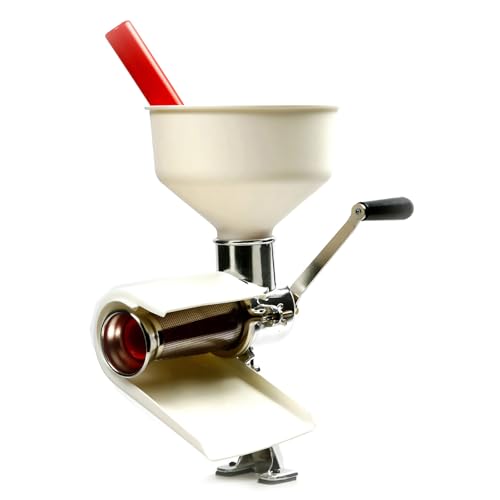
- 3-quart capacity for home batches
- Includes fine mesh screen and standard spiral
- Works with fruits, vegetables, and purees
Best For: General-purpose home sauce and puree making
Flexible Mounting Choice
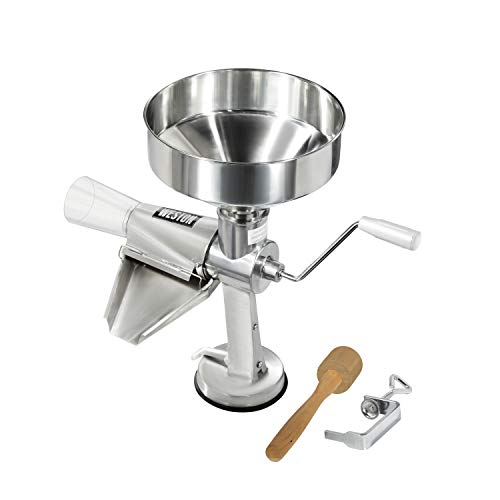
- One-gallon stainless steel hopper
- Suction-cup and C-clamp mounting
- Includes stomper and 1.5mm screen
Best For: Large batches with flexible countertop or garden use
Expandable Manual Pick

- Includes 1.3mm tomato and apple screen
- Clamps to countertops 3/4 to 2-1/8 inches thick
- Optional electric motor and screens available
Best For: Manual home preserving with future upgrade flexibility
Countertop Classic

- Separates skins and seeds while juicing
- Suction base helps stabilize the mill
- Useful for sauces, salsa, and purees
Best For: Small-batch home cooking
Manual Multi-Tasker

- Includes three milling discs
- Dual hooks improve bowl stability
- Dishwasher-safe and multifunctional
Best For: Versatile manual food preparation
Harvest-Ready Powerhouse

- Processes up to 88 pounds per hour
- Includes four texture screens
- Designed for continuous large-batch use
Best For: Harvest-season sauce making and canning
Best Overall Electric Tomato Press

- Three stainless-steel screens for varied textures
- One-gallon hopper for larger batches
- Two speeds with reverse for jam prevention
Best For: Home preservers processing sauces, purees, and salsa
Best Heavy-Duty Tomato Press
VBENLEM Commercial Tomato Strainer

- 370-watt pure copper motor
- 304 stainless-steel food-contact parts
- Large 9-inch funnel and adjustable trough
Best For: Frequent, high-volume sauce and jam processing
Best Multi-Use Tomato Press
AIRMSEN Grinder and Sauce Maker

- Combines tomato pressing with meat grinding
- Includes sausage and kibbeh attachments
- Reverse function and detachable parts
Best For: Home kitchens needing one appliance for multiple food-prep tasks
High-Volume Electric Pick – OMRA Spremy Electric Tomato Strainer
For shoppers comparing tomato presses, the OMRA Spremy is the high-capacity electric option. Its 1/4 HP motor and masticating-style worm are designed to separate tomato skins and seeds from fresh or cooked produce while processing up to 330 pounds per hour.
Best For: Large-batch tomato processing with minimal manual effort.
Pros:
- Electric operation with a 1/4 HP motor and cooling fan
- Processes up to 330 pounds of tomatoes per hour
- Die-cast metal housing, stainless steel hopper, and food-grade nylon auger
- Designed for tomato and apple puree production
Cons:
- Requires a corded 220-volt power source
- Its high-capacity design may be more than needed for small batches
The OMRA stands out when throughput and automation matter most. Confirm that your electrical setup supports 220 volts before choosing it.
Versatile Countertop Classic – Norpro 1951 Sauce Master
The Norpro 1951 is a versatile choice among tomato presses, using a chrome-plated steel screen to separate juice and pulp in one operation. It includes a fine mesh screen and can also handle other fruits, vegetables, and purees.
Best For: Home cooks who want one manual strainer for sauces, purees, and varied produce.
Pros:
- 3-quart, or 95-ounce, capacity
- Separates juice and pulp automatically during straining
- Includes a standard fine mesh screen, spiral, recipe, and instruction booklet
- Additional berry, pumpkin, and salsa screens are available separately
Cons:
- Additional screens cost extra
- The supplied notes do not specify an electric motor option
With its included fine screen and broad produce applications, the Sauce Master is a practical all-purpose pick for regular home preserving and sauce making.
Flexible Mounting Choice – Weston Metal Tomato Strainer
The Weston Metal Tomato Strainer is a useful option for shoppers seeking adaptable tomato presses. Its one-gallon hopper supports larger batches, while the suction-cup and C-clamp mounting system lets it attach to different flat surfaces.
Best For: Batch processing in kitchens, gardens, or other locations with suitable mounting surfaces.
Pros:
- One-gallon stainless steel hopper for larger batches
- Dual mount system uses a suction-cup base and C-clamp
- Includes a 1.5mm screen and stomper
- Splash guard and chute help direct puree into a container
Cons:
- Additional screens are sold separately
- Manual hand-crank operation requires user effort
- Mounting depends on a compatible flat surface
The Weston balances capacity, portability, and mounting flexibility. It is especially appealing if you want to process tomatoes away from a fixed countertop setup.
Expandable Manual Pick – Johnny Apple Sauce Maker
The Johnny Apple Sauce Maker is a clamp-mounted option for shoppers comparing manual tomato presses. It includes a 1.3mm apple and tomato screen, separates skins and seeds, and can be upgraded with an optional electric motor.
Best For: Home preservers who want manual control now and the option to add powered operation later.
Pros:
- Includes an apple/tomato screen and standard spiral
- Clamp mounts to countertops from 3/4 to 2-1/8 inches thick
- Handles sauces, purees, juices, jams, soups, and baby foods
- Optional electric motor and additional screens are available
Cons:
- The electric motor and extra screens are sold separately
- Clamp mounting requires a compatible countertop
- Manual operation requires turning the hand crank
This model is a flexible starting point for home use, particularly if you value accessory expandability and a secure clamp mount. Its supplied screen is ready for tomato and apple preparations.
Countertop Classic – Suction-Base Tomato Strainer
If you want a straightforward option for making sauces, salsa, or purees, this tomato press uses a suction-cup base to stay in place while you work. It separates skins and seeds to the side while juice flows into the tray, so there is no need to peel, deseed, or core tomatoes first.
Best For: Home cooks who want a manual tomato press for occasional sauce, salsa, and puree making.
Pros:
- Suction mount helps provide a stable setup during pressing.
- Skins and seeds are ejected separately from the juice.
- Includes a stainless steel pusher and is designed for easy cleaning.
- Can also be used for potato puree and other straining tasks.
Cons:
- Manual operation requires more effort than an electric machine.
- Plastic construction may be less substantial than stainless steel alternatives.
- The suction base requires a suitable smooth work surface.
This is a practical, compact choice for small-batch kitchen use, especially if you value simple operation and built-in suction stability over high-volume processing.
Manual Multi-Tasker – Stainless Steel Food Mill
This stainless steel food mill is a versatile manual alternative among tomato presses, with three interchangeable milling discs for adjusting texture. Its dual-hook design helps anchor it to a bowl, while the silicone-covered crank and handle are intended to make steady grinding easier.
Best For: Cooks who want one manual mill for tomato sauce, mashed potatoes, jams, and other fruits and vegetables.
Pros:
- Food-grade stainless steel construction with a mirror-polished finish.
- Three milling discs support different textures and help remove seeds.
- Dual hooks form a stable triangle with the handle for bowl support.
- Dishwasher-safe parts and a hanging hole simplify cleanup and storage.
Cons:
- Manual cranking can be slower and more labor-intensive for large batches.
- It is heavier than some basic plastic mills.
- The included discs require changing when switching textures.
Choose this model if durability and flexibility matter more than speed. The interchangeable discs make it better suited to cooks who regularly prepare several types of smooth or textured foods.
Harvest-Ready Powerhouse – Electric Tomato Strainer
For larger harvests, this electric tomato press is designed to process sauce, puree, salsa, and similar foods with less manual effort. Its motor provides steady power for continuous use, while the included screens let you choose between different textures.
Best For: Large-batch sauce making, harvest-season processing, and home canning projects.
Pros:
- Electric motor supports continuous sauce making and is rated for up to 88 pounds per hour.
- Separates peels and seeds in a single pass for smoother results.
- Includes 1 mm, 1.5 mm, 3 mm, and 6 mm screens for different textures.
- 304 stainless steel components resist fruit acids and removable parts can be cleaned without tools.
Cons:
- At 7.2 pounds, it is less convenient to move and store than a small manual mill.
- Requires access to a power source.
- Its high-capacity design may be more than needed for occasional small batches.
This is the strongest fit for gardeners and preserving enthusiasts who process substantial quantities. The multiple screens and guard cover add practical flexibility, while the electric drive reduces repetitive cranking.
Best Overall Electric Tomato Press – Weston Deluxe Tomato Strainer
For home canning and larger garden harvests, the Weston Deluxe is one of the most versatile tomato presses in this lineup. Its 250-watt motor, two-speed operation, one-gallon hopper, and three interchangeable screens make it suited to sauces, purees, jellies, and salsa.
Best For: Home preservers who want flexible screening options and batch-friendly capacity.
Pros:
- Removes skins and separates seeds without coring.
- Includes 1.5mm, 3mm, and 6mm stainless steel screens.
- Forward and reverse speeds help with processing and jam prevention.
- One-gallon hopper supports larger batches.
Cons:
- The plastic and stainless-steel construction may not feel as heavy-duty as an all-metal commercial machine.
- At 14 by 12 by 17 inches, it requires dedicated counter or storage space.
The Weston stands out as a well-rounded tomato press for cooks who want more control over texture. The included stomper and reverse function add convenience, while the multiple screens expand its use beyond standard tomato sauce.
Best Heavy-Duty Tomato Press – VBENLEM Commercial Tomato Strainer
The VBENLEM is a commercial-style option for shoppers prioritizing sturdy construction and high-volume tomato processing. It uses a 370-watt pure copper motor, a large 9-inch funnel, and food-contact components made from 304 stainless steel.
Best For: High-volume sauce making and users who prefer a stainless-steel food-processing machine.
Pros:
- Food-contact parts are made from 304 stainless steel.
- 370-watt pure copper motor is designed for demanding processing.
- Large 9-inch funnel supports steady feeding.
- Adjustable trough and brace help direct sauce and reduce splashing.
Cons:
- Its 22-pound weight and larger footprint make it less convenient to move and store.
- The supplied notes focus on sauce and jam processing rather than interchangeable screen sizes.
- Its commercial-grade design may be more machine than occasional users need.
Choose the VBENLEM when throughput and metal construction matter more than compactness. It is especially compelling for frequent preserving sessions, though its heavier build is less suited to occasional countertop use.
Best Multi-Use Tomato Press – AIRMSEN Grinder and Sauce Maker
The AIRMSEN combines tomato pressing with several other kitchen tasks, making it a practical choice when you want more than a dedicated tomato press. Along with its tomato strainer kit, it handles meat grinding, sausage making, and kibbeh preparation in a compact design.
Best For: Home cooks who want one appliance for tomato sauce and meat-processing tasks.
Pros:
- Four-in-one design includes tomato sauce processing, meat grinding, sausage, and kibbeh functions.
- Includes 5mm, 7mm, and 12mm grinding plates.
- Reverse function helps clear jams.
- Detachable parts and a safety lock support straightforward operation.
Cons:
- Parts are not dishwasher safe and require hand washing.
- The supplied details list 2500-watt peak motor performance but also specify 300 watts in the product details.
- It is a multipurpose grinder rather than a dedicated high-volume tomato press.
The AIRMSEN makes the most sense for kitchens that need an all-in-one appliance. Its tomato strainer attachment adds useful versatility, but shoppers focused exclusively on processing large tomato batches may prefer a dedicated press with a larger hopper.
How We Picked These Tomato Presses
We compared these Tomato Presses by looking at the features that matter most during real sauce-making sessions: processing speed, hopper capacity, motor power, construction, mounting stability, versatility, and cleanup requirements. We also included several formats because a high-volume canner has different needs from a home cook making a small batch.
Electric models can reduce repetitive cranking and are generally the best choice for large harvests. Manual strainers and food mills cost less, store more easily, and offer better control for occasional use. Stainless steel components and replaceable screens are especially useful when you expect frequent seasonal use.
Quick Comparison
| Best For | Recommended Type | What to Prioritize |
|---|---|---|
| Large harvests and canning | High-output electric press | Motor strength, hopper size, throughput, and continuous operation |
| Occasional homemade sauce | Manual clamp or suction-base strainer | Stable mounting, simple operation, and easy storage |
| Small batches and varied foods | Food mill | Interchangeable discs, comfortable handle, and bowl stability |
| Multi-purpose kitchen use | Electric grinder and sauce maker | Attachments, motor capability, and cleaning access |
Key Buying Factors for Tomato Presses
Power and Processing Capacity
Motor wattage is only one indicator of performance. Consider the machine’s stated output, hopper size, duty cycle, and ability to handle soft or partially cooked produce without frequent pauses. For garden harvests, a larger hopper and continuous-feed design can save considerable time.
Mounting and Stability
Clamp-based models need a compatible, sturdy work surface. Suction-base units are more flexible but work best on smooth, nonporous counters. Electric presses should have a stable footprint and controls that are easy to reach while feeding tomatoes.
Materials and Screens
Stainless steel parts resist staining and are a practical choice for acidic foods. Check whether the package includes multiple screens or milling discs, and confirm that replacement parts are available. Different screen sizes can change the texture of sauces, purées, and jams.
Cleanup and Storage
Look for removable augers, screens, splash guards, and feed trays. A powerful machine is less useful if it is difficult to disassemble after every batch. Also measure your cabinet or pantry space before choosing a full-size electric unit.
Who Should Buy Which Tomato Presses?
Choose a high-output electric model if you process bushels of tomatoes, make preserves regularly, or want to minimize manual effort. These machines are typically the fastest option, though they require more counter space and a larger investment.
Choose a manual clamp-mounted press for dependable seasonal use at a lower cost. It is a practical fit when you have a solid table or countertop and do not mind turning a handle.
Choose a suction-base press when portability and flexible placement matter more than maximum throughput. It can work well for modest batches, provided the counter creates a reliable seal.
Choose a stainless steel food mill for small portions, mashed foods, jams, and recipes where texture control matters. It is the most versatile low-tech option, but it generally requires more hands-on effort and may not separate tomatoes as quickly as a dedicated press.