Making tomato sauce from scratch is easier when a manual press separates skins and seeds while extracting usable pulp. The right model can save time, reduce mess, and improve consistency from batch to batch.
This roundup compares 10 manual tomato presses, sauce makers, and food mills with different capacities, mounting systems, materials, and texture controls.
Best 10 Manual Tomato Presses Picks for 2026
Versatile Choice
Johnny Apple Sauce Maker Model 250

- 1.3mm apple/tomato screen included
- Clamp fits 3/4- to 2-1/8-inch countertops
- Optional motor and specialty screens available
Best For: Multi-purpose home sauce and puree making
Classic Sauce Maker
Norpro 1951 Original Sauce Master
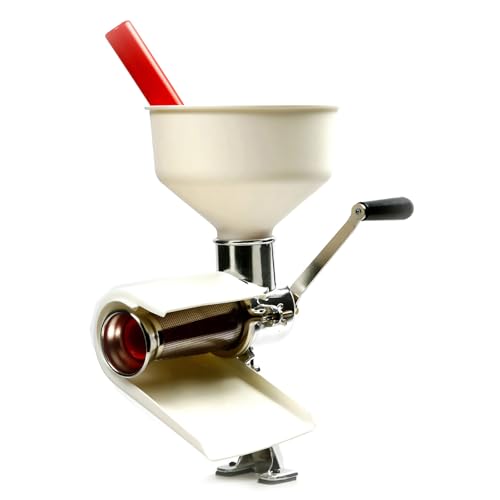
- 3-quart processing capacity
- Chrome-plated steel screen separates juice and pulp
- Specialty screens available separately
Best For: Traditional multi-use sauce straining
Large-Batch Stainless Pick
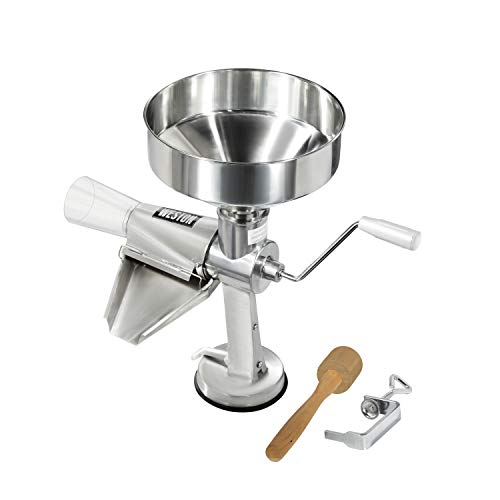
- 1-gallon hopper for larger batches
- Suction-cup and C-clamp mounting
- Includes splash guard, stomper, and 1.5mm screen
Best For: Large-batch tomato sauce and puree processing
High-Capacity Tabletop Pick
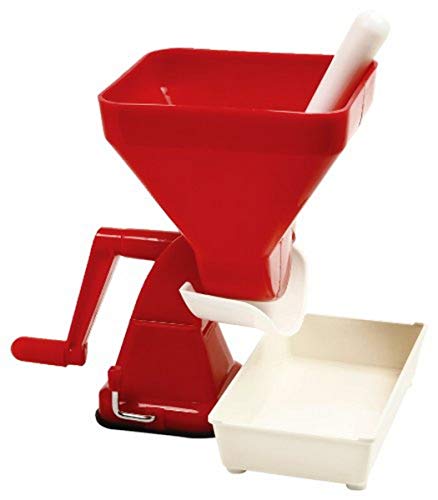
- 2.25-quart hopper for batch processing
- Suction base stabilizes the strainer
- Includes receiving tray and food pestle
Best For: Countertop canning and larger sauce batches
Versatile Stainless Mill
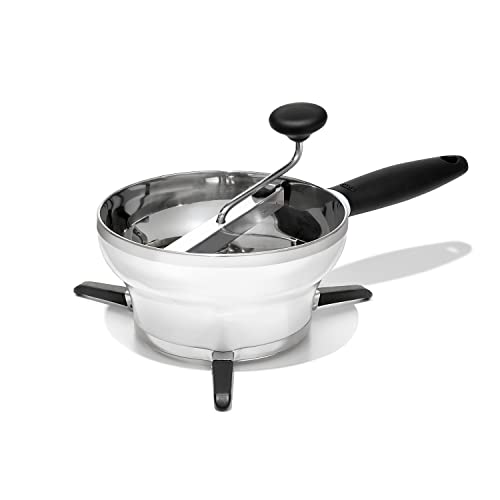
- 2.3-quart stainless steel bowl
- Three disks for varied textures
- Non-slip, foldable legs
Best For: Flexible purees and tomato sauces
Compact Suction Press

- Separates skins and seeds
- Sturdy suction-cup mount
- Includes stainless steel pusher
Best For: Small-batch tomato sauces and salsa
Small-Batch Auger Press
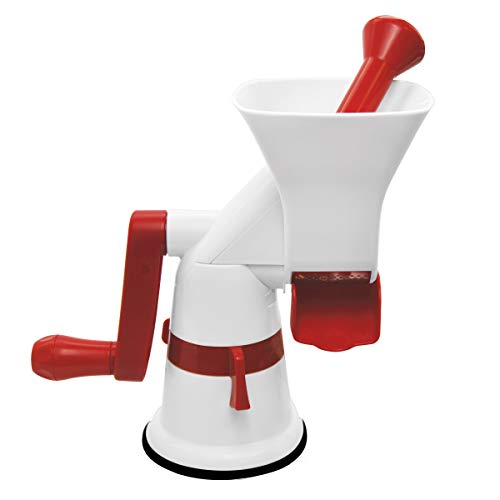
- 3-cup compact capacity
- Stainless steel 2 mm screen
- Auger helps reduce jamming
Best For: Small batches of sauces, juices, and jams
Versatile Stainless Steel Pick

- Stainless steel construction
- Three milling discs
- Dishwasher-safe design
Best For: Multi-purpose tomato sauce, potato, fruit, and canning prep
Simple Tomato Press Pick

- Stainless steel filter
- Large feed inlet
- Separates skins and seeds
Best For: Straightforward tomato juice and pulp preparation
Countertop Stability Pick

- Tabletop clamp design
- Hand-crank processing
- Filter blocks tomato skins
Best For: Stable countertop tomato prep and home canning
Versatile Choice – Johnny Apple Sauce Maker Model 250
For shoppers comparing manual tomato presses, the Johnny Apple Sauce Maker Model 250 is a versatile clamp-mounted option for separating skins and seeds from tomatoes, apples, and other produce. It includes a 1.3mm apple/tomato screen and a hand crank for making sauces, purees, juices, and more.
Best For: Home cooks who want one hand-crank strainer for tomato sauce, applesauce, purees, jams, and other produce.
Pros:
- Includes an apple/tomato screen, standard spiral, and instructions.
- Secure clamp fits countertops from 3/4 to 2-1/8 inches thick.
- Can accept an optional electric motor sold separately.
- Cast aluminum body with stainless steel screens and BPA-free plastic components.
Cons:
- Optional electric motor and specialty screens cost extra.
- Clamp mounting requires a suitable countertop edge.
This is a practical pick if you want broad produce-straining capability rather than a tomato-only tool. Its included screen handles common sauce projects, while the optional accessories expand its uses.
Classic Sauce Maker – Norpro 1951 Original Sauce Master
The Norpro 1951 Sauce Master is a straightforward choice among manual tomato presses, using a hand-operated straining system to separate juice and pulp in one operation. Its 3-quart capacity suits everyday batches of sauces, purees, and processed fruits or vegetables.
Best For: Cooks seeking a traditional multi-use strainer for tomato sauce, fruit purees, and vegetable preparations.
Pros:
- 3-quart capacity supports moderate-sized batches.
- Chrome-plated steel screen automatically separates juice and pulp.
- Includes a fine mesh screen, standard spiral, recipe, and instruction booklet.
- Additional berry, pumpkin, and salsa screens are available separately.
Cons:
- Additional specialty screens require separate purchases.
- The supplied notes do not specify a mounting system or countertop fit range.
The Sauce Master is a solid basic option for buyers who value a larger capacity and simple operation. Its accessory-screen ecosystem gives it flexibility, though the standard configuration is best suited to common straining tasks.
Large-Batch Stainless Pick – Weston Metal Tomato Strainer
Among manual tomato presses, the Weston Metal Tomato Strainer stands out for its stainless steel construction, 1-gallon hopper, and dual-mount base. It is designed to process tomatoes and other soft produce while directing puree into a container with a chute and splash guard.
Best For: Home preservers who need a generous hopper and flexible mounting for tomato sauce, salsa, jams, or purees.
Pros:
- Large 1-gallon hopper helps support bigger batches.
- Dual mount uses either suction cups or a C-clamp on suitable flat surfaces.
- Includes a stomper and 1.5mm multipurpose screen.
- Stainless steel splash guard and chute help contain mess.
Cons:
- Additional screens require the separately sold 07-0858 accessory kit.
- The dual mounting system still requires a compatible flat surface or clamp edge.
This Weston model is a strong fit when batch size and mounting flexibility matter. The included screen covers tomatoes and apples, while the splash guard and directed chute make processing more controlled.
High-Capacity Tabletop Pick – Norpro Jumbo Tomato Strainer
The Norpro Manual Jumbo Tomato Strainer is a high-capacity option for shoppers comparing manual tomato presses. Its stainless steel mesh separates seeds, skins, and stems, while the suction base, hopper, and receiving tray support organized countertop processing.
Best For: Home canners making larger batches of tomato sauce, salsa, puree, paste, or applesauce.
Pros:
- 2.25-quart hopper holds up to 9 cups of produce.
- Fitted 1.25-quart receiving tray catches puree directly.
- Strong suction base helps keep the unit stable on smooth surfaces.
- Includes a food pestle, instructions, and starter recipes.
Cons:
- Suction mounting is intended for smooth countertops, tables, or islands.
- The supplied notes do not list interchangeable specialty screens.
This Norpro is well suited to batch-oriented prep, especially when stability and a built-in receiving tray are priorities. Its manual design and included accessories keep the setup focused on straightforward canning preparation.
Versatile Stainless Mill – OXO Good Grips Food Mill
If you want a manual tomato press that can handle more than tomatoes, the OXO Good Grips Food Mill offers a flexible option for purees and sauces. Its 2.3-quart stainless steel bowl and three grinding disks let you choose fine, medium, or coarse textures.
Best For: Home cooks making tomato sauces, purees, and other foods in different textures.
Pros:
- Stainless steel bowl suits hot foods and helps prevent staining
- Three disks provide fine, medium, and coarse results
- Three non-slip legs fit over bowls and pots up to 11 inches wide
- Foldable legs and dishwasher-safe construction simplify storage and cleanup
Cons:
- It is a food mill rather than a dedicated auger-style tomato press
- The 2.3-quart capacity may not suit very large batches
The OXO is a strong choice when texture control and general-purpose versatility matter more than maximum tomato-processing volume.
Compact Suction Press – Tomato Strainer Food Mill
This manual tomato press is designed to streamline tomato preparation by separating skins and seeds as juice flows into the tray. The suction-cup base and included stainless steel pusher provide practical support for homemade sauces, salsa, and purees.
Best For: Cooks who want a dedicated tomato strainer for small-batch sauces, juices, salsa, and purees.
Pros:
- Separates skins and seeds without peeling, deseeding, or coring beforehand
- Suction mount helps keep the press in place during use
- Includes a stainless steel pusher for guiding tomatoes
- Designed for straining, juicing, and pureeing tomatoes
Cons:
- Plastic construction may feel less substantial than an all-metal press
- The notes do not specify a processing capacity
Choose this model if convenient tomato preparation and a secure countertop setup are priorities, particularly for fresh salsa and homemade pasta sauce.
Small-Batch Auger Press – Weston Fruit & Tomato Press
For shoppers seeking a compact manual tomato press, the Weston Fruit & Tomato Press combines hand-crank operation with a stainless steel screen. Its auger separates seeds and skins from pulp while the 3-cup capacity keeps the design suited to smaller batches.
Best For: Small-batch sauce, juice, jam, and baby-food preparation.
Pros:
- Manual handle operation requires no power source
- Auger helps prevent jamming and leaking
- Stainless steel screen has 2 mm holes
- Includes a stomper and offers a compact 3-cup capacity
Cons:
- Three-cup capacity is limited for large harvests
- The compact size is geared toward small batches rather than high-volume processing
The Weston is a practical fit for occasional preserving or smaller servings, especially when you want an auger-style press without a larger countertop footprint.
Versatile Stainless Steel Pick – 3-Disc Food Mill
For shoppers comparing manual tomato presses, this stainless steel food mill stands out as a versatile option for tomato sauce, mashed potatoes, jams, and canning. Its three interchangeable milling discs let you adjust the texture, while the dual-hook design helps keep the mill stable over a bowl.
Best For: Home cooks who want one manual mill for tomato sauces, purées, potatoes, fruit, and canning.
Pros:
- Food-grade stainless steel construction with a polished finish
- Includes three milling discs for different textures
- Dual hooks and a silicone-covered crank support steadier operation
- Dishwasher-safe and includes a spoon, funnel, and measuring spoon
Cons:
- At 1.29 kg, it is heavier than a basic plastic mill
- Its broader accessory set may be more than needed for occasional tomato pressing
This is a strong all-purpose choice if durability and flexibility matter more than having a tomato-only press. The multiple discs and included accessories make it useful across several kitchen tasks.
Simple Tomato Press Pick – Manual Tomato Juicer
This manual tomato press is designed for straightforward tomato and vegetable processing. It uses a stainless steel filter to separate skins and seeds from the pulp, while the large feed inlet helps accommodate more produce during preparation.
Best For: Cooks seeking a simple, easy-clean tool for separating tomato skins and seeds from juice and pulp.
Pros:
- Stainless steel filter separates peel and seeds from pulp
- Large-capacity feed inlet supports a steady workflow
- Simple structure is designed for convenient cleaning
- Wear-resistant PP housing is intended for regular kitchen use
Cons:
- The supplied notes do not list included accessories
- Its compact feature set is focused more on tomato and produce pressing than broad milling tasks
Choose this model when uncomplicated operation and produce separation are your priorities. It offers a focused approach to homemade juice and pulp preparation without the extra discs or accessories of a multi-purpose food mill.
Countertop Stability Pick – Clamp-On Tomato Grinder
Among manual tomato presses, this clamp-on grinder is a practical option for cooks who want more stability during hand-crank processing. Its tabletop clamp helps reduce wobbling, while the funnel-shaped opening supports steady feeding for sauces, juices, jams, and other preparations.
Best For: Home canners and cooks who value a secure countertop setup for repeated tomato processing.
Pros:
- Tabletop clamp helps hold the processor firmly in place
- Hand crank provides a manual way to extract juice and pulp
- Filter blocks tomato skins while smooth pulp flows into a bowl
- Suitable for sauces, soups, jams, juices, and pie fillings
Cons:
- Requires a suitable countertop edge for the clamp
- The ABS and stainless steel construction may feel less substantial than an all-metal mill
This model is a good fit for batch preparation where countertop stability is important. Its clamp and funnel design support a steady rhythm, while the filter keeps skins out of the resulting pulp and juice.
How We Picked the Best Manual Tomato Presses
We compared these Manual Tomato Presses and food mills by looking at the features that matter during real kitchen use: extraction efficiency, hopper and bowl capacity, mounting stability, material quality, cleanup, texture control, and versatility. We also considered whether each design is better suited to occasional sauce making, garden harvests, or broader purée and canning tasks.
Because a tomato press is only useful if it stays secure while you work, mounting style received particular attention. Clamp-based and suction-cup models can save counter space, while freestanding food mills are often simpler to position and use in a bowl or pot.
Quick Comparison
| Best For | Look For |
|---|---|
| Small batches | Compact food mill or low-capacity press |
| Garden harvests | Large hopper, sturdy clamp, and durable metal components |
| Different textures | Interchangeable screens or milling discs |
| Countertop convenience | Non-slip legs, suction base, or dual mounting options |
| Frequent canning | Easy disassembly, corrosion-resistant materials, and reliable pulp extraction |
Key Buying Factors for Manual Tomato Presses
Capacity and Batch Size
A larger hopper reduces refilling when processing tomatoes from the garden, but it can take up more storage space. Compact models are easier to keep in a cabinet and work well for sauces made from a few pounds of produce.
Mounting and Stability
Look for a strong clamp, stable non-slip feet, or a dependable suction base. The press should remain steady while turning the handle; movement makes extraction slower and increases spills.
Materials and Durability
Stainless steel components generally resist staining and corrosion and are a sensible choice for frequent use. Plastic-bodied models may be lighter and more affordable, but inspect the auger, screen, handle, and mounting hardware for solid construction.
Screen or Disc Options
A fine screen is useful for smooth tomato sauce, while interchangeable screens or milling discs add flexibility for chunky purées, applesauce, potatoes, and baby food. Confirm what is included and whether replacement parts are available.
Cleanup
Tomato pulp can collect around screens and augers, so removable parts and straightforward rinsing are valuable. A dishwasher-safe component is convenient, but always follow the manufacturer’s care instructions.
Who Should Buy Which Manual Tomato Presses?
Choose a compact manual press or food mill if you make occasional batches and want easy storage. Gardeners and home canners should prioritize a larger hopper, secure table mounting, and metal parts that can handle repeated processing. If you also prepare mashed vegetables, applesauce, or baby food, a food mill with multiple discs may offer better year-round value than a tomato-only press.
For the smoothest workflow, prepare ripe tomatoes before loading the hopper, work over a deep bowl or pot, and clean the screen soon after use. The best choice is the model that matches your batch size, available counter space, preferred texture, and willingness to disassemble it after each session.