Making smooth tomato sauce, applesauce, salsa, jam, or pumpkin puree is easier when a food strainer separates skins and seeds efficiently. The right machine can reduce prep time, limit mess, and produce more consistent results than a basic sieve.
This roundup compares 10 food strainer machines, including clamp-on manual models, hand-crank food mills, yogurt strainers, and high-capacity electric machines. Use the guide below to match power, capacity, mounting style, and cleanup requirements to your cooking routine.
Best 10 Food Strainer Machines Picks for 2026
Best All-in-One Pick
Johnny Apple Sauce Maker with Motor

- Includes four screens for different textures and produce.
- Switches between hand-crank and electric operation.
- Five-year warranty and strong countertop clamp.
Best For: Multi-purpose sauce, puree, and canning projects
Classic Sauce-Making Pick
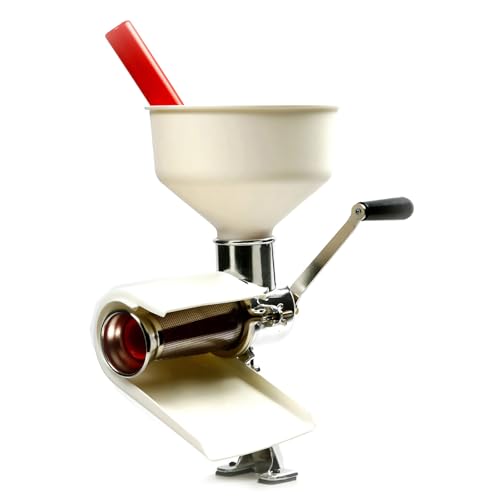
- 3-quart capacity for fruit, vegetable, and puree batches.
- Separates juice and pulp during hand-crank operation.
- Includes fine mesh screen and standard spiral.
Best For: Traditional hand-crank sauce preparation
Large-Batch Pick
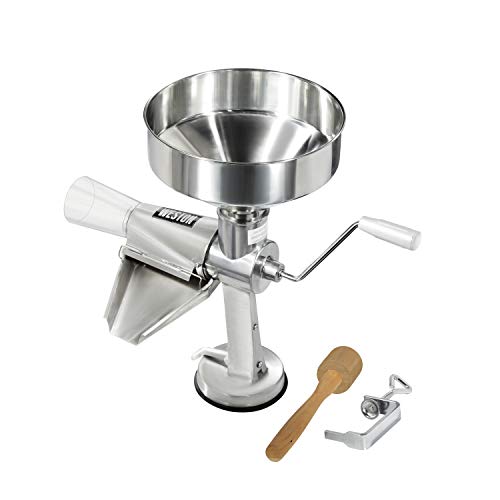
- One-gallon stainless steel hopper for larger batches.
- Suction-cup and C-clamp mounting options.
- Includes splash guard, stomper, and 1.5mm screen.
Best For: Garden harvests and high-volume sauce making
Best Manual Food Mill
Hungry Artisan 3-Disc Food Mill
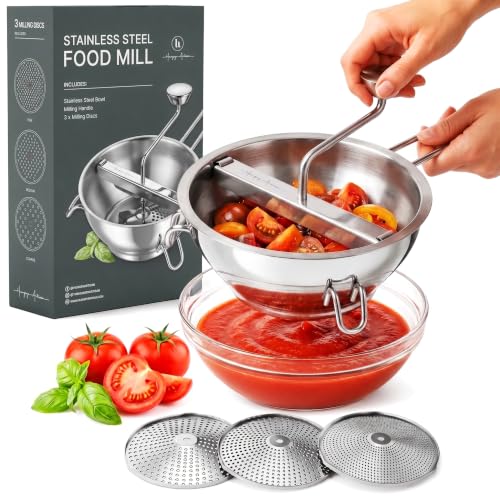
- Three discs offer coarse, medium, and fine textures.
- Hand-crank design works without an outlet.
- Stainless steel construction suits repeated use.
Best For: Portable, texture-controlled manual food preparation
Best Compact Option
Podoy Yogurt and Multi-Use Strainer

- 1.5-liter pitcher for household batches
- 0.5 mm stainless steel mesh filter
- Includes press stick and cleaning brush
Best For: Greek yogurt, plant-based milk, juices, and tea
Best Electric Choice

- Up to 88 pounds per hour
- Four interchangeable screen sizes
- Designed for continuous sauce making
Best For: Large-batch sauces, purees, salsa, and canning
Best Manual Sauce Maker
Johnny Apple Sauce Maker Model 250

- Hand-crank design separates skins and seeds
- Clamp fits countertops 3/4 to 2-1/8 inches
- Includes 1.3 mm apple/tomato screen
Best For: Manual sauces, purees, jams, juices, and baby food
Versatile Batch Strainer
Weston Deluxe Electric Tomato Strainer

- 250-watt motor with forward and reverse speeds
- One-gallon hopper for larger home batches
- Includes three stainless steel screens
Best For: Home canning, sauces, purees, and salsa
Flexible Countertop Pick

- Includes both hand-crank and electric operation
- Clamp fits countertops 3/4 to 2-1/8 inches thick
- 1.3mm screen separates skins and seeds
Best For: Small-batch sauces, jams, juices, and purees
High-Volume Stainless Steel Pick
VEVOR 370W Electric Tomato Strainer

- 370-watt motor for bulk processing
- Large hopper supports fewer refills
- Stainless steel components disassemble for cleaning
Best For: Harvest-season canning and frequent large-batch processing
Best All-in-One Pick – Johnny Apple Sauce Maker with Motor
For shoppers comparing food strainer machines, the Johnny Apple Sauce Maker stands out for its broad accessory selection and included electric motor. It can separate skins and seeds for sauces, purees, juices, jams, baby foods, and more, while the clamp mount provides a stable countertop setup.
Best For: Home cooks who want one machine for multiple produce-processing tasks and the option of hand-crank or electric operation.
Pros:
- Includes berry, apple/tomato, pumpkin, and salsa screens.
- Electric motor can replace the hand crank for easier processing.
- Strong clamp fits countertops from 3/4 to 2-1/8 inches thick.
- Cast aluminum body, stainless steel screens, and a five-year warranty.
Cons:
- Its larger accessory set may be more than occasional users need.
- Requires a suitable countertop edge for the clamp mount.
This is a versatile food strainer machine for frequent canning and sauce-making, especially if you value adjustable textures and powered processing in one package.
Classic Sauce-Making Pick – Norpro 1951 Sauce Master
The Norpro 1951 is a straightforward choice among food strainer machines, using a hand crank to force fruits and vegetables through a chrome-plated steel screen while separating juice and pulp. Its 3-quart capacity suits everyday sauce and puree batches.
Best For: Cooks seeking a traditional hand-operated strainer for vegetables, fruits, and purees.
Pros:
- 3-quart, or 95-ounce, capacity.
- Automatically separates juice and pulp in one operation.
- Includes a fine mesh screen, standard spiral, recipe, and instruction booklet.
- Additional berry, pumpkin, and salsa screens are available separately.
Cons:
- Only the standard fine mesh screen is included.
- Additional screens require separate purchases.
- Manual operation requires turning the crank.
The Sauce Master keeps the setup simple and provides a useful starting configuration, though expanding its capabilities adds to the overall cost.
Large-Batch Pick – Weston Metal Tomato Strainer
Among food strainer machines, the Weston Metal Tomato Strainer is designed for larger batches, with a one-gallon hopper and a 1.5mm screen. Its dual-mount system, splash guard, and directed chute make it practical for processing tomatoes, apples, sauces, purees, jams, and salsa.
Best For: Garden harvests and home canning projects that benefit from a large hopper and flexible mounting.
Pros:
- One-gallon stainless steel hopper supports larger batches.
- Dual mount uses either suction cups or a C-clamp.
- Splash guard and stainless steel chute help contain mess.
- Includes a stomper and multipurpose 1.5mm screen.
Cons:
- Additional screens require the separately sold accessory kit.
- Its single included screen offers less texture flexibility out of the box.
The Weston is a practical batch-processing option when capacity and mounting flexibility matter more than having multiple screens included.
Best Manual Food Mill – Hungry Artisan 3-Disc Food Mill
The Hungry Artisan 3-Disc Food Mill is a compact manual option for shoppers seeking food strainer machines without an electrical component. Its three stainless steel discs produce coarse, medium, or fine textures for applesauce, tomato sauce, baby food, purees, and jam bases.
Best For: Cooks who want portable, outlet-free control over sauce and puree texture.
Pros:
- Three discs provide coarse, medium, and fine textures.
- No outlet is needed for hand-crank operation.
- Stainless steel body, discs, and crank are designed for repeated use.
- Works with applesauce, tomato sauce, mashed potatoes, baby food, and jam bases.
Cons:
- Manual cranking is required for every batch.
- It has a smaller, lower-profile design than large-hopper strainer machines.
This food mill is a good fit for flexible, small-scale preparation where adjustable texture and easy placement matter more than powered or high-capacity processing.
Best Compact Option – Podoy Yogurt and Multi-Use Strainer
If you want food strainer machines for smaller kitchen tasks, the Podoy combines a 1.5-liter pitcher with a 0.5-millimeter stainless steel mesh filter. It can strain yogurt, nut milk, soy milk, juice, and tea, while the included press stick helps with yogurt preparation.
Best For: Home cooks making Greek yogurt, plant-based milk, juices, or tea in modest batches.
Pros:
- Supports several uses, including Greek yogurt, nut milk, soy milk, juice, and tea.
- Includes a pitcher, press stick, handle, and cleaning brush.
- Stainless steel mesh is designed for high-temperature resistance.
Cons:
- Its 1.5-liter pitcher is better suited to household quantities than large-batch processing.
- It is a manual strainer rather than an electric machine.
The Podoy is a practical choice when versatility and simple cleanup matter more than speed or high-volume output. Its compact format makes it particularly suitable for yogurt and beverage preparation.
Best Electric Choice – VEVOR 800W Tomato Strainer
For shoppers comparing food strainer machines for sauce making and harvest-season processing, the VEVOR electric tomato strainer offers continuous operation and a stated output of up to 88 pounds per hour. Its stainless steel filter separates skins and seeds, while four screens support different textures.
Best For: Large-batch tomato sauce, purees, salsa, strawberry preparations, and canning projects.
Pros:
- Electric motor provides steady power for continuous sauce making.
- Includes 1 mm, 1.5 mm, 3 mm, and 6 mm screens for varied textures.
- 304 stainless steel components resist fruit acids and wear.
- Guard cover helps reduce splatter during straining.
Cons:
- At 7.2 pounds, it is less portable than a compact manual strainer.
- Its electric design may be more machine than occasional cooks need.
The VEVOR stands out when throughput is the priority. Multiple screens and tool-free-removable core components add flexibility, while the included cleaning brush helps with maintenance after larger batches.
Best Manual Sauce Maker – Johnny Apple Sauce Maker Model 250
The Johnny Apple Sauce Maker is a clamp-mounted manual option among food strainer machines, designed to separate skins and seeds from fruits and vegetables. Its hand crank, 1.3-millimeter apple/tomato screen, and standard spiral are ready for sauces, purees, jams, juices, and other preparations.
Best For: Home cooks who want a sturdy hand-crank strainer for sauces, baby food, jams, and purees.
Pros:
- Handles apples, tomatoes, fruits, and vegetables for numerous recipes.
- Secure clamp fits countertops from 3/4 to 2-1/8 inches thick.
- Includes an apple/tomato screen and standard spiral out of the box.
- Optional electric motor and additional screens are available separately.
Cons:
- The electric motor is not included.
- Additional screens for salsa, pumpkin, and berries cost extra.
- Manual cranking requires more hands-on effort than an electric model.
This model is a flexible choice for cooks who prefer manual control and a secure countertop setup. Its cast aluminum body, stainless steel screen, BPA-free plastic components, and five-year warranty add durability for recurring use.
Versatile Batch Strainer – Weston Deluxe Electric Tomato Strainer
The Weston Deluxe is a practical choice among food strainer machines for home canning and preserving. Its two-speed 250-watt motor, one-gallon hopper, and three interchangeable screens support sauces, purees, jellies, and salsa.
Best For: Home gardeners and cooks processing medium-to-large batches of soft fruits and vegetables.
Pros:
- Forward and reverse motor speeds help with processing and jam prevention.
- One-gallon hopper reduces frequent refilling.
- Includes 1.5mm, 3mm, and 6mm stainless steel screens for different textures.
- Stomper supports safer feeding into the hopper.
Cons:
- The unit is relatively large at 14 by 12 by 17 inches.
- Its 250-watt motor is less powerful than the higher-wattage commercial-style option in this roundup.
With adjustable screening and useful batch capacity, the Weston offers flexibility for cooks who want one machine for smooth sauces and chunkier preparations.
Flexible Countertop Pick – Johnny Apple Sauce Maker
The Johnny Apple Sauce Maker is one of the more flexible food strainer machines for cooks who want electric convenience with a manual backup. It separates skins and seeds from produce for sauces, jams, juices, purees, and other preparations.
Best For: Home users who value clamp-mounted stability and the option to hand-crank or use the included motor.
Pros:
- Can be operated by hand crank or included electric motor.
- Clamp design fits countertops from 3/4 to 2-1/8 inches thick.
- Cast aluminum body and stainless steel screen provide a sturdy construction.
- Includes a 1.3mm apple/tomato screen and standard spiral.
Cons:
- Clamp mounting requires a suitable countertop edge.
- Only one screen is specified in the supplied details, offering less texture flexibility than multi-screen models.
This model stands out for versatility rather than maximum throughput, making the manual-electric setup useful when you want control over how the machine is powered.
High-Volume Stainless Steel Pick – VEVOR 370W Electric Tomato Strainer
The VEVOR Electric Tomato Strainer is designed for high-volume processing and is a strong contender among food strainer machines for harvest-season canning. Its 370-watt motor, large hopper, and stainless steel components are intended for tomato sauce, puree, jam, and fruit processing.
Best For: Frequent or bulk processing when speed, capacity, and durable food-contact components are priorities.
Pros:
- 370-watt motor supports faster processing of large batches.
- Large hopper helps reduce refill frequency.
- Stainless steel hopper, filter screen, juice tray, and guard resist fruit acids and wear.
- Core components disassemble without tools for easier cleaning.
Cons:
- At 21.7 pounds, it is heavier than the other listed models.
- The supplied notes specify a filter screen but do not list multiple screen sizes for texture control.
- Tomatoes should be cut into small pieces to help reduce clogging.
For serious preserving projects, the VEVOR emphasizes throughput and stainless steel durability, though its larger, heavier design may be more machine than occasional users need.
How We Picked the Best Food Strainer Machines
We grouped these Food Strainer Machines by the jobs they are designed to handle: small-batch straining, everyday sauce making, seasonal canning, and higher-volume processing. We considered drive type, hopper capacity, strainer or disc options, mounting stability, material quality, cleanup, and the kinds of produce each machine can process.
Manual models are often simpler and easier to store, while electric machines can save substantial time during large harvests. Product claims such as capacity and throughput can vary with produce texture, preparation, and feeding speed, so treat published figures as useful comparisons rather than guaranteed results.
Quick Comparison
| Best for | Recommended style | What to prioritize |
|---|---|---|
| Occasional applesauce or sauce | Compact manual strainer | Easy clamping, simple cleaning, included screen |
| Multiple textures and small batches | Hand-crank food mill | Interchangeable discs and sturdy construction |
| Greek yogurt, nut milk, or juice | Fine-mesh strainer | Mesh quality, bowl capacity, and drip control |
| Large harvests and canning | Electric food strainer | Motor output, hopper size, throughput, and stability |
Key Buying Factors for Food Strainer Machines
Manual or Electric Operation
Manual strainers are quiet, affordable, and dependable when you process modest quantities. Electric models make more sense for gardens, orchards, frequent canning, or users who want to minimize hand cranking. Check whether the motor is intended for continuous use and whether overheating limits are specified.
Capacity and Throughput
A larger hopper reduces refilling, but it also needs more counter space and storage room. Compare the stated processing rate with your likely batch size, and remember that fibrous, soft, or partially cooked produce may move at different speeds.
Discs, Screens, and Food Compatibility
Fine screens are useful for smooth sauces and purees, while coarser discs can leave more texture in applesauce or salsa. If you process several foods, choose a model with replaceable or multiple screens. For yogurt, nut milk, and juice, look for a purpose-built fine mesh rather than a tomato-focused separator.
Mounting, Materials, and Cleanup
Clamp-based machines need a compatible, sturdy work surface. A stable base prevents slipping and makes feeding safer. Stainless steel and well-finished food-contact parts generally offer good durability, but inspect every model for removable components, accessible crevices, and dishwasher guidance before buying.
Who Should Buy Which Food Strainer Machines?
- Choose a compact manual model if you make occasional sauce, applesauce, or puree and want low cost and easy storage.
- Choose a hand-crank food mill if you want more control over texture or regularly switch between different foods.
- Choose a fine-mesh strainer for Greek yogurt, nut milk, soy milk, and juice rather than traditional skin-and-seed separation.
- Choose an electric machine if you process large batches, preserve garden produce, or value speed more than minimal equipment.
Before ordering, confirm the included screens, mounting method, voltage, cleaning instructions, and available replacement parts. Those details often matter more in long-term use than headline capacity alone.