When you package hundreds or thousands of bags, a dependable sealer can improve throughput, reduce rework, and create a more professional finished product. The right machine depends on your bag material, daily volume, seal width, and available workspace.
This roundup compares continuous band sealers, impulse sealers, vacuum systems, and printer-equipped models so you can choose equipment that matches your workflow instead of paying for features you will not use.
Best 10 Bag Sealing Machines for Large Batches Picks for 2026
Heavy-Duty Vacuum Choice

- 16-inch bar seals bags up to 40 cm wide
- Supports up to 450 consecutive seals
- Works with smooth, textured, and Mylar bags
Best For: High-volume vacuum sealing in home or commercial kitchens
Fast Continuous Coder

- Seals at adjustable speeds up to 12 m/min
- Can print dates, remarks, and times
- Handles bags up to 5 kg and 0.08 mm thick
Best For: High-throughput packaging with coding requirements
Conveyor Heat-Sealing Workhorse

- Adjustable 0–300°C temperature range
- Continuous sealing up to 12 m/min
- Includes transfer table and replacement parts
Best For: Repetitive food and general packaging in small production areas
Wide Manual Sealing Option

- Provides a 24-inch sealing length
- Seals in about 3–5 seconds
- Has eight adjustable temperature settings
Best For: Wide-bag sealing in small businesses and light-commercial settings
High-Output Continuous Sealer
Adjustable Commercial Heat Sealer

- 0-12 m/min adjustable speed
- 0-300°C adjustable temperature
- 6-12mm adjustable seal width
Best For: Flexible food-packaging workflows and small commercial batches
Simple Impulse Option
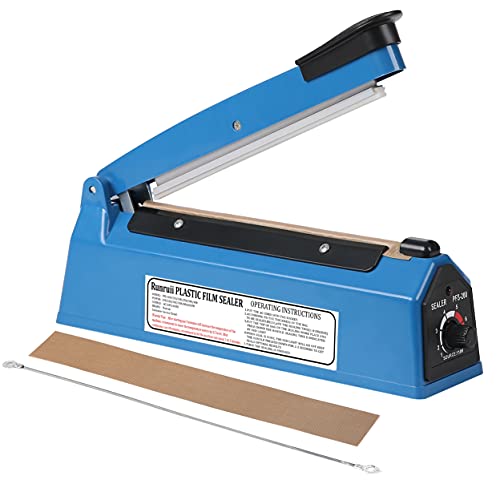
- No warm-up time
- Eight temperature settings
- Lightweight 3.5-pound design
Best For: Manual batch sealing in homes, stores, and small workspaces
Production-Line Sealing

- Automatic continuous operation
- Conveyor with adjustable table
- Seals and prints dates
Best For: Dedicated dry-food and component-packaging stations
Best High-Volume Coder

- Seals and prints codes in one pass
- Up to 16 m/min with 22-lb conveyor capacity
- Height-adjustable frame for lay-flat bags
Best For: Commercial lines needing fast sealing with integrated coding
Best Versatile Inflating Sealer

- 6–12 mm adjustable sealing width
- Up to 16 m/min with digital controls
- Supports marking and nitrogen inflation
Best For: Mixed packaging tasks requiring adjustable sealing
Best Compact Desktop Option
Automatic Continuous Bag Sealer

- Compact 23-lb desktop design
- 6–12 mm adjustable sealing width
- Handles plastic, foil, composite, and paper bags
Best For: Small businesses and home packaging spaces
Heavy-Duty Vacuum Choice – MAGIC SEAL MS4005
For shoppers comparing bag sealing machines for large batches, the MAGIC SEAL MS4005 combines a 16-inch sealing bar with double-pump vacuum performance. Its automatic and manual controls, dual operating modes, and cooling system make it adaptable to different bag types and repeated sealing tasks.
Best For: Kitchens and small commercial operations sealing vacuum bags, Mylar bags, and delicate or moist foods.
Pros:
- Seals bags up to 40 cm wide with an extra-wide 8 mm seal.
- Supports up to 450 consecutive seals with its air-cooling system.
- Works with smooth and textured bags, including Mylar bags.
- Offers automatic, manual, liquid-sealing, and bag-inflation functions.
Cons:
- Vacuum sealing requires more involved setup than a basic impulse sealer.
- Its 8.4-pound body and nearly 20-inch length require dedicated counter space.
The MS4005 is a strong all-around option when your workflow includes both vacuum packaging and frequent sealing. Its broad bag compatibility and high stated consecutive-seal capacity make it especially practical for larger kitchen batches.
Fast Continuous Coder – Automatic FR-900 Sealer
Among bag sealing machines for large batches, the FR-900 is designed for a steady, conveyor-assisted workflow. It seals continuously at adjustable speeds up to 12 meters per minute and can emboss or print dates, remarks, and times while closing compatible bags.
Best For: Production lines and packaging stations handling lightweight bags that need fast sealing and optional date or text coding.
Pros:
- Seals bags in about two seconds according to the supplied specifications.
- Adjustable sealing speed reaches 0–12 m/min.
- Automatic conveying and constant-temperature control support repeatable operation.
- Conveyor angle adjusts for bags of different sizes.
Cons:
- Designed for bags weighing no more than 5 kg.
- Compatible bag thickness is limited to 0.08 mm or less.
- Its automatic format may be more equipment than occasional users need.
The FR-900 makes the most sense when throughput and integrated coding matter more than portability. Confirm your bag thickness and weight before buying, since those limits determine whether it fits your packaging line.
Conveyor Heat-Sealing Workhorse – Commercial Band Sealer
This commercial band sealer is a practical candidate for bag sealing machines for large batches when you want automatic feeding and continuous heat sealing. Its adjustable temperature, conveyor, and up-to-12-meter-per-minute speed suit repetitive packaging in kitchens, bakeries, shops, and small production areas.
Best For: Repetitive sealing of compatible food and general-purpose packaging bags in small commercial workspaces.
Pros:
- Provides adjustable heat from 0–300°C.
- Supports continuous sealing at up to 12 m/min.
- Offers approximately 6–12 mm seal widths.
- Includes a transfer table, spare sealing belt, fuse, and other accessories.
Cons:
- At 27.1 pounds, it is less portable than a manual sealer.
- It is intended for compatible heat-sealable bags, not every packaging material.
- The larger 23-by-13-by-9.45-inch footprint needs substantial workspace.
Choose this model when consistent conveyor operation is more important than compact storage. Its wide temperature range and included maintenance parts add flexibility, but verify that your bags are heat-sealable before purchase.
Wide Manual Sealing Option – 24-Inch Impulse Sealer
For buyers seeking bag sealing machines for large batches without an automated conveyor, this 24-inch manual impulse sealer offers a broad working length and quick, handle-operated sealing. Its adjustable heat settings and seal-and-cut capability support varied small-business packaging tasks.
Best For: Small bakeries, coffee shops, fulfillment areas, and craft businesses needing wide manual seals for PE, PP, Mylar, or foil bags.
Pros:
- 24-inch (60 cm) sealing length accommodates wide bags.
- Seals in approximately 3–5 seconds without warm-up time.
- Eight temperature settings support different plastic bag materials.
- All-metal construction includes fuse protection and heat dissipation.
Cons:
- Manual operation requires an operator for every seal.
- The 3 mm seal is narrower than the 8 mm seal on some alternatives.
- Its stated positioning is small-batch and light-commercial use rather than automated production.
This sealer is a good fit when bag width and straightforward operation matter more than conveyor automation. It can improve consistency over improvised closures, but high-volume facilities may prefer a continuous band model.
High-Output Continuous Sealer – Adjustable Commercial Heat Sealer
For shoppers comparing bag sealing machines for large batches, this commercial continuous band sealer offers adjustable speed, temperature, and sealing width. Its 600-watt heating system is designed for efficient, consistent sealing across several food-packaging materials.
Best For: Small commercial operations, kitchens, and packaging workflows that need adjustable continuous sealing.
Pros:
- Adjustable speed from 0 to 12 m/min for different production volumes.
- Temperature adjusts from 0-300°C for varied packaging needs.
- Sealing width adjusts from 6-12mm to accommodate different bag sizes.
- Works with aluminum foil, kraft paper, and CPP sealing bags.
Cons:
- The displayed temperature may be lower than the actual heating temperature, so adjustments require care.
- At 16.3 pounds, it is less portable than a basic impulse sealer.
- It is semi-automatic rather than fully automatic.
This model is a practical middle ground for users who want continuous operation and more control than a handheld impulse unit. Verify your bag material and fine-tune the temperature before starting a large run.
Simple Impulse Option – 12-Inch Manual Bag Sealer
If you need bag sealing machines for large batches without a conveyor or automatic feed, this 12-inch manual impulse sealer keeps the process straightforward. It requires no warm-up time, offers eight temperature settings, and is compact enough for retail, grocery, produce, or household use.
Best For: Budget-conscious users sealing batches manually when portability and simple operation matter.
Pros:
- No warm-up time is required before use.
- Eight temperature settings support different bag materials.
- Lightweight 3.5-pound design is easy to move and store.
- Designed to seal PE and PP plastic bags and can seal more than 10,000 bags.
Cons:
- Manual operation requires pressing the handle for 2-3.5 seconds per seal.
- It cannot cut bags.
- The 12-inch sealing length may limit wider packaging.
This sealer is best when your batch process can accommodate hands-on loading and pressing. It lacks the throughput features of a continuous band machine, but its low weight and no-warm-up design make it convenient for recurring manual jobs.
Production-Line Sealing – FR-770 Horizontal Band Sealer
For higher-volume packaging, this automatic horizontal band sealer is one of the more production-oriented bag sealing machines for large batches. It combines a conveyor, adjustable conveyor table, intelligent temperature control, cooling and heating blocks, and optional date embossing for a more complete packing workflow.
Best For: Automatic horizontal sealing of dry food, grain, vacuum, kraft paper, and small-component packaging.
Pros:
- Automatic continuous operation supports streamlined batch packaging.
- Thickened conveyor belt and stainless-steel storage platform are designed for durability and easier cleaning.
- Embossing and printing wheels can seal and print dates at the same time.
- Over-current protection helps protect the machine if power exceeds the normal range.
Cons:
- At 19 kg, it is substantially heavier and less portable than manual sealers.
- Its horizontal configuration is intended for dry food and may not suit every package orientation.
- It requires more workspace than a compact impulse unit.
This is the strongest fit of the three for a dedicated packing station where automatic feeding and date marking add value. Its heavier stainless-steel construction favors stability and repeated use over easy relocation.
Best High-Volume Coder – U.S. Solid Inkjet Band Sealer
For bag sealing machines for large batches, this U.S. Solid model stands out by combining continuous horizontal sealing with inline inkjet coding. Its 600W motor, conveyor speed up to 16 m/min, and 22-pound conveyor capacity suit commercial packaging lines handling pre-filled, lay-flat bags.
Best For: High-volume operations that need sealing and batch, expiration-date, barcode, QR-code, or logo printing in one pass.
Pros:
- Seals and prints codes in the same pass.
- Runs at speeds up to 16 m/min with a 10 mm sealing width.
- Handles PVC, Mylar, and other films with adjustable temperatures up to 300°C.
- Heavy-duty metal construction and a height-adjustable frame support production use.
Cons:
- At 72.4 pounds, it is less convenient to move than desktop models.
- The integrated printer may add complexity if coding is not required.
This is the most production-oriented option in the group, especially when traceability and labeling are part of the workflow. Choose it when throughput and integrated coding matter more than portability.
Best Versatile Inflating Sealer – VEVOR Continuous Band Sealer
This VEVOR continuous band sealer is a practical choice among bag sealing machines for large batches, offering automatic operation, adjustable 6–12 mm sealing widths, and speeds up to 16 m/min. Its digital controls and carbon-steel body are suited to recurring commercial sealing work.
Best For: Businesses that need adjustable sealing, optional nitrogen inflation, and marking functions across different bag materials and sizes.
Pros:
- Adjustable sealing width accommodates varied packaging requirements.
- Digital temperature controls and panel adjustments simplify operation.
- Supports embossing, alphanumeric printing, and nitrogen inflation.
- Includes replacement belts, a fuse, and other maintenance accessories.
Cons:
- The air tank required for inflation is not included.
- Its 48.5-pound weight may limit portability.
With broad adjustment options and added inflation functionality, this model offers flexibility for varied packaging workflows. Factor in the separate air-tank purchase if you plan to use the nitrogen feature.
Best Compact Desktop Option – Automatic Continuous Bag Sealer
For smaller production spaces seeking bag sealing machines for large batches, this automatic desktop sealer combines adjustable speed, digital temperature control, and a built-in 6-inch conveyor. It handles plastic, foil, composite, and paper bags from 0.02–0.16 mm thick.
Best For: Small businesses and home operations that want continuous sealing in a lighter, more compact machine.
Pros:
- Compact 23-pound design is easier to position than heavier industrial models.
- Adjustable 6–12 mm sealing width suits varied bag sizes.
- Reaches temperatures up to 300°C and heats quickly.
- Built-in conveyor supports smooth, consistent feeding.
Cons:
- Its 500W motor is lower powered than the 600W models in this roundup.
- It is specified for thinner bags up to 0.16 mm, limiting heavier-material use.
- The notes do not list a maximum conveyor load or operating speed.
This is the most approachable option for space-conscious users who still need automatic continuous sealing. It makes the most sense when compactness and material versatility outweigh the need for documented high-speed or heavy-duty capacity.
How We Picked the Best Bag Sealing Machines for Large Batches
We focused on machines designed to handle repetitive packaging rather than occasional household use. The comparison considers sealing method, operating speed, temperature control, seal width, conveyor support, bag compatibility, cooling behavior, and ease of adjustment. We also included both continuous-duty band sealers and manual impulse models because production needs vary widely.
Models with digital controls, automatic feeding, or coding capability can improve consistency, while simpler impulse sealers may be more practical for mixed bag sizes or lower-volume work. Always verify the machine’s voltage and material specifications before ordering.
Quick Comparison
| Machine type | Best for | Main advantage | Potential limitation |
|---|---|---|---|
| Continuous band sealer | High-volume production | Fast, repeatable sealing | Needs setup space and regular cleaning |
| Impulse sealer | Mixed bag sizes and materials | Simple, flexible operation | Usually requires manual positioning |
| Vacuum sealer | Air-sensitive foods and products | Removes air before sealing | Slower or less suitable for open-ended batch lines |
| Band sealer with printer | Traceability and retail packaging | Can add dates or lot information | Higher complexity and maintenance |
Key Buying Factors for Bag Sealing Machines for Large Batches
Throughput and Operating Speed
For continuous production, look for an adjustable conveyor or band speed that matches your filling station. A faster rating is not always better if workers cannot feed bags consistently. Horizontal machines suit products that remain stable on a conveyor; vertical configurations are often better for liquids, powders, or irregular contents.
Bag Material and Seal Width
Confirm compatibility with PE, PP, foil-laminated, Mylar, kraft-lined, or other materials used in your operation. Seal width affects durability and appearance, while adjustable temperature helps prevent weak seals, scorching, or melted film. Thick or multilayer bags generally require more heat and dwell time.
Controls, Cooling, and Maintenance
Digital temperature controls and variable speed settings make repeatable results easier. Automatic cooling or post-seal cooling can protect the seam during demanding runs. Choose accessible heating elements, belts, and guides so routine cleaning and replacement are manageable.
Workspace, Power, and Product Handling
Measure the machine, conveyor, and clearance around the operator. Check whether the unit requires 110V power or another electrical setup. A built-in conveyor is useful for heavier bags, while a compact desktop design may be preferable when space is limited.
Who Should Buy Which Bag Sealing Machines for Large Batches?
- Choose a continuous band sealer if you need consistent, hands-off sealing for long production runs.
- Choose an impulse sealer if bag sizes change frequently or your volume is moderate and operators can work manually.
- Choose a vacuum sealer for food, textiles, or other products where removing air is part of the packaging requirement.
- Choose a printer-equipped model when lot codes, dates, or other markings are essential to fulfillment or retail compliance.
Before buying, test representative bags if possible. A machine that matches your film, product weight, and daily workflow will generally deliver better results than one selected solely for its maximum speed.