Grinding your own flour, cornmeal, and other dry grains in bulk can improve freshness while reducing dependence on packaged staples. The right mill can also make large jobs faster, cleaner, and easier to repeat.
This roundup compares 10 grain mills for large batches, from countertop stone and impact mills to heavy-duty electric pulverizers, manual models, and agricultural grinders. Focus on capacity, motor power, durability, adjustability, and the type of grain you plan to process most often.
Best 10 Grain Mills for Large Batches Picks for 2026
Balanced Electric Choice

- 450-watt motor with thermal protection
- Corundum stones and adjustable texture control
- CSA listed and assembled in the USA
Best For: Home bakers seeking adjustable electric stone milling
Heavy-Duty Manual Workhorse
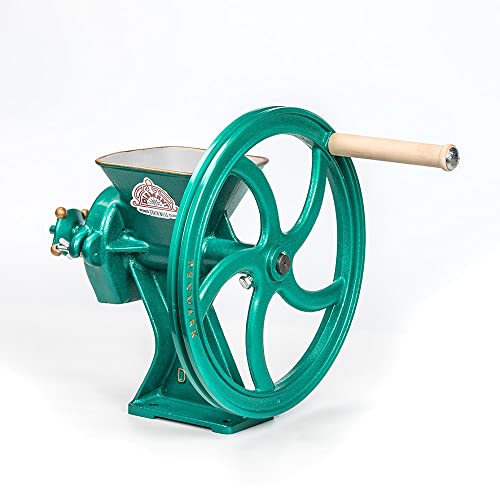
- Extra-large iron and steel burrs
- Handles grains, beans, spices, and feed
- Cast-iron flywheel can be motorized
Best For: High-volume, multi-purpose milling
High-Capacity Electric Pick

- 1,200-watt motor for hard grains
- 8-cup hopper and 12-cup flour canister
- Impact heads make fine bread flour
Best For: Frequent bakers making larger flour batches
Traditional Manual Mill

- 2,400-gram capacity with high hopper
- Cast-iron body and adjustable grind
- Not suitable for superfine whole-wheat flour
Best For: Coarse grain, corn, brewing, and multipurpose grinding
Best for Easy Setup

- 3000W motor for continuous grinding
- Handles dry grains and soaked ingredients
- Adjustable thickness with cast-iron construction
Best For: Large batches and versatile wet/dry milling
Manual Self-Sufficiency Pick
Lehman's 6-Cup Manual Grain Mill

- 6-cup hopper for fewer refills
- Polished stainless steel grinding burrs
- Manual operation with motorization option
Best For: Off-grid use and controlled dry-grain milling
Farm-Size Hopper Pick
25L Agricultural Feed Grain Mill

- 25-liter capacity for larger batches
- Six interchangeable sieves
- Designed for dry grain and feed
Best For: Home or farm dry-grain processing
High-Capacity Speed Pick
1000g Commercial Grain Grinder

- 3000W motor with up to 32,000 RPM
- 1000g stainless steel chamber
- Adjustable 70-300 mesh powder control
Best For: Fast dry-ingredient grinding with adjustable fineness
Farm-Scale Capacity Pick

- 60L or 15.8-gallon capacity
- 1500W motor reaching 19,000 RPM
- Six sieves for varied grind sizes
Best For: Bulk farm, feed, and dry-grain milling
Compact Control Pick

- 2100W motor with 28,000 RPM speed
- 5-, 15-, and 30-second timer settings
- 30-300 mesh fineness range
Best For: Compact, timed grinding of repeated dry-ingredient batches
Balanced Electric Choice – NutriMill Harvest
For shoppers comparing grain mills for large batches, the NutriMill Harvest combines a 450-watt motor with durable corundum milling stones and adjustable texture control. Its thermal protection and automatic shutoff add practical safeguards for regular kitchen use.
Best For: Home bakers who want an electric stone mill with adjustable flour texture and a sturdy, relatively compact design.
Pros:
- 450-watt heavy-duty motor supports routine grain milling.
- Near-diamond-hard corundum stones are built for durable use.
- Texture control knob adjusts the grind from fine to coarse.
- Thermal protection and automatic shutoff provide added convenience.
Cons:
- Its 18.7-pound build is less portable than a lightweight mill.
- It has a smaller listed capacity than the dedicated large-hopper models in this roundup.
The Harvest is a well-rounded option when you want electric convenience and stone milling rather than maximum batch capacity. Its CSA listing and U.S. assembly may also appeal to buyers prioritizing documented construction standards.
Heavy-Duty Manual Workhorse – Lehman's Diamant
The Lehman’s Diamant stands out among grain mills for large batches with its oversized iron and steel burrs, solid cast-iron flywheel, and broad range of uses. It can mill grain, legumes, seeds, spices, coffee, and animal feed, while its flywheel can also be motorized.
Best For: Serious home users, small farms, or anyone wanting a durable manual mill capable of handling varied ingredients and substantial workloads.
Pros:
- Extra-large 5-1/4-inch machined iron burrs produce fine or coarse results.
- Solid cast-iron flywheel adds momentum and smooths hand-cranking.
- Handles grains, beans, legumes, spices, seeds, nuts, and animal feed.
- Can be motorized for less manual effort.
Cons:
- At 56 pounds, it is very heavy and not easy to move.
- The hand-crank design requires physical effort unless motorized.
- Its substantial size may be excessive for occasional small-batch use.
With its large burrs and cast-iron construction, the Diamant is the strongest choice here for demanding, flexible milling. It is best treated as a long-term workhorse rather than a compact countertop appliance.
High-Capacity Electric Pick – NutriMill Impact Compact
For grain mills for large batches, the NutriMill Impact Compact pairs a powerful 1,200-watt motor with an 8-cup hopper and 12-cup flour canister. Its impact milling heads are designed for fine bread flour, while the nesting parts and cyclone air filtration help keep operation and storage manageable.
Best For: Frequent bread bakers who need an electric mill for larger flour batches and fine-textured wheat flour.
Pros:
- 1,200-watt motor is designed to mill hard grains such as wheat.
- 8-cup hopper and 12-cup canister support larger batches.
- Impact milling heads target consistent, fine bread flour.
- Parts nest together for easier storage.
Cons:
- Its impact-milling design is specifically oriented toward fine bread flour rather than broad ingredient versatility.
- The white finish may show flour residue more readily than darker finishes.
This is the most directly batch-focused electric model in the group. Choose it when capacity, high motor power, and bread-flour performance matter more than stone milling or manual versatility.
Traditional Manual Mill – Victoria High Hopper
The Victoria High Hopper is a manual cast-iron grinder with a 2,400-gram capacity, adjustable coarseness, and a clamp for tables from 1/2 to 2 inches thick. It is useful for corn, barley, coffee, seeds, spices, and other ingredients, though it is not intended to make superfine whole-wheat flour.
Best For: Buyers who want an affordable-style manual grinder for coarse grain, corn, brewing, and multipurpose kitchen tasks.
Pros:
- 2,400-gram capacity and high hopper support larger manual loads.
- Cast-iron construction with double tin plating is built for durability.
- Adjustable screw changes the coarseness and fineness of the grind.
- Clamps to many tables and includes a non-slip surface protector.
Cons:
- It cannot grind to a superfine texture.
- It will not turn whole wheat into fine powder.
- Manual cranking can be labor-intensive for repeated large batches.
The Victoria is a practical choice for coarse milling and varied food-preparation tasks, especially when electricity is unavailable or unwanted. Its stated texture limitation makes it less suitable for fine bread flour than the electric mills above.
Best for Easy Setup – 3000W Wet & Dry Grain Mill
For shoppers comparing grain mills for large batches, this VEVOR model stands out for its 3000W motor, continuous grinding design, and adjustable thickness control. Its cast-iron construction and included wet- and dry-grinding discs also make it more versatile than a dry-only mill.
Best For: Large-batch dry milling, feed processing, and users who also want to process soaked soybeans or rice into pulp.
Pros:
- Powerful 3000W motor is designed for continuous grinding.
- Supports both dry grinding and wet grinding with included discs.
- Adjustable thickness accommodates grains, spices, coffee, cereal, and nuts.
- Stainless steel funnel and solid cast-iron body are built for regular use.
Cons:
- Its industrial-style design and roughly 28-inch height require substantial counter or storage space.
- The product is intended for milling and grinding, not general food preparation.
This is the most capable choice here for buyers prioritizing motor power and versatility over compactness. It is especially practical when a single machine needs to handle both dry grains and wet ingredients.
Manual Self-Sufficiency Pick – Lehman's 6-Cup Manual Grain Mill
Among grain mills for large batches, Lehman’s manual model is a strong fit for shoppers who want substantial hopper capacity without relying on electricity. The 6-cup hopper, 12-inch flywheel, and stainless steel burrs support dry-grain milling to pastry flour.
Best For: Off-grid kitchens, backup milling, and home bakers who want manual control over dry flour production.
Pros:
- Large 6-cup hopper reduces the need for constant refilling.
- Grinds wheat, corn, rye, rice, quinoa, and small beans when free-flowing and dry.
- Electrolytically polished stainless steel burrs provide a smooth grinding surface.
- Large flywheel supports easier hand grinding and the mill can also be motorized.
Cons:
- Manual operation requires physical effort for extended batches.
- It is designed for dry grains and does not provide the wet-grinding versatility of some electric models.
- At 26 pounds and 14 inches high, it is not especially lightweight.
This mill makes sense when reliability and independence from household power matter more than speed. Its generous hopper and motorization option give it useful flexibility, while the manual flywheel preserves an off-grid workflow.
Farm-Size Hopper Pick – 25L Agricultural Feed Grain Mill
For grain mills for large batches that need to serve a home or small farm, this 25-liter agricultural grinder offers a sizable material bucket and continuous feeding. Six interchangeable sieves let you choose a grind size from 0.6 to 8 mm for dry wheat, corn, soybeans, and similar materials.
Best For: Home or farm users processing dry grain and feed with a large hopper and selectable sieve sizes.
Pros:
- 25-liter capacity suits larger processing jobs.
- Six sieves provide multiple grinding fineness options from 0.6 to 8 mm.
- Removable hopper and bucket simplify cleaning and storage.
- Continuous feeding and a replaceable blade support ongoing use.
Cons:
- For dry materials only; wet ingredients should not be processed.
- The 33.07-inch height may require dedicated floor or storage space.
- Hopper and bucket must be completely dry before reassembly to protect the motor.
This model is a practical capacity-focused option for dry-grain and feed work. Its sieve selection is useful when batch requirements vary, though buyers must be comfortable with the height and the dry-only operating limits.
High-Capacity Speed Pick – 1000g Commercial Grain Grinder
For shoppers comparing grain mills for large batches, this 1000g commercial grinder emphasizes speed, capacity, and fine powder control. Its 3000W motor, 32,000 RPM operation, and stainless steel chamber are suited to repeated dry-ingredient grinding at home or in small food-service settings.
Best For: Fast processing of dry grains, spices, coffee, herbs, and other ingredients when adjustable powder fineness is important.
Pros:
- Large 1000g stainless steel grinding chamber helps reduce the number of cycles.
- Adjustable 70-300 mesh settings support coarse through very fine textures.
- Triple-blade system, overload protection, and automatic shutoff add practical operating features.
- Includes a flour sieve, cleaning tools, and replacement carbon brushes.
Cons:
- Only suitable for dry materials; wet, oily, and sticky ingredients are not recommended.
- At 16.2 inches tall, it may require dedicated counter or storage space.
This is a strong fit when you want high-speed, fine grinding in manageable 1000g batches. The included sieve and safety features make it more versatile, though its dry-only design limits the ingredient range.
Farm-Scale Capacity Pick – 60L Grain Mill Grinder
Among grain mills for large batches, this 60L model is designed for substantially higher-volume work than compact kitchen grinders. Its 15.8-gallon capacity, 1500W motor, enclosed chamber, and interchangeable sieves make it practical for farms, feed preparation, and bulk dry-grain milling.
Best For: Large farms and home users grinding dry corn, wheat, rice, spices, and animal feed in bulk.
Pros:
- 60L/15.8-gallon bucket capacity supports substantial grinding jobs.
- Six included sieve options provide several coarse-to-fine output sizes.
- 1500W copper motor reaches speeds up to 19,000 RPM.
- Sealed feed inlet and enclosed chamber help reduce dust leakage and simplify storage.
Cons:
- Grinding in batches is recommended despite the large capacity.
- Its 37.4-inch height and 26.5-pound weight make it less convenient for small kitchens.
- Materials must be dry, and overheating protection requires cooling before reopening.
This is the most volume-oriented option in the group, especially for feed or farm use. Its tall, heavy design and batch-use guidance matter, but the large hopper and sieve selection are valuable for recurring bulk milling.
Compact Control Pick – VEVOR 1.8 lb Grain Mill
If you need grain mills for large batches but prefer a smaller countertop footprint, this VEVOR grinder offers a practical middle ground. Its 1.8-pound capacity, 2100W motor, timed controls, and 30-300 mesh range are suited to repeated smaller batches of dry grains, spices, coffee, and cereals.
Best For: Home kitchens and light-duty work where timed grinding, portability, and adjustable fineness matter more than maximum hopper capacity.
Pros:
- Compact 1.8-pound capacity is easier to place and store than a farm-scale mill.
- 5-, 15-, and 30-second timer settings simplify repeatable grinding.
- 28,000 RPM motor and triple stainless-steel blades support fine, even results.
- 270-degree swing design and included sieve help with processing and cleanup.
Cons:
- Its 1.8-pound capacity requires more cycles for truly large batches.
- Continuous operation is limited to five minutes followed by a recommended rest.
- Not designed for wet, oily, or sticky ingredients.
This model is best when batch size is moderate and counter space or ease of use is a priority. The timer and broad mesh range offer useful control, but higher-volume users may prefer the larger-capacity alternatives.
How We Picked the Best Grain Mills for Large Batches
We evaluated these mills by looking at the factors that matter most when processing substantial quantities of dry grain: hopper and chamber capacity, motor power or manual leverage, construction materials, grind adjustment, cleaning demands, and intended use. We also separated household flour mills from commercial-style pulverizers and farm feed grinders, since their performance, noise, particle consistency, and safety requirements can differ considerably.
Capacity alone does not determine throughput. A powerful motor may handle demanding jobs quickly, while a stone mill may be better suited to fresh flour and texture control. Manual mills can remain useful where electricity is unavailable, but they require considerably more effort for repeated large batches.
Quick Comparison
| Mill type | Best suited to | Main advantage | Potential trade-off |
|---|---|---|---|
| Electric stone mill | Fresh flour at home | Consistent, adjustable milling | Usually slower than high-speed pulverizers |
| Impact or high-speed mill | Fast flour production | Strong throughput and fine results | More noise and heat may be produced |
| Manual cast-iron mill | Off-grid or occasional use | No electricity required | Labor-intensive for large quantities |
| Commercial pulverizer | Very large dry batches | High power and capacity | May be bulky, loud, or less precise |
| Farm feed grinder | Grain, corn, and animal feed | Large hoppers and sieve options | Not always ideal for baking flour |
Key Buying Factors for Grain Mills for Large Batches
Capacity and Throughput
Check both the hopper size and the recommended continuous operating time. A large hopper reduces refilling, but a mill with a modest hopper may still be faster if its motor and milling chamber support higher throughput. For repeated batches, look for overload protection, cooling provisions, and clear guidance about rest periods.
Motor Power and Grind Control
Higher wattage can help with hard grains and bulk work, but it is not a complete performance rating. Adjustable thickness, replaceable screens, or multiple sieves are more useful when you need flour, meal, cracked grain, or feed from one machine.
Construction, Cleaning, and Noise
Cast iron and stainless steel can provide durability, while food-contact components should be easy to access and clean. High-speed commercial units are often louder and may create more dust, so consider ventilation, hearing protection, and where the mill will be stored.
Compatibility and Safety
Confirm that the mill is designed for the grains you use, including wheat, corn, oats, rice, or soybeans. Never process wet, oily, or unsuitable materials unless the manufacturer specifically permits it. Verify voltage, plug type, grounding, and included accessories before purchase.
Who Should Buy Which Grain Mills for Large Batches?
Choose an electric stone or impact mill if your priority is fresh baking flour and regular household batches. A manual cast-iron model makes more sense for emergency preparedness, off-grid use, or buyers who value mechanical simplicity. For very high-volume processing, commercial pulverizers offer speed and capacity, but they need more space and may require stronger dust control. If you are grinding grain for livestock or farm use, select an agricultural grinder with a large hopper and interchangeable sieves rather than a compact kitchen flour mill.