Freshly milled flour can bring more flavor and flexibility to homemade bread, pastries, and everyday cooking. The right grain mill depends on how often you bake, which grains you use, and whether you prefer electric convenience or hands-on control.
We compared these 10 options by milling style, capacity, adjustability, construction, and practical kitchen use so you can choose a dependable fit for your pantry and baking routine.
Best 10 Grain Mill with Stone Burrs Picks for 2026
Powerful Stone Milling

- 450-watt motor with thermal protection
- Corundum stone milling burrs
- Adjustable texture control
Best For: Home users seeking an electric stone mill with adjustable grinding
Hand-Powered Capacity
Lehman's Manual Power Grain Mill

- Six-cup hopper for larger batches
- 12-inch flywheel eases hand grinding
- Can be motorized later
Best For: Users wanting a substantial manual mill for dry grains and small beans
Compact Electric Grinding

- 450-watt motor with thermal protection
- Corundum Grainmaster milling stones
- 12-cup stated capacity
Best For: Home bakers milling non-oily grains and legumes
Stand Mixer Convenience
KitchenAid All Metal Grain Mill

- Fits household KitchenAid mixers
- 12 grind levels from coarse to fine
- Includes cleaning brush
Best For: KitchenAid owners seeking a compact grain-milling attachment
Best Overall Versatility

- Stone and stainless steel burr sets
- Grinds grains, oily foods, spices, and nuts
- Locking adjustment with secure table mount
Best For: Versatile manual milling and nut butter
Best Traditional Cast-Iron Pick

- Durable cast-iron construction
- High 2400 g hopper capacity
- Adjustable for coarse-to-finer grinding
Best For: Traditional coarse grinding and corn milling
Best Handmade Stone Design

- Natural granite stone grinding disks
- Heavy 37-pound countertop design
- Grinds grains, coffee, nuts, herbs, and spices
Best For: Traditional countertop milling for baking and spices
Classic Hand-Crank Option

- Durable cast-iron construction
- Adjustable manual grinding
- Clamps to 1/2–2-inch tables
Best For: Coarse-to-medium home grinding and versatile ingredient prep
Fast Electric Flour Maker
NutriMill Impact Compact Grain Mill

- 1,200-watt motor for hard grains
- Fine bread-flour milling heads
- 8-cup hopper and 12-cup canister
Best For: Frequent bread bakers needing fast, fine flour
Traditional Stone Grinding
Manual Granite Stone Grain Mill
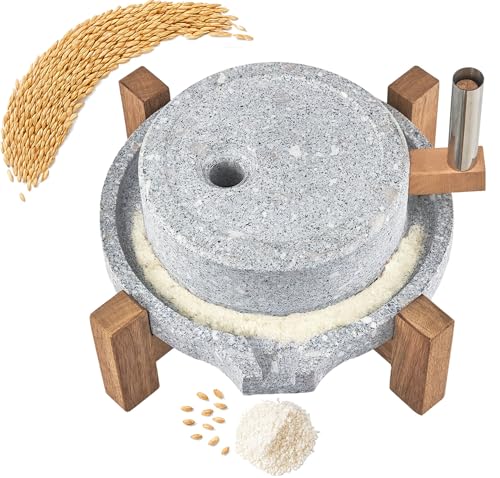
- Hand-polished natural granite
- Dry and wet grinding capability
- Low-speed, low-temperature milling
Best For: Traditional small-batch dry and wet home grinding
Powerful Stone Milling – NutriMill Harvest Black
If you want a dedicated grain mill with stone burrs for regular home baking, the NutriMill Harvest combines a 450-watt motor with near-diamond-hard corundum milling stones. Its texture control knob lets you adjust the grind, while thermal protection helps safeguard the motor during sustained milling.
Best For: Home users who want an electric stone mill with adjustable texture control.
Pros:
- 450-watt heavy-duty motor with auto-shutoff thermal protection
- Near-diamond-hard corundum Grainmaster milling stones
- Patented texture control knob
- CSA tested and listed; designed and assembled in the USA
Cons:
- At 18.7 pounds, it is not especially lightweight
- Its electric design requires access to power
This is a strong fit if you prioritize convenient electric milling and adjustable results in a compact 7-by-7-by-13-inch package.
Hand-Powered Capacity – Lehman's Manual Power Grain Mill
For shoppers seeking a grain mill with stone burrs but preferring manual operation, Lehman’s Power Grain Mill uses stainless steel grinding burrs and a large 12-inch flywheel. It can process dry grains and small beans to pastry flour, and its six-cup hopper suits larger batches.
Best For: Self-sufficiency-minded users who want a high-capacity manual mill that can also be motorized.
Pros:
- Grinds wheat, corn, rye, rice, quinoa, and small beans
- Six-cup hopper supports larger milling sessions
- 12-inch flywheel provides momentum for easier hand grinding
- Can be motorized and has four pre-drilled mounting holes
Cons:
- Manual operation requires physical effort
- At 26 pounds and 14 inches high, it is substantial
- Uses stainless steel burrs rather than stone burrs
This mill stands out for capacity and flexibility, but buyers specifically committed to stone burrs should note the supplied specifications identify stainless steel grinding burrs.
Compact Electric Grinding – NutriMill Harvest Silver
The silver NutriMill Harvest is a dedicated grain mill with stone burrs for home use, pairing a 450-watt motor with near-diamond-hard corundum stones. It is designed to mill non-oily grains and legumes, with a texture control knob for changing the grind.
Best For: Home bakers who want an electric stone mill with a 12-cup stated capacity.
Pros:
- Near-diamond-hard corundum Grainmaster milling stones
- 450-watt motor with auto-shutoff thermal protection
- Texture control knob supports adjustable grinding
- Compact 7-by-7-by-13-inch footprint
Cons:
- Designed for non-oily grains and legumes, limiting ingredient choices
- Electric operation requires a power source
- Weighs 18.6 pounds
With its compact footprint, stone construction, and electric convenience, this version is a practical choice for routine home milling when you mainly work with suitable non-oily ingredients.
Stand Mixer Convenience – KitchenAid All Metal Grain Mill
If you already own a KitchenAid stand mixer, this attachment offers a space-saving way to grind low-moisture grains. It provides 12 grind levels from coarse to fine and includes a cleaning brush, making it a convenient alternative to storing a separate electric grain mill with stone burrs.
Best For: KitchenAid owners who want adjustable grain grinding without buying a standalone mill.
Pros:
- Fits all household KitchenAid stand mixers
- Offers 12 grind levels from coarse to fine
- Works with wheat, corn, rice, and other low-moisture, low-oil grains
- Includes a cleaning brush and one-year warranty policy
Cons:
- Requires a compatible KitchenAid stand mixer
- Specifications identify aluminum construction, not stone burrs
- Ingredient use is limited to low-moisture, low-oil grains
This attachment is best viewed as a convenient accessory for existing KitchenAid setups; it does not meet the supplied specifications for a stone-burr mill.
Best Overall Versatility – WonderMill Junior Deluxe
The WonderMill Junior Deluxe is a strong choice if you want a grain mill with stone burrs that can handle more than dry grains. Its stone and stainless steel burr sets, locking adjustment knob, and table clamp support everything from fine flour and cracked grain to nut butter and oily ingredients.
Best For: Home cooks who want a versatile manual mill for flour, masa, nut butter, spices, and ingredients electric mills may not handle.
Pros:
- Stone burrs grind wheat, corn, and other dry beans while stainless steel burrs handle oily or high-moisture foods.
- Can produce up to 1.25 cups of flour per minute, according to the supplied specifications.
- Supports precise settings from ultra-fine flour to coarse cracked grain.
- Heavy-duty aluminum construction and a secure double-clamp table mount are designed for long-term use.
Cons:
- At 14 pounds, it is heavier than many compact manual grinders.
- Manual cranking requires more effort than using an electric mill.
Choose this model when flexibility matters most. The combination of stone and stainless steel burrs gives it a broader ingredient range than a basic grain-only hand mill.
Best Traditional Cast-Iron Pick – Victoria Manual Grain Mill
The Victoria Manual Cast Iron Grain Mill is a traditional option for shoppers seeking a sturdy grain mill with stone burrs, though this model uses white iron grinding discs rather than stone. Its high hopper, adjustable screw, and table clamp make it practical for coarse-to-medium milling and everyday kitchen grinding.
Best For: Users who want a traditional cast-iron hand mill for corn, grains, coffee, spices, and other general-purpose grinding.
Pros:
- Heavy-duty cast-iron construction includes double tin plating and erosion-resistant discs.
- High hopper holds up to 2400 g, according to the supplied details.
- Adjustable screw lets you change the grinding coarseness and fineness.
- Clamps to tables 1/2 to 2 inches thick and includes a non-slip surface protector.
Cons:
- It cannot produce a superfine texture or turn whole wheat into fine powder.
- Its 90-day limited warranty is relatively short.
- This is not a stone-burr mill; it uses white iron discs.
This Victoria mill suits cooks prioritizing traditional construction and broad, everyday utility over fine flour production. It is better for coarse grinding, corn, and general food preparation than pastry-style flour.
Best Handmade Stone Design – Granite Countertop Stone Mill
This handmade countertop model is a straightforward grain mill with stone burrs for shoppers who prefer natural materials and electricity-free operation. Its granite stone disks and wooden stand are suited to grinding wheat, corn, coffee, nuts, herbs, and dried spices for home baking and cooking.
Best For: Home users who value a traditional countertop mill for bread flour, tortillas, spices, and small-batch ingredient preparation.
Pros:
- Natural granite stone disks are designed to preserve authentic flavors and nutrients while grinding.
- Handmade wooden frame and ergonomic handle provide a traditional countertop setup.
- Works without electricity and is intended for simple countertop installation.
- Heavy 37-pound construction helps keep the approximately 7.8-inch mill stable during use.
Cons:
- At 37 pounds, it is difficult to move or store frequently.
- Manual operation may be labor-intensive for larger batches.
- The supplied notes do not specify an output rate or adjustment range.
Consider this mill if stability, natural granite, and a rustic handmade design are more important than portability or documented throughput. Its broad ingredient list makes it useful for baking and seasoning, but the heavy countertop format is best kept in one place.
Classic Hand-Crank Option – Victoria Cast Iron Grain Mill
If you want a sturdy, manually operated grain mill with stone burrs, the Victoria offers durable cast-iron construction and adjustable grinding. Its white iron discs handle grains and other ingredients, though it is not designed for superfine flour.
Best For: Home users who want a clamp-on manual mill for coarse-to-medium grinding, corn, barley, seeds, spices, and similar ingredients.
Pros:
- Heavy-duty cast-iron body with double tin plating and erosion-resistant discs.
- Adjustable screw lets you change the grind from coarser to finer settings.
- Clamps to tables from 1/2 to 2 inches thick and includes a non-slip surface protector.
- Versatile enough for grains, coffee, beans, nuts, spices, and more.
Cons:
- Cannot produce a superfine texture or fine whole-wheat powder.
- Manual operation requires more effort than an electric mill.
- Its low hopper may require more frequent refilling for larger batches.
This is a practical choice when durability, compact tabletop mounting, and broad ingredient versatility matter more than ultra-fine flour or electric convenience.
Fast Electric Flour Maker – NutriMill Impact Compact Grain Mill
For shoppers comparing a grain mill with stone burrs to high-speed electric designs, the NutriMill takes a different approach: its 1,200-watt motor and impact milling heads are built for fine bread flour from hard grains such as wheat.
Best For: Frequent bread bakers who want an electric mill for larger batches and convenient storage.
Pros:
- Powerful 1,200-watt motor is designed for hard grains like wheat.
- Impact milling heads target a fine, consistent bread-flour texture.
- 8-cup hopper and 12-cup flour canister support larger batches.
- Nesting parts and cyclone air filtration help with storage and airflow.
Cons:
- It uses impact milling heads rather than stone burrs.
- Electric operation requires access to a power outlet.
- The supplied notes emphasize flour milling rather than wet-grinding versatility.
If speed and fine flour are your priorities, this compact electric model is more suitable than a traditional manual stone-style grinder, especially for regular bread making.
Traditional Stone Grinding – Manual Granite Stone Grain Mill
This manual grain mill with stone burrs uses hand-polished natural granite and a low-speed grinding design for dry or wet ingredients. Its wood base and hand-operated mechanism suit shoppers seeking traditional home milling with an emphasis on gentle grinding.
Best For: Home users who want a decorative manual stone mill for grains, seeds, wet mixtures, and small-batch kitchen projects.
Pros:
- Natural granite construction is hard, durable, and suitable for dry or wet grinding.
- Deep grooves and low-speed operation support cooler grinding intended to preserve flavor and nutrients.
- Can process wheat, beans, corn, rice, sesame, and other ingredients.
- Stable wood base, ergonomic handle, and reversible clockwise or counterclockwise operation.
Cons:
- Manual grinding is slower and more labor-intensive than electric milling.
- Its supplied notes do not specify hopper or flour-canister capacity.
- The stone construction may be less convenient to move or store than a compact electric design.
This is the closest match here for shoppers specifically seeking a natural stone grinding experience, particularly when wet-grinding capability and traditional craftsmanship are important.
How We Picked the Best Grain Mill with Stone Burrs
We focused on mills suited to home use, comparing stone-burr designs alongside closely related grain grinders included for their practical performance and versatility. Key considerations included power source, milling capacity, flour-texture control, hopper design, materials, cleanup, and the types of grains or ingredients each mill can handle.
Electric models generally offer speed and repeatable results, while manual mills provide independence from outlets and more control over the pace. We also considered whether a mill is best for occasional baking, frequent bread making, or broader kitchen tasks such as grinding spices, nuts, and seeds.
Quick Comparison
| Best For | Look For | Why It Matters |
|---|---|---|
| Frequent baking | Electric motor and adjustable grind | Makes larger batches faster |
| Off-grid or occasional use | Manual crank and stable base | Works without electricity |
| Small kitchens | Compact footprint or mixer attachment | Saves storage space |
| Multiple ingredients | Compatible burrs and broad food range | Expands the mill’s usefulness |
Key Buying Factors for a Grain Mill with Stone Burrs
Electric or Manual Operation
A powered mill is the practical choice when you regularly make whole-grain flour or need several cups at once. Manual models take more effort but can be quieter, easier to maintain, and useful during power outages.
Capacity and Batch Size
Check both the hopper size and the mill’s continuous operating capacity. A large hopper is convenient, but the motor, burr design, and manufacturer’s recommended run time determine how efficiently the mill handles repeated batches.
Grind Adjustment and Ingredient Compatibility
Look for straightforward settings that move from coarse meal to fine flour. Confirm that the model supports your preferred grains, including wheat, corn, rice, or specialty grains. Do not assume a grain mill is suitable for oily foods unless the manufacturer specifically says so.
Construction and Cleanup
Stone burrs can produce excellent flour texture, but the mill should still be stable and easy to access for brushing out residual meal. Cast iron and other heavy materials improve stability, while removable parts simplify maintenance.
Who Should Buy Which Grain Mill with Stone Burrs?
Choose an electric stone mill if freshness and speed matter most, especially for frequent bread bakers. A manual high-capacity mill is better for buyers who value durability, self-reliance, or occasional use without adding another appliance that needs an outlet. A stand-mixer attachment makes sense when counter and storage space are limited and you already own a compatible KitchenAid mixer.
For the broadest kitchen utility, prioritize a model explicitly rated for more than dry wheat. If you mainly want flour for bread and pastries, focus instead on consistent fine-grind performance, stable operation, and easy cleaning. Whichever style you choose, buy according to your normal batch size rather than the largest advertised hopper.