Choosing the right food dehydrator for small business can help you produce consistent batches of jerky, dried fruit, herbs, pet treats, and other shelf-stable products without overspending on industrial equipment.
This roundup compares 10 stainless-steel and high-capacity dehydrators by usable drying space, tray count, temperature range, airflow design, controls, and practical small-business value.
Best 10 Food Dehydrator for Small Business Picks for 2026
Best High-Capacity Workhorse
12-Tray Commercial Stainless Steel Dehydrator

- 22.67 sq. ft. of drying area
- 70°F–190°F controls with 24-hour timer
- 1,200W stainless-steel commercial design
Best For: Bulk batches of jerky, produce, herbs, and pet foods
Best Quiet 12-Tray Option
HOPERAN Stainless Steel Food Dehydrator

- 12 stainless-steel trays with dual-fan airflow
- 86°F–196°F range and 24-hour timer
- Quiet operation below 48 dB
Best For: Quiet small-batch production and shared kitchens
Best Compact Starter
COSORI 6-Tray Stainless Steel Dehydrator

- 6.5 sq. ft. of drying space
- 600W motor with horizontal airflow
- Up to 48-hour timer and under-48 dB operation
Best For: New businesses and moderate batches in smaller workspaces
Best Production Capacity
18-Tray Commercial Food Dehydrator

- 18 trays with 2,000W fast-drying power
- 70°F–190°F range and 24-hour timer
- Jerky racks, 20 hooks, and extensive accessories
Best For: High-volume small-business production
Best for Easy Setup
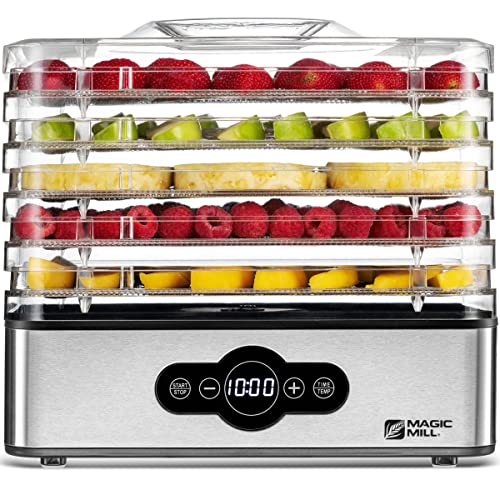
- Five adjustable stainless steel trays
- 95°F–167°F control and 48-hour timer
- Compact 240-watt design
Best For: Small-batch production in limited workspace
High-Capacity Value Pick

- 10 trays with 6.5 sq. ft. of drying area
- Single-zone airflow for even heat distribution
- Includes mats, drip tray, and mitt
Best For: Larger small-business batches and varied ingredients
Heavy-Duty Production Pick

- 600-watt rear-fan even-drying system
- Full stainless steel construction
- 95°F–176°F control with 48-hour timer
Best For: Durable, repeatable small-business production
High-Capacity Pick
10-Tray Commercial Stainless Steel Dehydrator

- 10 stainless steel trays with up to 17 square feet of drying area
- 68°F–194°F controls and a 24-hour timer
- Rear fan, transparent door, and dishwasher-safe removable trays
Best For: Small businesses running larger batches of jerky, fruit, herbs, or vegetables
Compact Long-Run Pick
Rosewill 8-Tray Food Dehydrator

- Eight stainless steel trays in a compact 12-by-12.8-inch design
- 95°F–195°F temperature range and up to a 48-hour timer
- Includes mesh trays and a fruit leather/drip sheet
Best For: Small kitchens needing extended drying cycles in a compact machine
Safety-Focused Pick

- Eight stainless steel trays with a compact countertop footprint
- 650W motor, 48-hour timer, and temperature up to 167°F
- Dual-layer insulation, interior light, mesh tray, and drip tray
Best For: Busy small kitchens seeking compact batch drying with added safety features
Best High-Capacity Workhorse – 12-Tray Commercial Stainless Steel Dehydrator
For a food dehydrator for small business operations, this 12-tray commercial model emphasizes batch capacity, durable stainless-steel construction, and broad temperature control. Its 22.67 square feet of usable drying area and 1,200-watt motor suit businesses processing substantial quantities of jerky, produce, herbs, or pet foods.
Best For: Small businesses that need a large stainless-steel drying chamber for recurring bulk batches.
Pros:
- 12 trays provide up to 22.67 square feet of drying area.
- Adjustable 70°F–190°F temperature range and timer settings up to 24 hours.
- Food-grade stainless-steel body, glass door, rear fan, and horizontal airflow support even drying.
- Includes jerky hooks, silicone pads, a non-stick sheet, drip tray, and gloves.
Cons:
- The 21.38-by-17.2-by-18.5-inch footprint requires dedicated counter or floor space.
- At 1,200 watts, it uses more power than the smaller 600-watt model in this roundup.
- The listed 120V/60Hz specification is intended for use in the USA and Canada.
This is a practical choice when throughput matters more than compactness. The glass door, quiet operation below 50 dB, automatic cooling, and overheat protection add convenience for scheduled production runs.
Best Quiet 12-Tray Option – HOPERAN Stainless Steel Food Dehydrator
This HOPERAN is a useful food dehydrator for small business owners who want 12-tray capacity without a particularly loud workspace appliance. Dual rear fans, digital controls, and a 24-hour timer support consistent batch drying for jerky, fruit, vegetables, herbs, mushrooms, and pet treats.
Best For: Small-scale producers who prioritize quiet operation, stainless-steel trays, and flexible batch preparation.
Pros:
- 12 removable food-grade 304 stainless-steel trays accommodate bulk batches.
- Dual fans provide 360° airflow designed to dry trays evenly without rotation.
- Temperature adjusts from 86°F to 196°F with a timer of up to 24 hours.
- Runs below 48 dB and includes mesh screens, a fruit-roll sheet, gloves, and a recipe book.
Cons:
- Its 800-watt motor is less powerful than the 1,200W and 2,000W commercial models here.
- The 11.9-by-12.2-by-16.1-inch dimensions and 16-pound weight should still be checked against available workspace.
With a two-year manufacturer warranty, automatic shutoff, overheat protection, and dishwasher-safe trays, this model balances capacity and convenience. It may fit best where quieter overnight or shared-kitchen operation is important.
Best Compact Starter – COSORI 6-Tray Stainless Steel Dehydrator
For a food dehydrator for small business use where space and power consumption matter, the COSORI six-tray model offers 6.5 square feet of drying space in a smaller format. Its 600-watt motor, horizontal airflow, and digital controls make it suitable for testing products or handling moderate recurring batches.
Best For: New or space-conscious businesses producing moderate quantities of jerky, fruit, herbs, and fruit leather.
Pros:
- Six stainless-steel trays provide 6.5 square feet of drying space.
- 600-watt motor and rear-mounted fan support faster, even drying without manual intervention.
- Digital controls offer 95°F–165°F temperature adjustment and a timer up to 48 hours.
- Includes a mesh screen, fruit-roll sheet, dishwasher-safe trays, and a 50-recipe cookbook.
Cons:
- Six trays provide less capacity than the 12- and 18-tray commercial options.
- The 95°F–165°F range has a lower maximum temperature than the other listed models.
- Its 17.8-inch depth may still require careful counter-space planning.
This COSORI is easier to match to a smaller production area and offers the longest timer in the group. Choose it when a lower-capacity, quieter unit is more practical than maximum throughput.
Best Production Capacity – 18-Tray Commercial Food Dehydrator
When a food dehydrator for small business must handle the largest batches in this roundup, this 18-tray commercial unit stands out. Its 2,000-watt power rating, 70°F–190°F controls, and included hanging racks and hooks are geared toward substantial production of jerky, herbs, fruit, vegetables, and dog treats.
Best For: Small businesses with high-volume drying needs and enough room for a large, 57.3-pound machine.
Pros:
- 18 stainless-steel trays maximize batch capacity.
- 2,000-watt power rating and temperatures from 70°F to 190°F support demanding production schedules.
- Includes two jerky hanging racks, 20 hooks, silicone sheets, a drip tray, storage containers, and gloves.
- Dishwasher-safe trays, automatic shutoff, overheat protection, and below-50 dB operation add usability.
Cons:
- At 21.5 by 17 by 29.53 inches and 57.3 pounds, it needs substantial dedicated space.
- The 2,000-watt rating may increase electrical demand compared with smaller models.
- Its 18-tray capacity can be excessive for businesses handling only occasional or modest batches.
This is the strongest fit for production-focused users who can accommodate its tall cabinet-style footprint. A three-year after-sales service description and claimed continuous operation support its commercial positioning, though actual workflow capacity should be matched to your available power and space.
Best for Easy Setup – 5-Tray Magic Mill Dehydrator
For shoppers seeking a food dehydrator for small business use, this compact Magic Mill model offers a manageable five-tray setup, digital controls, and a 48-hour timer. Its adjustable trays accommodate both thin ingredients and thicker cuts, making it practical for varied small-batch production.
Best For: Small businesses producing modest batches of jerky, fruit, vegetables, herbs, or dog treats.
Pros:
- Five adjustable stainless steel trays can hold ingredients at standard or increased heights.
- Temperature adjusts from 95°F to 167°F, with a timer running up to 48 hours.
- Detachable trays are washable with soapy water or in a dishwasher.
- Compact 240-watt design fits smaller work areas.
Cons:
- Five trays provide less production capacity than the larger models in this roundup.
- The body is BPA-free plastic rather than a fully stainless steel construction.
This is a sensible entry-level option when space and batch size matter most. Businesses expecting frequent, higher-volume runs may benefit from a larger tray capacity and stronger heating system.
High-Capacity Value Pick – 10-Tray Commercial Dehydrator
This 10-tray commercial dehydrator is a strong candidate for a food dehydrator for small business applications when you need more drying area without moving to an especially large unit. It provides 6.5 square feet of space, single-zone airflow, and accessories for different types of ingredients.
Best For: Small businesses making larger batches of dried fruit, herbs, spices, snacks, or jerky.
Pros:
- Ten stainless steel trays provide 6.5 square feet of drying area.
- Single-zone airflow is designed to distribute heat consistently across the trays.
- Includes silicone mats, mesh mats, a drip tray, and a silicone oven mitt.
- Adjustable temperature and programmable timer support different recipes.
Cons:
- The supplied notes do not specify the temperature range or wattage.
- Its 10-tray capacity may require more storage space than a compact five-tray unit.
With its larger capacity and included accessories, this model is well suited to businesses that want to increase batch output while keeping operation straightforward. Confirm the available temperature and timer specifications if your recipes require narrow settings.
Heavy-Duty Production Pick – 7-Tray Magic Mill Pro
For a food dehydrator for small business use that prioritizes power, repeatability, and durable construction, the Magic Mill Pro stands out. Its 600-watt rear-fan system, seven full-size stainless steel trays, one-degree temperature adjustments, and long timer are designed for consistent batch drying.
Best For: Small businesses needing durable equipment for recurring batches of jerky, fruit, herbs, and snacks.
Pros:
- Full stainless steel construction includes the exterior, interior, and seven trays.
- 600-watt rear fan and heat system is designed to dry trays evenly without rotation.
- Temperature adjusts from 95°F to 176°F in one-degree increments.
- Includes a 48-hour timer, automatic shutoff, keep-warm mode, mesh screens, and a fruit roll/drip tray.
Cons:
- It is heavier at 7.26 kg and may be less convenient to move frequently.
- Seven trays offer less stated drying area than the 10-tray model.
- The higher-power design may be more machine than very small operations need.
This is the strongest fit for repeatable production and long-term durability among these options. Its stainless build and precise controls can support demanding routines, while the included accessories expand the types of products you can prepare.
High-Capacity Pick – 10-Tray Commercial Stainless Steel Dehydrator
For a food dehydrator for small business operations that need substantial batch capacity, this 1,000-watt model offers 10 stainless steel trays and a usable drying area of up to 17 square feet. Its broad temperature range, long timer, and removable components make it practical for recurring batches of jerky, fruit, herbs, mushrooms, and vegetables.
Best For: Small businesses that prioritize high capacity, stainless steel construction, and flexible batch scheduling.
Pros:
- Includes 10 food-grade 304 stainless steel trays, plus silicone sheets, a drip tray, gloves, and storage containers.
- Adjustable temperature from 68°F to 194°F in 5°F increments and a timer of up to 24 hours.
- Rear-mounted fan, air-circulation design, double-row vents, and a transparent door support even drying and monitoring.
- Removable, dishwasher-safe trays and drip tray simplify cleanup.
Cons:
- Its 21.46-inch depth and 1000-watt draw may require more counter space and power than compact units.
- The controls support Fahrenheit only.
- The timer tops out at 24 hours, shorter than some competing models.
This is a strong capacity-focused choice for producers who routinely dehydrate larger quantities. The lifetime warranty and safety features add reassurance, while the stainless steel trays and included accessories support varied commercial-style prep.
Compact Long-Run Pick – Rosewill 8-Tray Food Dehydrator
This Rosewill model is a practical food dehydrator for small business users who need multiple trays without a large footprint. It combines eight full-size stainless steel trays with a 48-hour timer, adjustable heat, and a rear-fan circulation system for extended drying sessions.
Best For: Small commercial kitchens and makers needing compact storage, long drying cycles, and straightforward controls.
Pros:
- Eight stainless steel trays provide useful batch capacity in a 12-by-12.8-inch footprint.
- Temperature adjusts from 95°F to 195°F, with a 0.5-to-48-hour timer.
- Includes mesh trays and a fruit leather sheet that can also serve as a drip tray.
- Automatic shutoff, a built-in handle, and a 360-degree hot-air circulation system add convenience.
Cons:
- Its 400-watt motor is lower powered than the other listed units.
- The one-year manufacturer warranty is shorter than the lifetime warranty offered by the high-capacity model.
- The temperature range does not extend as low as some units for delicate drying tasks.
Choose this dehydrator when counter space and long unattended recipes matter more than maximum wattage. Its eight trays and 48-hour timer suit steady small-batch production, while the included specialty sheets expand the types of foods you can process.
Safety-Focused Pick – 650W 8-Tray Food Dryer
For a food dehydrator for small business use that balances batch capacity with a compact countertop footprint, this 650-watt dryer provides eight stainless steel trays and a timer of up to 48 hours. Its dual-layer insulation, interior light, and one-touch controls are useful in busy kitchens producing jerky, fruit, herbs, and other dried foods.
Best For: Small businesses wanting an eight-tray unit with long timer operation, safety insulation, and included starter accessories.
Pros:
- Eight stainless steel trays and a 650-watt motor support batch drying in a compact design.
- Temperature adjusts up to 167°F and the timer runs for up to 48 hours.
- Dual-layer insulation is designed to keep the exterior cooler during extended use.
- Includes a mesh tray, drip tray, recipe guide, interior light, and automatic shutoff.
Cons:
- The maximum temperature of 167°F is lower than the other listed dehydrators.
- The tray count matches the smaller eight-tray models rather than the 10-tray high-capacity option.
- The construction combines ABS with stainless steel, rather than being an all-stainless-steel unit.
This model is a sensible middle ground for compact production spaces. It offers more power than the 400-watt Rosewill while retaining an eight-tray format, and its insulation, viewing light, and simple controls suit frequent use in a busy workspace.
How We Picked the Best Food Dehydrator for Small Business
We focused on the features that matter most when a dehydrator will be used regularly rather than occasionally. The comparison considers tray capacity, usable drying area, temperature range, timer length, wattage, airflow design, construction, cleaning convenience, and the ability to expand production without immediately moving to a large commercial system.
Models with stainless-steel trays and interiors receive particular attention because they are generally better suited to frequent use and easier to inspect and maintain. We also included smaller six- to eight-tray machines for businesses testing demand, alongside 10-, 12-, and 18-tray options for higher-volume production.
Quick Comparison
- Best for high-volume batches: An 18-tray commercial model offers the greatest capacity in this selection.
- Best balance of capacity and footprint: A 10- or 12-tray stainless-steel unit can provide commercial-style output without requiring the space of the largest machine.
- Best for starting small: Six- and eight-tray dehydrators are easier to place in a home-based workspace and typically use less power.
- Best for precise scheduling: Look for digital temperature controls and timers lasting 48 hours or longer.
- Best for even drying: Rear-mounted fans can reduce the need to rotate trays, although batch layout and food thickness still affect results.
Key Buying Factors for a Food Dehydrator for Small Business
Capacity and Usable Drying Area
Tray count alone does not tell you how much product a machine can process. Check tray dimensions, spacing, and stated usable square footage. Large batches of sliced fruit or jerky need broad tray surfaces, while herbs and small treats may benefit from more compact shelves.
Temperature Range and Controls
Choose a machine that supports the temperatures required for your products. Lower settings are useful for herbs and delicate ingredients, while higher settings can be important for meat preparation and faster drying. Digital controls and a dependable timer help improve repeatability across batches.
Airflow, Power, and Noise
Rear-fan designs generally distribute heat more consistently than basic stackable units. Higher wattage may shorten drying times, but it can also increase electricity use. For a small commercial kitchen, consider ventilation, operating noise, and available circuit capacity before choosing the most powerful model.
Cleaning and Food-Contact Materials
Removable stainless-steel trays are practical for frequent production, especially when making sticky fruit leather or seasoned jerky. Confirm whether trays, liners, and drip areas are easy to remove and clean. A smooth interior is preferable to hard-to-reach seams where food residue can collect.
Who Should Buy Which Food Dehydrator for Small Business?
Choose a six- or eight-tray model if you are launching a home-based brand, selling at occasional markets, or still measuring demand. These machines can be easier to store and may be more economical for small batches.
Choose a 10- or 12-tray commercial dehydrator if you already have recurring orders for jerky, fruit, herbs, or pet treats. This range offers a useful compromise between production capacity, footprint, and operating cost.
Choose an 18-tray machine if your priority is throughput and you have sufficient counter space, ventilation, and electrical capacity. It is best suited to established operations that can keep most of the drying area in use.
Before buying, estimate your weekly output, measure the available workspace, and confirm the machine’s temperature, timer, power, and cleaning requirements. The best Food Dehydrator for Small Business is the one that matches your real batch volume while leaving enough capacity for growth.