A compact bread machine can make fresh loaves, dough, and specialty recipes without taking over a limited countertop. The best choice balances footprint with useful capacity, simple controls, and settings that match how you bake.
We’ve gathered 10 bread machines for small kitchens, ranging from one-pound mini models to two-pound programmable machines. Use the guide below to compare their most important differences before buying.
Best 10 Bread Machines for Small Kitchens Picks for 2026
Best All-Around Compact Pick

- 12 automatic programs, including gluten-free
- 1-, 1.5-, and 2-pound loaf sizes
- 13-hour delay start with paddle-removal alert
Best For: Small households seeking flexible everyday bread baking
Best for One-Pound Loaves

- Compact 1-pound bread and cake capacity
- Quick-bake cycle under two hours
- Dough, jam, cake, and 13-hour delay settings
Best For: Individuals and couples who want small fresh loaves
Best Budget-Friendly Feature Set

- 19 one-touch programs for bread and more
- Three loaf sizes up to 2 pounds
- 15-hour delay timer and keep-warm function
Best For: Beginners wanting broad preset variety
Best for Custom Recipes
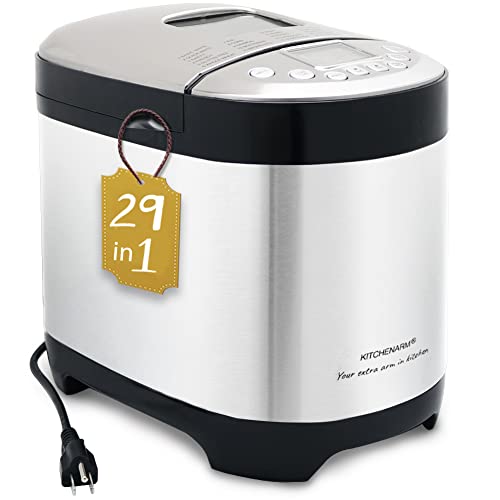
- 29 automatic menus, including specialty breads
- Four programmable Homemade menus
- Three loaf sizes with 15-hour delay timer
Best For: Bakers who want deep recipe customization
Best Compact Pick

- Compact 1.5 lb design for two or three people
- 19 programs with gluten-free, dough, jam, and yogurt settings
- 15-hour delay timer and carrying handle
Best For: Couples and small kitchens
Best for Everyday Use
KITCHENARM 19-in-1 Bread Machine

- Programmable Homemade cycle for custom recipes
- Three loaf sizes and three crust colors
- Includes 57 recipes and recipe-cloud access
Best For: Beginners and recipe experimenters
Best Even-Baking Design

- Dual heaters for surrounding baking
- 20 programs with gluten-free, dough, jam, and yogurt options
- Ceramic pan, delay timer, and stated under-40 dB motor noise
Best For: Small kitchens with vertical clearance
Compact ExpressBake Pick
Amazon Basics 2-Lb Bread Maker

- 9.17-inch-wide footprint
- 14 programs, including gluten-free
- ExpressBake in under 90 minutes
Best For: Small households seeking simple, fast bread making
Quiet Family-Size Option

- Three loaf sizes from 1 to 2 pounds
- 17 automatic programs
- 15-hour delay timer and keep-warm mode
Best For: Families wanting flexible scheduling and quiet operation
Largest-Capacity Choice

- 2.2-pound maximum loaf capacity
- 16 programs, including yogurt and homemade
- Under-50-decibel operation with 15-hour timer
Best For: Families needing larger loaves and specialty programs
Best All-Around Compact Pick – Cuisinart CBK-110NAS
For shoppers comparing bread machines for small kitchens, the Cuisinart CBK-110NAS offers a practical balance of compact dimensions, loaf-size flexibility, and automatic programs. It can make 1-, 1.5-, or 2-pound loaves while handling kneading, rising, and baking with one-button program selection.
Best For: Small households that want flexible loaf sizes, gluten-free baking, and overnight scheduling.
Pros:
- 12 programs include gluten-free, artisan dough, jam, and cake settings.
- Three loaf sizes and three crust shades accommodate different preferences.
- 13-hour delay start, 60-minute keep-warm function, and viewing window support convenient scheduling.
- Paddle-removal alert helps simplify cleanup and reduce the chance of a baked-in paddle.
Cons:
- Hand-wash care may require more cleanup effort.
- The maximum loaf size is 2 pounds, which may not suit larger households.
The CBK-110NAS is a well-rounded choice when counter space matters but you still want useful customization. Its vertical design and broad program selection make it particularly versatile for everyday bread and occasional dough or dessert projects.
Best for One-Pound Loaves – Zojirushi Home Bakery Mini
The Zojirushi Home Bakery Mini is a compact option for anyone seeking bread machines for small kitchens without committing to large loaves. Its 1-pound capacity, quick-bake cycle, and carrying handle make it suited to modest portions and limited counter space.
Best For: Individuals or couples who prefer small, fresh loaves and quick-bake convenience.
Pros:
- Bakes compact 1-pound loaves of bread or cake.
- Quick-bake cycle takes under two hours.
- Includes settings for cookie dough, pasta dough, fresh jam, and cake.
- 13-hour delay timer, viewing window, and carrying handle add convenience.
Cons:
- Its 1-pound capacity is less suitable for families or larger batches.
- It offers fewer programs than several larger-capacity alternatives.
- The warranty is limited to one year.
This machine stands out when portion control and footprint matter more than maximum capacity. It is a focused, space-conscious pick for fresh bread, small baking projects, and occasional dough or jam preparation.
Best Budget-Friendly Feature Set – Elite Gourmet EBM8103M
The Elite Gourmet EBM8103M packs 19 one-touch programs into a compact design, making it a strong contender among bread machines for small kitchens. It supports three loaf sizes and includes specialty settings for gluten-free bread, dough, jam, cake, and more.
Best For: Beginners who want many automatic programs and flexible loaf sizes in a small-kitchen appliance.
Pros:
- 19 presets cover common breads, gluten-free recipes, dough, pizza dough, cake, and jam.
- Choose 1-, 1.5-, or 2-pound loaves for different household needs.
- 15-hour delay timer and 60-minute keep-warm function help match baking to your schedule.
- Designed to bake without heating the entire oven, which suits apartments and hot days.
Cons:
- Hand-wash care adds maintenance work.
- The 14-inch depth may require careful counter-space planning.
The EBM8103M is appealing if variety and scheduling are priorities. Its broad preset selection gives beginners an easy starting point while retaining enough loaf-size flexibility for both small households and occasional larger bakes.
Best for Custom Recipes – KITCHENARM 29-in-1
For advanced bakers researching bread machines for small kitchens, the KITCHENARM 29-in-1 offers unusually extensive menu and customization options in a relatively narrow footprint. Along with automatic bread cycles, it provides a programmable Homemade menu for adjusting individual stages such as kneading, rising, fermentation, and baking.
Best For: Beginners and experienced bakers who want automatic presets plus detailed control over personal recipes.
Pros:
- 29 menus include gluten-free, sourdough, brioche, keto, salt-free, sugar-free, cake, jam, and yogurt options.
- Homemade menu supports up to four personalized programs and cycle-level adjustments.
- Three loaf sizes, three crust colors, a 15-hour delay timer, and one-hour keep-warm function provide flexibility.
- Includes add-nuts and remove-paddle alerts, 15-minute power-interruption recovery, and a two-year warranty.
Cons:
- Its extensive customization may be more than casual users need.
- The 14.2-inch depth and 12-inch height require careful placement in a small kitchen.
- Hand-wash care is specified.
The KITCHENARM is the strongest fit for shoppers who expect to experiment rather than rely only on preset recipes. Its recipe resources and programmable cycles offer room to grow, while the 1-, 1.5-, and 2-pound options keep batch sizes practical.
Best Compact Pick – Briskind 1.5 lb Bread Maker
For shoppers comparing bread machines for small kitchens, the Briskind 1.5 lb model keeps its footprint and loaf size practical. Its 19 programs, compact 12-by-9-by-10.5-inch dimensions, and carrying handle make it a flexible choice for smaller households.
Best For: Couples, small families, and apartment kitchens that need versatile bread-making functions without a bulky appliance.
Pros:
- Compact 1.5 lb capacity serves about two or three people and also supports 1 lb loaves.
- Offers 19 settings, including gluten-free, low-carb, sourdough starter, jam, yogurt, dough, and manual knead, rise, and bake controls.
- Includes a 15-hour delay timer, one-hour keep-warm function, power-failure backup, and fruit-and-nut reminder.
- Comes with two kneading paddles, measuring tools, a paddle-removal tool, recipe materials, and a two-year warranty.
Cons:
- The 1.5 lb maximum capacity may be too small for larger households.
- It is designed for 120-volt use and is not applicable to 230-volt areas such as the UK and EU.
The Briskind is a particularly space-conscious option when counter room and portion size matter more than maximum capacity. Its broad menu selection also gives beginners and experienced bakers room to experiment.
Best for Everyday Use – KITCHENARM 19-in-1 Bread Machine
The KITCHENARM 19-in-1 is a strong option for bread machines for small kitchens when you want compact dimensions without giving up recipe control. It supports 1 lb, 1.5 lb, and 2 lb loaves, with saved settings and a programmable cycle for more personalized baking.
Best For: Beginners who want guided recipes and experienced users who want to customize kneading, rising, and baking times.
Pros:
- Offers 19 menus, including gluten-free, sourdough, dough, jam, yogurt, and a fully programmable Homemade cycle.
- Supports three loaf sizes and three crust colors, with settings saved for easier repeat baking.
- Includes 57 recipes, access to a recipe cloud, bread-mix compatibility, and alarms for adding ingredients or removing the paddle.
- Has a 15-hour delay timer, 2-year warranty, and lifetime customer service.
Cons:
- At 13.9 by 9.4 by 11.7 inches, it is larger than the most compact 1.5 lb models.
- The 2 lb capacity may produce more bread than some one- or two-person households need.
This model balances beginner-friendly automation with unusually broad control over the baking cycle. It is worth considering if your small kitchen can accommodate its slightly larger footprint and you expect to explore different recipes over time.
Best Even-Baking Design – Neretva 20-in-1 Bread Maker
Among bread machines for small kitchens, the Neretva stands out for its dual-heater design and broad menu selection. It supports 1.65 lb and 2 lb loaves while adding a ceramic pan, 20 programs, and a stated motor-noise level below 40 dB.
Best For: Small households that want a versatile machine with larger loaf options, quieter operation, and features aimed at more even baking.
Pros:
- Provides 20 programs, including gluten-free, sugarless, pizza dough, ferment, jam, yogurt, and homemade settings.
- Dual top-and-bottom heaters are designed for 360-degree surrounding baking and more even results.
- Uses a nonstick ceramic pan and includes two kneading paddles, a mitt, measuring tools, and a paddle-removal hook.
- Offers a 15-hour delay timer, one-hour keep-warm function, and 15-minute power-interruption recovery.
Cons:
- The listed 23.5-inch height may require careful clearance planning, despite its relatively narrow 7.91-inch width.
- Its 1.65 lb and 2 lb loaf options may be more capacity than some smaller households require.
- The controls lock during operation and require holding Start/Pause/Stop for three seconds to unlock.
The Neretva is appealing when even baking and menu variety are priorities. Before buying, measure your available vertical clearance carefully, since the listed height could be a more important fit factor than its narrow width.
Compact ExpressBake Pick – Amazon Basics 2-Lb Bread Maker
If you want bread machines for small kitchens, the Amazon Basics Programmable Bread Maker is a practical option with a relatively compact 9.17-inch width. Its automatic mixing, kneading, rising, and baking make it easy to produce up to a 2-pound loaf with limited hands-on work.
Best For: Small households that want straightforward controls, gluten-free options, and a quick ExpressBake cycle.
Pros:
- Compact 9.17-inch-wide design for easier counter placement
- 14 programs include bread, dough, gluten-free options, and jam
- ExpressBake can produce bread in less than 90 minutes
- Three crust-color settings and a 2-pound capacity
Cons:
- Only offers a single loaf capacity rather than multiple loaf-size choices
- Product care instructions specify wiping with a dry cloth
This model stands out when counter space and convenience matter most. Its LCD controls and ExpressBake setting are useful for everyday baking, though shoppers wanting a delay timer or more customizable loaf sizes may prefer another machine.
Quiet Family-Size Option – 2-Lb 17-in-1 Bread Maker
For shoppers comparing bread machines for small kitchens, this 2-pound stainless steel model balances family-sized capacity with beginner-friendly automation. It offers 17 programs, three loaf sizes, and a 15-hour delay timer, although its listed dimensions make it better suited to kitchens with enough vertical and counter clearance.
Best For: Families or meal planners who want flexible loaf sizes, delayed baking, and quiet operation.
Pros:
- Three loaf sizes from 1 to 2 pounds and three crust settings
- 17 programs cover bread, cake, whole wheat, jam, yogurt, and gluten-free baking
- 15-hour delay timer and one-hour keep-warm function
- Quiet operation rated at approximately 50 decibels
Cons:
- Its 600-watt design and 2-pound capacity may take more counter space than a compact single-loaf machine
- Basic bread cycles take about 3 hours 35 minutes to 3 hours 45 minutes, depending on loaf size
- Requires cooling for approximately 20–30 minutes if overheat protection pauses operation
This bread maker is a versatile choice for households that need scheduling flexibility without much noise. Its adjustable loaf sizes help reduce unnecessary baking, but confirm your available counter space before buying.
Largest-Capacity Choice – SUMSATY 2.2-Lb Bread Maker
Among bread machines for small kitchens, the SUMSATY offers the largest stated capacity here while retaining selectable 1-, 1.5-, and 2.2-pound loaf sizes. Its 16 programs, under-50-decibel operation, and 15-hour timer make it a flexible kitchen assistant, but the 12.99-inch depth should be measured against your available workspace.
Best For: Families that want larger loaves, specialty programs, and the option to scale down when needed.
Pros:
- 2.2-pound maximum capacity with three loaf-size choices
- 16 programs include gluten-free, French, yogurt, jam, and homemade settings
- Quiet operation rated below 50 decibels
- 15-hour timer and one-hour automatic keep-warm function
Cons:
- Its 12.99-inch depth may be less convenient for very shallow counters
- Hand-wash care is specified for the machine and components
- Largest loaf size may be more than a small household needs
The SUMSATY is the most accommodating pick for larger households or anyone who wants room for specialty recipes. Its adjustable capacity improves flexibility, but compact-kitchen shoppers should prioritize measuring the deeper footprint before committing.
How We Picked the Best Bread Machines for Small Kitchens
We focused on machines that make sense for apartments, compact homes, dorms, and crowded countertops. Our comparison considers footprint, loaf-size flexibility, program selection, control simplicity, cleanup features, and the practical value of extras such as gluten-free, dough, jam, or homemade cycles. A smaller appliance is not automatically better: the right model should fit your storage space while producing enough bread for your household.
Because specifications and included accessories can vary by seller or production run, confirm the current dimensions, wattage, warranty, and included parts before ordering.
Quick Comparison
| What to Compare | Best for | What to Look For |
|---|---|---|
| Loaf capacity | Household size | One-pound models for one or two people; adjustable 1-, 1.5-, or 2-pound settings for flexibility |
| Programs | Recipe variety | Basic, whole wheat, dough, rapid, gluten-free, and custom cycles |
| Controls | Everyday convenience | Clear buttons, readable display, timer, and memory backup |
| Cleanup | Frequent use | Removable nonstick pan and kneading paddle |
| Storage | Small kitchens | Compact depth, manageable weight, and a carrying handle or cord storage |
Key Buying Factors for Bread Machines for Small Kitchens
Countertop Footprint and Storage
Measure the space where you plan to use the machine, including clearance for the lid and ventilation. Also check its height under cabinets and whether you can store it easily after each use. A carrying handle is useful when the appliance must move between a cupboard and counter.
Loaf Size and Bread Shape
Small machines may produce taller, narrower loaves, while two-pound models offer more servings but usually occupy more space. Adjustable loaf sizes are valuable if you bake for different numbers of people or want to avoid leftovers.
Programs and Customization
Preset menus simplify routine baking, but a homemade or manual cycle gives you more control over kneading, rising, and baking times. Gluten-free settings can help with convenience, although results still depend heavily on the recipe and ingredients.
Ease of Use and Cleanup
Look for a readable display, delay timer, viewing window, removable pan, and removable paddle. Keep in mind that even compact machines may need hand-washing for nonstick components. A keep-warm feature is convenient, but removing bread promptly generally helps preserve the crust.
Who Should Buy Which Bread Machines for Small Kitchens?
- Choose a one-pound mini machine if you live alone, bake modest portions, or have very limited storage.
- Choose an adjustable-capacity model if you want one appliance for small weekday loaves, larger family batches, and dough preparation.
- Choose a model with a homemade cycle if you already have favorite recipes or want precise control beyond preset programs.
- Choose a simpler programmable machine if you mainly want dependable white, wheat, rapid, or dough cycles without a steep learning curve.
- Choose a larger two-pound machine if your household regularly eats bread and the added countertop space is acceptable.
Before purchasing, compare the machine’s exterior dimensions with your available space, then prioritize the loaf size and programs you will actually use. That approach is usually more useful than choosing solely by the highest number of presets.