Choosing among cider presses for small businesses means balancing batch capacity, pressing efficiency, durability, and the space available for prep and cleanup. A suitable press can help turn seasonal fruit into cider, juice, wine, or other value-added products without making every production day unnecessarily labor-intensive.
This roundup compares 10 manual, hydraulic, stainless steel, and wood-basket presses across several capacities and designs. Use the guide below to match your expected batch volume and operating style with the right press format.
Best 10 Cider Presses for Small Businesses Picks for 2026
Heritage Workhorse
Double-Tub American Harvester Press

- Grinds apples to a fine texture
- Hard maple and cast iron construction
- Can produce up to 50 gallons in an afternoon
Best For: Small cider operations needing high output and durable construction
Compact Batch Tool
7L Stainless Steel Fruit Crusher

- 7-liter hopper for small batches
- Processes 35–45 kg per hour
- Produces uniform pieces for pressing
Best For: Portable, modular small-scale fruit processing
Traditional Juice Maker

- 4.75-gallon manual capacity
- Solid beechwood basket and heavy-duty stand
- Built-in pour spout for juice collection
Best For: Quiet seasonal pressing and moderate small-shop batches
Water-Powered Capacity
10.7-Gallon Hydraulic Fruit Press

- 10.7-gallon/40-liter pressing capacity
- Runs from a standard garden hose
- Includes filter bag and splash guard
Best For: Small commercial operations needing larger, low-effort batches
High-Yield Classic

- 18-liter press with stainless-steel crusher
- Rust-resistant food-grade stainless steel
- Manual and portable, with no power needed
Best For: Small-scale cider and juice batches with hard fruits or vegetables
Easy-Clean Stainless

- 12-liter stainless-steel pressing system
- Includes two food-grade filter bags
- Disassembles for easier cleaning
Best For: Versatile small batches where maintenance and hygiene are priorities
Portable T-Handle

- 7-liter usable capacity for small batches
- T-shaped handle and phase-in pressing design
- Includes a stainless-steel fruit grinder
Best For: Portable cider and juice production at modest volumes
High-Capacity Hydropress
5.8-Gallon Stainless Steel Cider Press

- Hydraulic jack delivers up to 6,613.87 pounds of pressure
- 5.81-gallon outer bucket for larger batches
- 304 stainless steel with included filter bucket
Best For: Small operations needing higher capacity and reduced manual effort
Traditional Hand-Crank Choice
4.75-Gallon Wooden Cider Press
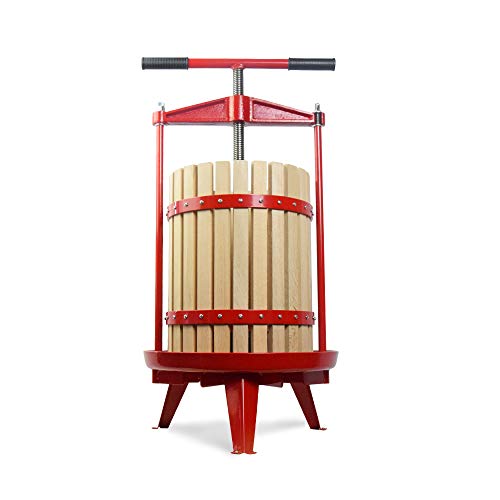
- Manual T-handle with progressive pressing action
- Handles about 22 to 33 pounds of fruit per batch
- Includes a filter bag and portable design
Best For: Small sellers wanting a traditional, hand-powered setup
Stable Manual Workhorse
3.69-Gallon Stainless Steel Press

- Removable 304 stainless steel basket
- Stable triangular base and cast iron crossbeam
- Includes two food-grade filter bags
Best For: Small businesses wanting easy-clean manual pressing for moderate batches
Heritage Workhorse – Double-Tub American Harvester Press
For small businesses seeking cider presses for small businesses, the American Harvester is a substantial option built around both grinding and pressing. Its double-tub design and two-person operation are aimed at processing larger harvests efficiently, with the supplied notes stating that it can produce up to 50 gallons in an afternoon.
Best For: Small cider operations that need high afternoon output and a durable, traditional machine.
Pros:
- Apple Eater grinder reduces apples to a fine texture for pressing.
- Hard maple and cast iron construction is designed for long-term durability.
- Double-tub, two-person operation supports production of up to 50 gallons in an afternoon.
- Its heirloom-style construction can serve as a distinctive centerpiece for a business.
Cons:
- Two-person operation may require extra labor during busy pressing sessions.
- Its substantial construction may be more than a very small or occasional operation needs.
This is the strongest fit here for buyers prioritizing capacity, durability, and an integrated grind-and-press workflow over compactness.
Compact Batch Tool – 7L Stainless Steel Fruit Crusher
This 7-liter manual crusher is a practical entry point for small businesses seeking cider presses for small businesses, especially when space and portability matter. It prepares apples and pears into uniform pieces that can then be loaded into a separate press, and its stated processing rate is 35–45 kg of fruit per hour.
Best For: Small-scale producers who need a portable fruit crusher for garden, home, or seasonal processing.
Pros:
- Large 7-liter hopper holds up to 1.8 gallons of fruit.
- Designed to process approximately 35–45 kg of fruit per hour.
- Produces uniform 1/4-inch pieces that are easy to press with minimal waste.
- Food-grade 304 stainless steel, reinforced iron, and table-mount components support regular use.
Cons:
- It is a crusher and grinder rather than a complete juice press.
- Manual operation requires hands-on feeding and processing.
- Hand-wash-only care may add cleanup time.
Choose this model when you already have a press or want to build a modular setup around a compact, high-throughput crusher.
Traditional Juice Maker – 4.75-Gallon Beechwood Press
For small businesses seeking cider presses for small businesses with a quieter, hands-on workflow, this 4.75-gallon manual press offers a sturdy beechwood basket and heavy-duty stand. It is designed for apples, grapes, and berries, with a built-in pour spout for straightforward juice collection.
Best For: Small juice shops and seasonal producers making moderate batches of cider, juice, or homemade wine.
Pros:
- Solid red beech basket is designed to resist moisture and wear.
- Manual screw operation requires no motor and works quietly.
- Built-in pour spout simplifies juice collection.
- Breakaway basket design helps remove fruit pulp between pressings.
Cons:
- Its 4.75-gallon capacity is smaller than the larger commercial-style options.
- Fruit must be crushed before loading the press.
- Manual operation requires physical effort for each batch.
This press is a sensible choice for businesses that value simple operation, moderate capacity, and a traditional wood-basket design.
Water-Powered Capacity – 10.7-Gallon Hydraulic Fruit Press
Businesses comparing cider presses for small businesses may appreciate this 10.7-gallon hydraulic model when higher pressure and larger batches are priorities. It connects to a standard domestic garden hose, uses water pressure rather than electricity or manual muscle, and includes a filter bag and splash guard.
Best For: Small cideries, catering operations, hotels, and fresh-fruit sellers needing efficient hydraulic pressing.
Pros:
- 10.7-gallon/40-liter capacity supports larger batches than the manual tabletop options.
- Water-powered operation reduces reliance on electricity and muscle power.
- High pressure is designed to support strong juice yields, even when partially filled.
- Food-grade materials and a maximum 3-bar pressure setting support controlled operation.
Cons:
- It requires access to a domestic water supply and a suitable hose connection.
- At 46.8 pounds, it is less portable than compact manual equipment.
- The supplied notes do not indicate that it includes a fruit grinder, so fruit preparation may require separate equipment.
Its larger capacity and hose-powered mechanism make it the most efficient choice here for operators who want faster pressing without adding an electric motor.
High-Yield Classic – 4.75-Gallon Wood Basket Press
For small businesses looking for cider presses, this manual SQUEEZE master model combines an 18-liter solid wood basket with a stainless-steel fruit crusher. Its extended hand shank, phase-in pressing design, and larger pressing area are intended to reduce effort while improving juice extraction.
Best For: Small-scale cider, wine, and juice production using apples, pears, peaches, carrots, and other hard fruits or vegetables.
Pros:
- 4.75-gallon capacity supports larger manual batches.
- Food-grade stainless steel construction is rust resistant.
- Includes a 7-liter/1.8-gallon crusher for preparing hard produce.
- Manual operation works without a power supply and is easy to relocate.
Cons:
- Hand-wash-only care may require additional cleanup time.
- Manual pressing requires operator effort for repeated production runs.
The combination of a crusher and larger press makes this a practical option when a small operation wants a more complete, portable setup without relying on electricity.
Easy-Clean Stainless – 12-Liter Fruit Wine Press
For small businesses comparing cider presses, the VEVOR 12-liter model offers an all-stainless-steel pressing system with a thickened plate, two barrels, and included filter bags. Its triangular handle is designed for straightforward manual operation, while the disassemblable barrels simplify cleanup.
Best For: Small manual batches of cider, grape juice, wine, fruit puree, honey, olive oil, or similar products, especially where easy cleaning matters.
Pros:
- 12-liter/3.17-gallon capacity suits family-size or small commercial batches.
- Stainless-steel barrels, plate, frame, and base provide corrosion-resistant construction.
- Includes two food-grade filter bags.
- Disassembles for cleaning and is described as dishwasher compatible.
Cons:
- The 12-liter capacity is smaller than some 18-liter options.
- Manual operation may be slower for high-volume production.
- Product-care details also specify hand washing.
This is a versatile choice for operators who value a stable frame, hygienic stainless-steel surfaces, and easier maintenance over maximum batch capacity.
Portable T-Handle – 7-Liter Cider Press
For small businesses seeking cider presses with a compact manual workflow, this SQUEEZE master model pairs a 7-liter usable press capacity with a solid wood basket and stainless-steel grinder. The T-shaped handle and phase-in pressing design are intended to make operation more manageable while processing up to 22–33 pounds of fruit at a time.
Best For: Portable small-batch cider, apple, and grape pressing where a manageable capacity and manual operation are preferred.
Pros:
- 7-liter usable capacity and 9-liter maximum capacity support small batches.
- Can press approximately 22–33 pounds of fruit at one time, according to the supplied specifications.
- Food-grade stainless steel construction is designed for durability and rust resistance.
- Portable manual design needs no electricity.
Cons:
- Smaller usable capacity may require multiple cycles for larger orders.
- Hand-wash-only care adds cleanup work.
- Manual pressing requires physical effort.
Its smaller footprint and T-handle make this a useful fit for mobile or low-volume operations, while the included grinder helps prepare fruit before pressing.
High-Capacity Hydropress – 5.8-Gallon Stainless Steel Cider Press
For small businesses comparing cider presses for small businesses, this stainless steel hydropress emphasizes capacity and reduced manual effort. Its hydraulic jack supplies up to 6,613.87 pounds of pressure, while the 5.81-gallon outer bucket supports larger batches of juice or wine.
Best For: Small juice shops, wineries, farms, and other operations that prioritize batch capacity and hydraulic pressing assistance.
Pros:
- Food-safe 304 stainless steel construction.
- Hydraulic jack helps reduce fatigue during extended pressing.
- 5.81-gallon outer bucket and 2.91-gallon filter bucket support substantial batches.
- Reinforced triangular brackets provide a stable structure.
Cons:
- At 24.2 pounds, it is less convenient to move frequently than a smaller press.
- Its 30.7-inch height and hydraulic design may require more storage space and setup than a basic hand press.
This is the strongest capacity-focused option in the group. Choose it when hydraulic assistance and stainless steel construction matter more than portability or a traditional manual setup.
Traditional Hand-Crank Choice – 4.75-Gallon Wooden Cider Press
This traditional wooden press is a practical candidate for cider presses for small businesses that want a manual, portable setup. Its T-handle and progressive screw mechanism are designed to make pressing easier, while the 4.75-gallon capacity accommodates roughly 22 to 33 pounds of fruit per batch.
Best For: Farm stands, small eateries, fresh-squeezed juice sellers, and businesses seeking a straightforward hand-powered press.
Pros:
- Large pressing plate is designed to improve juice yield.
- T-shaped handle and phase-in pressing action help reduce operating effort.
- Can press apples, grapes, and other fruit, as well as vinasse, pomace, and honeycomb.
- Includes one filter bag and has a portable design.
Cons:
- Manual operation requires ongoing physical effort.
- Wood construction should be hand-washed and may require more care than stainless steel.
- Its 4.75-gallon capacity is smaller than the largest option here.
This press suits businesses that value a familiar, non-electric workflow and attractive traditional construction. It offers useful capacity without the hydraulic equipment of a commercial-style hydropress.
Stable Manual Workhorse – 3.69-Gallon Stainless Steel Press
For businesses evaluating cider presses for small businesses, this 14-liter manual model balances a stainless steel basket with a stable triangular base. The removable basket, included filter bags, and swing-open crossbeam make it practical for repeated apple and grape pressing in compact commercial settings.
Best For: Restaurants, fresh juice shops, farms, wineries, and small producers that prefer manual operation with easy cleanup.
Pros:
- Removable 304 stainless steel basket supports easier cleaning.
- Triangular base and cast iron crossbeam provide stability.
- Includes two food-grade filter bags.
- T-handle and progressive pressing mechanism support straightforward manual use.
Cons:
- Its 3.69-gallon capacity is lower than the other listed presses.
- At 34 pounds, it is relatively heavy for a manual press.
- Best results may require pre-cutting or pre-crushing fruit.
This is a solid middle-ground choice for operators who want durable stainless steel contact surfaces and manageable cleanup. Its smaller capacity makes it better for moderate batches than high-volume production.
How We Picked the Best Cider Presses for Small Businesses
We focused on the factors that matter most in a small commercial or farm-based workflow: usable basket capacity, construction materials, pressing mechanism, stability, cleaning requirements, and ease of loading and unloading. The selection includes compact manual models for limited production, traditional wood-basket presses for straightforward batch work, and larger hydraulic or hydropress designs for users who need more output with less hand effort.
Capacity claims should be treated as approximate. Fruit type, preparation, moisture content, and how finely the fruit is crushed all affect the amount of juice produced and the time required per batch.
Quick Comparison
| Press type | Best suited to | Main advantage | Watch for |
|---|---|---|---|
| Compact manual crusher | Small batches and prep work | Low cost and easy storage | Limited throughput |
| Wood-basket manual press | Traditional cider and juice production | Simple operation and familiar workflow | More hands-on labor and cleanup |
| Stainless steel manual press | Frequent food-processing use | Durability and easier sanitation | May require more storage space |
| Hydraulic or hydropress | Larger recurring batches | Higher pressing force with less manual effort | Greater cost, weight, and maintenance needs |
Key Buying Factors for Cider Presses for Small Businesses
Capacity and Throughput
Choose capacity based on your normal batch size rather than the largest possible harvest. A 4.75-gallon press can be easier to load, unload, and clean, while 10-gallon-class models reduce the number of cycles for higher-volume work. Also consider whether the grinder or crusher can keep pace with the press.
Pressing Method and Effort
Manual screw presses are straightforward and do not need power, but they require physical effort and repeated handling. Hydraulic and hydropress models can apply stronger, more consistent pressure and may be preferable when pressing several batches in one day.
Materials, Stability, and Sanitation
Stainless steel baskets are a practical choice for frequent cleaning and moisture exposure. Wood baskets offer a traditional setup but need careful washing, drying, and storage. Look for a wide, stable base, reinforced frame, secure handles, and a splash guard or collection area that keeps juice from spreading across the work surface.
Workflow and Cleanup
A press is only as efficient as the steps around it. Check how easily the basket, filter bag, tray, and pressing plates can be removed. Confirm that replacement bags and other wear parts are available, and measure your work area before buying—especially if the unit must be stored between seasonal batches.
Who Should Buy Which Cider Presses for Small Businesses?
Choose a compact manual crusher or smaller press if you make occasional cider, process limited fruit, or need equipment that can be stored easily. Choose a traditional wood-basket press if you want a simple, low-tech setup for recurring small-to-medium batches and do not mind hands-on operation.
Choose a stainless steel manual model if sanitation, durability, and frequent washing are priorities. Choose a hydraulic or hydropress if your business processes larger volumes and reducing operator fatigue matters more than minimizing upfront cost. Before purchasing, compare the press with your grinder, collection containers, and available labor so the entire production line remains balanced.