Making fresh apple cider at home does not require a commercial-size machine. The best cider presses for small kitchens balance useful capacity with a compact footprint, manageable operation, and straightforward cleanup.
This roundup compares ten manual presses and related fruit-processing options, from small 3-liter models to larger family-size baskets. Use the buying guide below to match capacity, construction, and storage needs to your kitchen.
Best 10 Cider Presses for Small Kitchens Picks for 2026
Best Compact Wooden Press
1.6-Gallon Beechwood Fruit Press

- Stable triangular base and natural beechwood basket
- Includes two food-grade filter bags
- Manual screw press for small household batches
Best For: Home cider, juice, and fruit-wine making with prepared fruit
Best Prep Tool for Small Batches

- Crushes apples and pears into uniform pieces
- 7-liter hopper suits home-scale processing
- 304 stainless steel with reinforced iron frame
Best For: Preparing fruit before a separate cider or juice press
Best Traditional Basket Press
4.75-Gallon Beechwood Cider Press

- Large basket for seasonal home batches
- Heavy-duty stand with built-in pour spout
- Breakaway basket helps with pulp removal
Best For: Home cider makers processing crushed fruit in larger batches
Best High-Pressure Option
5.8-Gallon Stainless Steel Hydraulic Press

- Food-grade 304 stainless steel construction
- Hydraulic jack provides very high pressing force
- Large barrel and reinforced frame support bigger batches
Best For: High-volume home or restaurant cider and juice production
Compact Traditional Pick

- Compact 1.6-gallon format for smaller batches
- Extended handle helps reduce pressing effort
- Includes a filter bag for cleaner juice
Best For: Small kitchens and occasional home pressing
Easy-Clean Home Brewer

- Beech wood basket with steel base
- Filter bag supports cleaner juice and easier cleanup
- Adjustable blocks suit varying fill levels
Best For: Small-batch cider, juice, and wine making
High-Capacity Crusher Combo
4.75-Gallon Press With 7-Liter Crusher

- Large 4.75-gallon pressing capacity
- Includes a 7-liter crusher for hard produce
- Rust-resistant stainless steel components
Best For: Larger home batches and small-scale fruit processing
Compact Stainless Pick
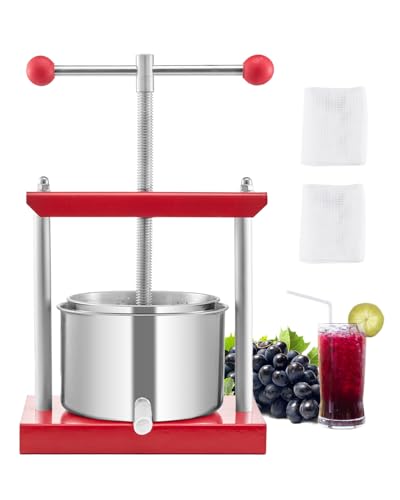
- 0.8-gallon size for small batches
- Stainless steel barrels and plate
- Includes two food-grade filter bags
Best For: Small-batch home cider and juice pressing
Family-Batch Oak Choice

- Processes about 22–33 pounds of fruit
- Natural untreated oak construction
- Wide plate and manual screw press
Best For: Larger home batches and family gatherings
High-Capacity Farmhouse Press

- 3.69-gallon capacity for large batches
- Removable 304 stainless steel basket
- Swing-open beam and stable triangular base
Best For: Large batches in farms, wineries, or spacious home work areas
Best Compact Wooden Press – 1.6-Gallon Beechwood Fruit Press
For shoppers comparing cider presses for small kitchens, this 1.6-gallon VEVOR model offers a manageable manual format with a solid beechwood basket and stable triangular base. Its extended handle and progressive screw mechanism are designed for straightforward, low-noise pressing.
Best For: Home users who want a compact press for prepared apples, grapes, fruit wine, or small-batch juice.
Pros:
- Solid natural beechwood basket with a stable triangular base.
- Includes two food-grade filter bags for cleaner pressing.
- Eight supporting blocks and a thick pressing block support thorough extraction.
- Useful 1.6-gallon capacity for household batches and gatherings.
Cons:
- Hard fruit must be crushed before pressing.
- At 22.64 inches tall and 15.9 pounds, it still requires dedicated storage space.
- Hand-wash care may make cleanup more involved.
This is a practical choice when you want a traditional wooden press without stepping up to a larger commercial-style unit. Pair it with a crusher if you regularly process whole apples.
Best Prep Tool for Small Batches – 7-Liter Manual Fruit Crusher
This manual crusher is a useful companion for cider presses for small kitchens, especially when whole apples or pears need to be broken down first. Its 7-liter hopper and table-mount design provide a relatively compact way to prepare fruit for pressing.
Best For: Home brewers and cider makers who need to crush apples, pears, grapes, or other fruit before using a separate press.
Pros:
- 7-liter, 1.8-gallon hopper for practical home-sized batches.
- Produces uniform pieces intended to press with minimal waste.
- Food-grade 304 stainless steel with a reinforced iron frame.
- Table-mount components help keep the crusher secure during use.
Cons:
- This is a crusher, not a complete juice or cider press.
- It must be mounted securely to a suitable table or work surface.
- Hand-wash care adds cleanup work.
Choose this model when fruit preparation is the bottleneck in your setup. It is best viewed as the crushing stage of a small-kitchen cider workflow, followed by a separate basket or hydraulic press.
Best Traditional Basket Press – 4.75-Gallon Beechwood Cider Press
For those seeking cider presses for small kitchens with more batch capacity, this manual beechwood press combines a 4.75-gallon basket with a heavy-duty stand. The built-in spout and quiet hand operation make it suited to home cider, juice, and seasonal fruit processing.
Best For: Households processing larger seasonal batches of crushed apples, grapes, or berries.
Pros:
- 4.75-gallon capacity provides more room than compact tabletop presses.
- Solid red beech basket is designed for moisture and wear resistance.
- Built-in pour spout simplifies juice collection.
- Breakaway basket design helps remove pulp between batches.
Cons:
- Its 24.4-by-14.4-by-27.6-inch footprint is substantial for a small kitchen.
- Fruit must be crushed before loading.
- Hand-wash care may require extra cleanup time.
This press offers a traditional, high-capacity format, but it is not the most space-efficient option. Check your storage and counter area carefully before choosing it for a small kitchen.
Best High-Pressure Option – 5.8-Gallon Stainless Steel Hydraulic Press
This stainless steel hydraulic model is one of the more substantial cider presses for small kitchens, offering strong extraction with less manual turning. Its food-grade construction, reinforced frame, and 5.8-gallon outer barrel make it better suited to users who prioritize capacity and pressing force over a compact footprint.
Best For: Serious home users, restaurants, or small operations that need high-pressure extraction for cider, wine, and fruit juice.
Pros:
- Food-grade 304 stainless steel is rust-resistant and hygienic.
- Hydraulic jack delivers up to 6,613.87 pounds of stated pressure.
- 5.81-gallon outer barrel supports substantial batches.
- Triangular reinforcement helps stabilize the frame during pressing.
Cons:
- The larger capacity and reinforced construction may be excessive for a very small kitchen.
- Its hydraulic mechanism is more complex than a basic screw press.
- The supplied notes do not provide full dimensions or detailed care instructions.
If reducing manual effort matters more than minimizing equipment size, this is the strongest option in the group. Confirm available floor and storage space before buying, since its capacity is aimed at larger-scale pressing.
Compact Traditional Pick – 1.6-Gallon Blue Wooden Press
For shoppers comparing cider presses for small kitchens, this manual 1.6-gallon model offers a compact, portable way to press apples, grapes, and other fruit. Its extended hand shank is designed to reduce effort, while the solid wood basket and included filter bag support small-batch juice, cider, or wine making.
Best For: Small households, family parties, and beginners who want a portable manual press for batches of roughly 6 to 8 pounds of fruit.
Pros:
- Compact 1.6-gallon capacity suits smaller batches and kitchen use.
- Extended handle and phase-in pressing design are intended to reduce labor.
- Includes a filter bag and can press fruit, pomace, and honeycomb.
Cons:
- Assembly is required.
- Its smaller capacity may be limiting for larger harvests.
- Manual pressing requires physical effort.
This is a practical choice when storage space and batch size matter most. Choose it for occasional, small-batch pressing rather than high-volume orchard processing.
Easy-Clean Home Brewer – 1.6-Gallon Beech Wood Press
This 1.6-gallon beech wood press is a strong contender among cider presses for small kitchens, especially for users who want a traditional manual setup. The included filter bag, adjustable pressing blocks, and compact package are suited to small batches of pre-chopped apples, grapes, berries, and other fruit.
Best For: Home brewers, gardeners, and kitchen users making small batches of cider, juice, or fruit wine.
Pros:
- Durable beech wood basket pairs with a heavy-duty steel base.
- Included filter bag helps separate pulp and simplify cleanup.
- Adjustable pressing blocks accommodate different fill levels.
- Designed for cider, juice, wine, and multiple types of fruit.
Cons:
- Assembly is required before first use.
- Hard fruit such as apples and pears should be pre-chopped.
- The 1.6-gallon size may not suit large harvests.
Its combination of a kitchen-friendly capacity and cleanup-focused accessories makes this a well-rounded option for regular small-batch use. Prepping hard fruit properly should help it perform as intended.
High-Capacity Crusher Combo – 4.75-Gallon Press With 7-Liter Crusher
For shoppers who need more output than typical cider presses for small kitchens provide, this 4.75-gallon manual press combines a solid wood basket with a 7-liter fruit crusher. The crusher is designed for hard fruits and vegetables, while the press uses a longer hand shank and wide pressing plate to support more thorough extraction.
Best For: Experienced home cider makers, gardeners, and small-scale users processing larger batches of apples, pears, peaches, or vegetables.
Pros:
- 4.75-gallon press capacity handles substantially larger batches.
- Included 7-liter crusher helps prepare hard fruit and vegetables.
- Food-grade stainless steel construction is rust resistant and durable.
- Manual operation works without a power supply and is easy to relocate.
Cons:
- Its larger capacity may require more storage space than a small kitchen allows.
- Manual operation still requires physical effort.
- Hand washing is recommended for care.
This is the most capable option here for users prioritizing batch size and fruit preparation. However, its 4.75-gallon format and separate crusher make it better suited to spacious kitchens, garages, or outdoor processing areas than very compact counters.
Compact Stainless Pick – 3L Fruit Wine Press
For shoppers comparing cider presses for small kitchens, this 3-liter VEVOR model offers a relatively compact manual format. Its stainless steel barrels, T-handle, and removable components make it practical for occasional household juice and cider pressing.
Best For: Small-batch cider, juice, wine, and fruit pressing at home.
Pros:
- Compact 0.8-gallon capacity suits smaller batches and home use.
- Stainless steel pressing plate and barrels are durable and corrosion-resistant.
- Includes two food-grade filter bags and has removable barrels for easier cleaning.
- Manual T-handle operation requires no electricity.
Cons:
- Its 3-liter capacity is limited for large harvests or party-size production.
- The product-care details specify hand washing, despite the notes mentioning dishwasher convenience.
- Pre-cutting fruit and using a filter bag is recommended for better results.
This is the most space-conscious choice of the group, especially for buyers prioritizing stainless steel construction and manageable batches over maximum throughput.
Family-Batch Oak Choice – 4.8-Gallon Cider Press
Among cider presses for small kitchens, this oak model is better suited to buyers who have room for a larger manual press and want to process family-size quantities. Its screw mechanism and wide pressure plate are designed to handle substantial fruit loads without electricity.
Best For: Family gatherings, larger home batches, restaurants, and small fruit operations.
Pros:
- 4.8-gallon capacity can process about 22 to 33 pounds of fruit at once.
- Natural oak construction is described as untreated, odorless, durable, and moisture-resistant.
- Wide pressure plate is designed for thorough squeezing and higher juice yield.
- Works with apples, grapes, berries, distiller’s grains, honeycomb, and other materials.
Cons:
- At 15 by 15 by 27.6 inches and 26 pounds, it requires more storage space than a compact press.
- Wood construction requires water flushing and careful drying after use.
- The larger basket may be more capacity than occasional small-kitchen users need.
This press offers substantial capacity and a traditional oak build, but its footprint makes it a better fit for a dedicated storage area than a very tight countertop.
High-Capacity Farmhouse Press – 14L Stainless Basket Press
For shoppers seeking cider presses for small kitchens but expecting occasional large batches, this 14-liter VEVOR press provides significantly more capacity than compact household models. The removable stainless steel basket, swing-open crossbeam, and triangular base support a more substantial pressing setup.
Best For: Large family batches, wineries, farms, restaurants, and fresh-juice operations.
Pros:
- 3.69-gallon capacity is designed for abundant juice production.
- Removable 304 stainless steel basket simplifies cleaning.
- Cast iron crossbeam swings open for easier loading.
- Triangular base, T-handle, and progressive screw mechanism support stable manual pressing.
Cons:
- Its 38.39-inch height and roughly 34-pound weight make it a poor fit for very limited kitchens.
- Fruit should be pre-crushed for the best juicing results.
- Non-food-contact metal parts require food-grade lubricant to help prevent corrosion.
This is the productivity-focused option: capable and sturdy for large batches, but its tall, heavy design is better suited to a utility area, garage, or commercial-style workspace than a small countertop.
How We Picked the Best Cider Presses for Small Kitchens
We focused on manual presses and compact fruit-processing equipment suited to home cider making, rather than commercial production. The selection covers several useful capacity ranges, including approximately 3, 6, 14, 18, and 22 liters. We also considered basket material, frame stability, pressing mechanism, portability, likely cleanup demands, and how easily each style can be stored between uses.
Because product specifications and included accessories can vary, confirm the current basket size, materials, assembly requirements, and accessories before ordering. A fruit crusher or scratter may be useful alongside a press, but it does not replace a press for extracting juice.
Quick Comparison
| Capacity range | Best suited to | Main advantage | Potential trade-off |
|---|---|---|---|
| 3 liters | Small batches and limited storage | Smallest footprint | More batches for a full harvest |
| 6 liters | Occasional home cider making | Good compact compromise | Limited for large harvests |
| 14–18 liters | Families and regular seasonal use | Fewer loading cycles | Heavier and harder to store |
| Approximately 22 liters | Large batches and group use | High output per session | Needs more counter and storage space |
Key Buying Factors for Cider Presses for Small Kitchens
Capacity and Available Space
Choose capacity based on the amount of fruit you can process in one session, not just the advertised basket volume. A 3- or 6-liter press is easier to move and store, while a 14- to 18-liter model reduces repeated loading when several people are making cider. Measure both the storage area and the operating height before buying.
Basket and Frame Construction
Wooden baskets can offer traditional appeal and may be gentle on fruit, but they require thorough drying after washing. Stainless steel baskets are generally easier to wipe down and may suit frequent use. A stable base, strong crossbeam, and rigid frame matter because pressing creates substantial force.
Pressing Mechanism and Effort
Manual screw presses are simple and do not require power, but they need steady hand force. Long handles can improve leverage. Hydraulic-jack designs may reduce physical effort, although they are usually heavier, larger, and more involved to clean or store.
Preparation, Cleanup, and Safety
Apples normally need to be crushed or scratted before pressing. Check whether a separate crusher is required and whether the press includes a suitable collection tray. Wash food-contact surfaces promptly, inspect wood for retained moisture, and keep fingers clear of moving parts while operating the mechanism.
Who Should Buy Which Cider Presses for Small Kitchens?
Choose a 3-liter model if you have minimal storage, make small experimental batches, or want the lightest setup. Choose a 6-liter press for the best balance of portability and useful household capacity.
Choose a 14- to 18-liter model if you process garden or orchard fruit regularly and have a dedicated storage location. Choose the largest press when output matters more than compactness and you can safely provide a stable operating surface.
For most apartment kitchens and occasional home brewers, compact Cider Presses for Small Kitchens are easiest to live with when they are simple to assemble, stable during use, and small enough to dry and store completely after each batch.