Choosing the right food strainer can help a small food business process tomatoes, fruit, sauces, jams, and purées more consistently while reducing manual prep.
This roundup compares 10 electric and manual models across capacity, motor power, construction, mounting style, and day-to-day versatility.
Best 10 Food Strainer Machines for Small Businesses Picks for 2026
Compact Electric Tomato Separator
OMRA Spremy Electric Tomato Strainer

- Handles up to 330 lb of tomatoes per hour
- Automatically separates skins and seeds
- Requires 220-volt corded power
Best For: Small businesses specializing in tomato and apple puree
Manual Multi-Use Sauce Strainer
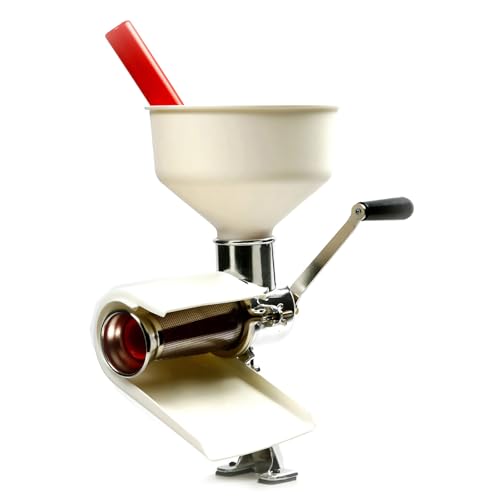
- Handles fruits, vegetables, and purees
- Includes fine mesh screen and standard spiral
- Offers a 3-quart capacity
Best For: Hands-on sauce and puree production without electric power
High-Capacity Electric Food Mill
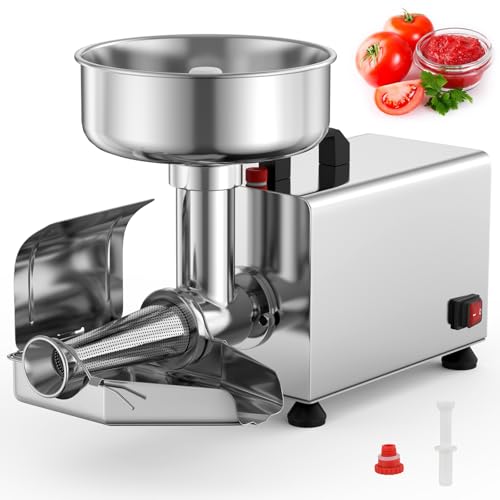
- Processes a stated 200-350 lb per hour
- Uses 304 stainless steel construction
- Supports tomatoes, berries, strawberries, and pineapple
Best For: Small commercial kitchens needing faster multi-fruit processing
Flexible Manual Tomato Press
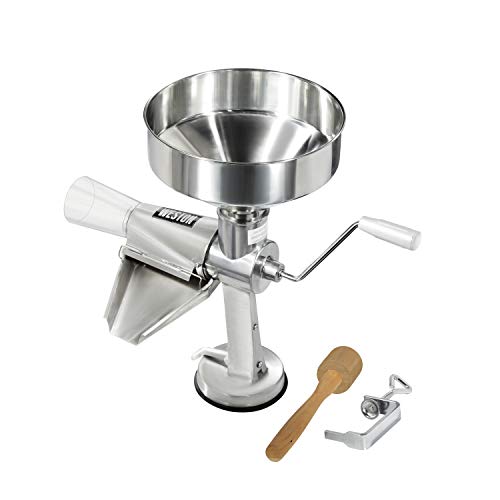
- Features a one-gallon stainless steel hopper
- Mounts with a suction base or C-clamp
- Includes a 1.5mm screen and splash guard
Best For: Flexible manual processing of tomatoes, apples, sauces, and purees
Best Compact Hybrid

- Manual or included electric operation
- 1.3mm screen separates skins and seeds
- Clamp mounts to common countertop thicknesses
Best For: Small-batch processing with flexible operation
Best Versatile Batch Model
Weston Deluxe Electric Tomato Strainer

- One-gallon hopper for larger batches
- 250-watt motor with forward and reverse
- Three screen sizes for varied textures
Best For: Sauces, purees, jams, and salsa production
Best High-Output Stainless Steel
Commercial Electric Tomato Mill

- 450-watt motor with stated 110-pound-per-hour output
- 304 food-grade stainless steel construction
- Large funnel and fully disassemblable design
Best For: Higher-volume sauce and preserve production
High-Volume Harvest Pick
VEVOR Electric Tomato Strainer

- Processes up to 200 pounds per hour
- Large hopper reduces refills
- Tool-free disassembly simplifies cleanup
Best For: Small businesses processing large batches of tomatoes, fruit, sauce, or jam
Stainless-Steel Production Choice

- Rated for about 110 pounds per hour
- Wide 8.4-inch fruit funnel
- 304 stainless-steel food-contact parts
Best For: Small producers making ketchup and berry jams
Multi-Function Kitchen Workhorse
AIRMSEN Meat Grinder and Sauce Press

- Handles tomato sauce, meat, sausage, and kibbeh
- Includes three grinding plate sizes
- Reverse function helps clear jams
Best For: Small kitchens needing one appliance for sauce and meat preparation
Compact Electric Tomato Separator – OMRA Spremy Electric Tomato Strainer
For small businesses seeking food strainer machines for small businesses, the OMRA Spremy offers electric tomato processing in a compact, portable design. Its 1/4 HP motor and masticating-style auger are designed to separate tomato skins and seeds from fresh or cooked produce.
Best For: Small-batch sauce makers and businesses focused primarily on tomato or apple puree.
Pros:
- Processes up to 330 pounds of tomatoes per hour.
- Separates puree from seeds and skins automatically.
- Includes a stainless steel hopper, die-cast metal housing, and food-grade nylon auger.
- Made in Italy with a cooling-fan-equipped motor.
Cons:
- The 220-volt power requirement may not suit every workspace.
- The listed 7.87-inch dimensions indicate a smaller processing setup than larger commercial machines.
Choose this model when compact size and dedicated tomato processing matter more than broad ingredient versatility or heavy-duty stainless-steel construction.
Manual Multi-Use Sauce Strainer – Norpro 1951 Sauce Master
The Norpro 1951 is a manual option for businesses comparing food strainer machines for small businesses without adding an electric motor to the workspace. It forces fruits, vegetables, and purees through a chrome-plated steel screen to separate juice and pulp in one operation.
Best For: Small producers who want a flexible, manually operated strainer for sauces, purees, fruits, and vegetables.
Pros:
- Supports vegetables, fruits, and purees.
- Includes a fine mesh screen and standard spiral.
- Has a 3-quart, or 95-ounce, capacity.
- Additional berry, pumpkin, and salsa screens are available separately.
Cons:
- Manual operation requires more hands-on effort than electric models.
- Only the standard fine mesh screen and spiral are included.
- The listed dimensions are relatively substantial for a manual appliance.
This is a practical choice when ingredient flexibility and simple operation are priorities, especially for businesses processing moderate quantities without electric equipment.
High-Capacity Electric Food Mill – COSTWAY 450W Tomato Strainer
For businesses needing food strainer machines for small businesses with higher throughput, the COSTWAY electric tomato strainer combines a 450W full-copper motor with an 8.5-inch feed chute. It is built to process tomatoes and several fruits for sauces, jams, and preserves.
Best For: Small commercial kitchens and food producers needing fast electric processing across multiple fruit types.
Pros:
- Rated to process 200-350 pounds per hour.
- Uses food-grade 304 stainless steel construction.
- Detachable parts are dishwasher-safe and designed for tool-free disassembly.
- Includes a safety pusher, enclosed motor guard, anti-slip feet, and insulated switch.
Cons:
- The 110-120V unit weighs 22 pounds and takes up a 20.5-by-11-by-13-inch footprint.
- Product-care instructions specify hand washing, despite dishwasher-safe detachable parts.
- Its higher capacity may be more than very small operators need.
Consider this COSTWAY model when throughput, stainless-steel construction, and easier breakdown are more important than the smallest possible footprint.
Flexible Manual Tomato Press – Weston Metal Tomato Strainer
The Weston Metal Tomato Strainer is a manual solution for food strainer machines for small businesses that need flexible placement. Its one-gallon hopper, dual-mount system, and stainless steel components support tomato, apple, jam, preserve, salsa, and puree preparation.
Best For: Small businesses that process soft fruits and vegetables at different workstations or outdoors.
Pros:
- One-gallon hopper supports larger batches than many compact manual strainers.
- Dual mounting uses either a suction-cup base or C-clamp.
- Includes a splash guard, stomper, and 1.5mm screen.
- Processes tomatoes and apples without peeling or coring first.
Cons:
- Manual handle operation requires physical effort.
- Additional screens for broader puree and sauce applications are sold separately.
- The supplied 1.5mm screen may not match every desired texture.
This Weston model makes sense for operators who value mounting flexibility, a generous hopper, and straightforward manual separation over electric speed.
Best Compact Hybrid – Johnny Apple Sauce Maker
For small businesses that need flexible food strainer machines for small businesses, the Johnny Apple Sauce Maker offers a compact clamp-mounted design with both manual and electric operation. Its 1.3mm screen is suited to separating skins and seeds for sauces, purees, juices, jams, soups, and baby food.
Best For: Small-batch processors that want manual backup plus electric assistance.
Pros:
- Includes an electric motor and can also be hand-cranked.
- Handles sauces, purees, pie fillings, juices, jams, and more.
- Stainless steel screen and sturdy cast aluminum body.
- Clamp fits countertops from 3/4 to 2-1/8 inches thick.
Cons:
- The clamp-based design is intended for countertop mounting.
- Only the included 1.3mm apple/tomato screen is specified.
This model is a practical choice when workspace and batch sizes are modest, especially if you value the option to switch between hand-cranking and electric operation. Its five-year warranty adds reassurance for regular use.
Best Versatile Batch Model – Weston Deluxe Electric Tomato Strainer
The Weston Deluxe is one of the more versatile food strainer machines for small businesses, combining a 250-watt, two-speed motor with a one-gallon hopper. It includes three stainless steel screens so operators can switch between smooth straining and chunkier purees or salsa.
Best For: Small businesses processing garden harvests, bulk produce, sauces, jams, and salsa.
Pros:
- One-gallon hopper supports larger batches.
- Forward and reverse motor speeds help with processing and jam prevention.
- Includes 1.5mm, 3mm, and 6mm stainless steel screens.
- Stomper supports safer feeding into the hopper.
Cons:
- Its 14-by-12-by-17-inch footprint requires dedicated counter space.
- The product carries a one-year warranty.
With multiple screen sizes and reverse operation, this Weston model gives a small commercial kitchen more control over texture and workflow. It is especially useful when recipes range from smooth tomato sauces to chunky salsa.
Best High-Output Stainless Steel – Commercial Electric Tomato Mill
For operations prioritizing throughput, this commercial electric tomato mill stands out among food strainer machines for small businesses with a 450-watt pure copper motor and a large 8.4-inch funnel. The stainless steel construction and fully disassemblable design are aimed at frequent sauce and preserve production.
Best For: Restaurants, beverage shops, and small commercial operations needing higher-volume tomato or fruit processing.
Pros:
- 450-watt motor is rated to produce approximately 110 pounds of sauce per hour.
- 304 food-grade stainless steel body is rust-resistant and durable.
- Large funnel accommodates more fruit per loading cycle.
- Fully disassembles for cleaning, with an adjustable bowl angle to aid drainage.
Cons:
- At 9.5 kg, it is less portable than compact countertop models.
- The 110V electrical configuration may require compatibility checking.
- The supplied notes do not specify interchangeable screen sizes.
This mill makes the most sense when production volume and cleanability matter more than portability. Its stainless steel build, ventilation, and high stated output support a more demanding small-business workflow.
High-Volume Harvest Pick – VEVOR Electric Tomato Strainer
For small businesses looking for food strainer machines for small businesses, the VEVOR electric tomato strainer is designed for high-volume sauce, puree, juice, and jam processing. Its 370W motor, large hopper, and stated capacity of up to 200 pounds per hour make it suited to busy harvest-season production and bulk canning.
Best For: Small sauce, jam, and produce-processing businesses handling large batches.
Pros:
- Separates peels and seeds in a single pass for smoother sauces and purees.
- Large hopper helps reduce frequent refilling during high-volume work.
- Stainless steel hopper, screen, tray, and guard are designed to withstand fruit acids and regular use.
- Key components disassemble without tools for quicker rinsing and cleanup.
Cons:
- Tomatoes should be cut into small pieces to help reduce clogging.
- At 21.7 pounds, it is less convenient to move than a compact countertop appliance.
Choose this model when throughput and straightforward cleanup matter more than portability. Its design is especially practical for repeat sauce making, fruit processing, and seasonal preservation.
Stainless-Steel Production Choice – 450W Electric Food Strainer
This 450W electric food strainer is a practical option for small businesses that need food strainer machines for small businesses with a stated output of about 50 kilograms, or 110 pounds, of jam per hour. Its wide funnel and stainless-steel food-contact parts support batch processing for ketchup and berry jams.
Best For: Small commercial kitchens and producers making ketchup, strawberry jam, or blueberry jam.
Pros:
- Pure copper motor is rated to produce about 50 kg of jam per hour.
- 8.4-inch funnel accommodates a larger amount of fruit at once.
- Food-contact components use 304 stainless steel.
- Detachable construction and heat-dissipation holes support cleaning and operating durability.
Cons:
- Hand washing is required according to the care instructions.
- The supplied notes do not specify a precise separation or yield rate for individual produce types.
This model is a strong fit when stainless-steel construction, a roomy funnel, and a stated commercial-grade output are priorities. Its simple assembly may also help teams get production started without a complicated setup.
Multi-Function Kitchen Workhorse – AIRMSEN Meat Grinder and Sauce Press
For businesses or home-based food operations that need more than tomato processing, the AIRMSEN combines a tomato strainer with meat grinding, sausage, and kibbeh functions. Among food strainer machines for small businesses, its multi-function format can reduce the need for separate equipment, although the supplied details position it primarily for home kitchen use.
Best For: Small kitchens that need tomato sauce processing alongside meat grinding and sausage preparation.
Pros:
- Combines meat grinding, sausage making, kibbeh preparation, and tomato sauce processing.
- Includes 5 mm, 7 mm, and 12 mm grinding plates for different textures.
- Reverse function helps clear jams, while rubber feet improve stability.
- Detachable parts and a safety lock support straightforward operation and handling.
Cons:
- Not dishwasher safe; hand washing is recommended.
- The product is described for home kitchen use rather than explicitly commercial production.
- Specifications list 2500W peak motor power in the features but 300 watts in the product details, so buyers should verify the rating.
This is the most versatile option of the three for kitchens with varied preparation needs. It makes sense when one appliance must handle tomato sauce as well as grinding and stuffing, but dedicated high-volume sauce equipment may be preferable for continuous commercial batches.
How We Picked the Best Food Strainer Machines for Small Businesses
We focused on machines suited to repeated small-batch or light commercial work rather than occasional household use alone. The comparison considers motor power, stated processing capacity, hopper size, stainless-steel construction, included screens or accessories, mounting options, cleanup requirements, and the types of produce each machine can handle.
Capacity claims can vary with produce ripeness, preparation, operator speed, and screen selection, so treat pounds-per-hour figures as benchmarks rather than guaranteed output. A machine with a lower advertised rate may still be the better choice if it is easier to clean, less demanding on electrical service, or more suitable for your batch size.
Quick Comparison
| Best for | What to prioritize | Models in this roundup |
|---|---|---|
| High-volume tomato processing | Powerful motor, large hopper, stable base, replaceable screens | COSTWAY, VEVOR, 450W commercial models |
| Flexible sauce and fruit production | Multiple screens, adjustable workflow, easy disassembly | Weston Deluxe, OMRA, Norpro |
| Small workspaces | Clamp mounting, compact storage, simple setup | Weston Metal, Johnny Apple Sauce Maker |
| Mixed kitchen duties | Interchangeable functions and sturdy components | AIRMSEN combination model |
Key Buying Factors for Food Strainer Machines for Small Businesses
Throughput and Batch Size
Estimate your busiest realistic production day, then choose enough capacity to avoid constant feeding without paying for a machine your electrical setup or staff cannot support. Commercial-style 370W and 450W units may suit larger seasonal runs, while compact machines can be more practical for made-to-order or specialty batches.
Motor, Materials, and Stability
Look for a motor rated for sustained use, corrosion-resistant contact surfaces, and a stable base or dependable clamp. Stainless steel is valuable in wet food environments because it is durable and easier to sanitize. Confirm voltage and outlet requirements before buying.
Screen Flexibility and Yield
Different screens affect texture and how effectively skins and seeds are separated. If you make tomato sauce, applesauce, salsa, jelly, or berry purée, prioritize models with suitable screen options and readily available replacements.
Cleaning and Maintenance
Fast disassembly, accessible food-contact parts, and simple lubrication can matter as much as peak output. Check whether components are dishwasher-safe, which parts must be hand-washed, and whether replacement augers, screens, or seals are sold.
Who Should Buy Which Food Strainer Machines for Small Businesses?
Choose a high-capacity electric model if you process harvests, supply markets, or produce several batches in one session. Choose a compact or clamp-based strainer if counter space is limited or production is intermittent. A model with multiple screens is the better all-rounder for businesses making both smooth sauces and fruit-based products. If you also need grinding capability, a combination machine may save equipment space, but verify that its straining performance matches your primary recipe.
Before ordering, confirm the warranty, local electrical compatibility, food-contact materials, replacement-part availability, and the manufacturer’s recommended duty cycle. The best Food Strainer Machines for Small Businesses are not always the fastest; they are the ones that match your actual volume, recipes, workspace, and cleaning routine.