Freshly pressed oil can offer better control over ingredients, flavor, and processing than many store-bought alternatives. The right machine depends on the seeds or nuts you use, how much oil you need, and whether convenience or hands-on control matters most.
We selected 10 oil presses spanning compact household models, manual extractors, and higher-capacity commercial machines. Use the guide below to compare capacity, heating, controls, cleanup, and everyday usability before choosing.
Best 10 Oil Presses Picks for 2026
Best Overall
Automatic Hot & Cold Oil Press

- Hot- and cold-press modes
- Up to 9–13.5 lb per hour
- Digital temperature control
Best For: High-volume home use and small commercial batches
Best Manual Value
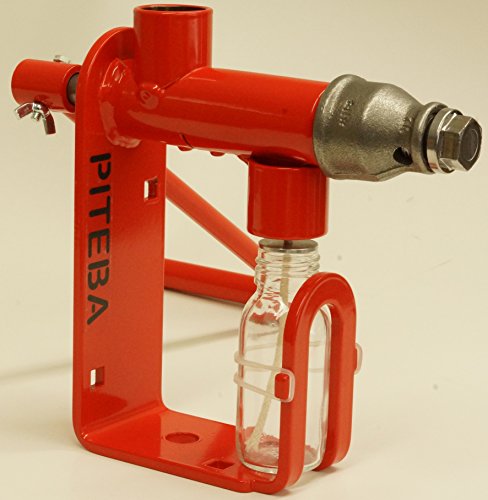
- No external power required
- Continuous manual expelling
- Compact 5.2-pound tool
Best For: Small farms and off-grid pressing
Best Electric Precision
Stainless Steel Hot & Cold Press

- Digital temperature management
- 6.61–13.22 lb hourly range
- Detachable, cleaning-friendly parts
Best For: Controlled electric pressing at home
Best Portable Manual
CGOLDENWALL Household Oil Expeller

- Compact manual operation
- Stainless-steel construction
- One-year warranty included
Best For: Small batches of oil-rich nuts and seeds
High-Capacity Pick
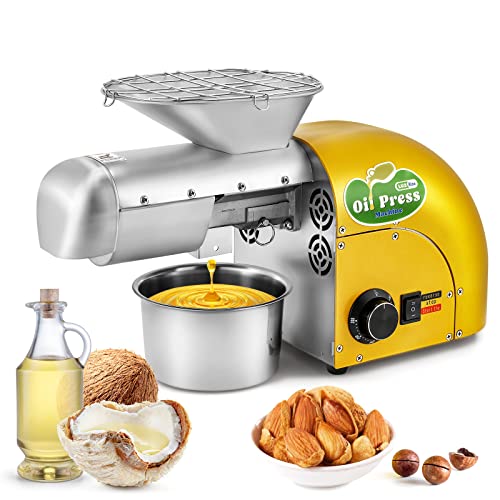
- 13–19 lb/hr advertised capacity
- 122–572°F temperature adjustment
- Hot and cold pressing with lower-noise operation
Best For: Frequent pressing of dry, oil-rich nuts and seeds
Dual-Outlet Workhorse

- Two independent motors and oil outlets
- Four-stage gears support up to 24-hour operation
- Automatic preheat and pressing controls
Best For: Higher-throughput domestic or commercial pressing
Temperature-Controlled Choice
Automatic 1800W Seed Oil Press
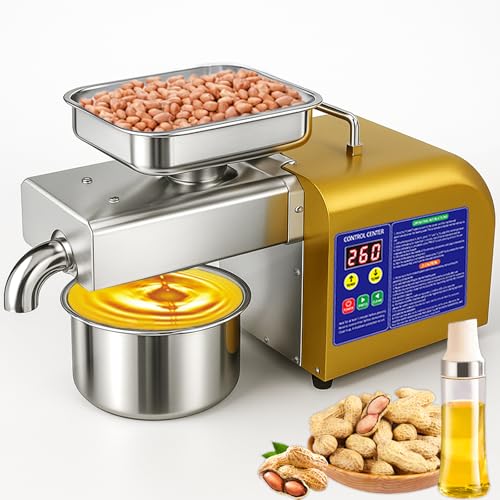
- 11–20 lb/h advertised output
- 104–572°F real-time temperature control
- Automatic heating and countdown operation
Best For: Repeat batches of listed nuts and oil-rich seeds
Best Everyday Oil Press

- Hot and cold pressing modes
- Digital temperature control with preheat timer
- Stainless steel with overheating protection
Best For: Home users making small batches from common seeds and nuts
Best High-Capacity Oil Press
CGOLDENWALL 1000W Oil Extractor

- Up to 10 lb per hour for peanuts
- Temperature range of 32–572°F
- Includes accessories and two-year warranty
Best For: Frequent batch pressing and varied seeds or nuts
Best Adjustable Oil Press
Commercial 610W Seed Oil Maker

- Temperature adjustable from 50–250°C
- Stated 3–6 kg-per-hour capacity
- Non-fingerprint stainless-steel shell
Best For: Regular small-batch pressing with adjustable heat control
Best Overall – Automatic Hot & Cold Oil Press
This 820W automatic oil press is a versatile option for home users and small commercial operations. Its hot- and cold-press modes, adjustable temperature range, and listed throughput of up to 9–13.5 pounds per hour make it suited to frequent batches of compatible seeds and nuts.
Best For: High-volume home use or small commercial pressing with adjustable temperature control.
Pros:
- Offers both hot- and cold-press settings.
- Processes peanuts, sesame, soybeans, sunflower seeds, flaxseed, walnuts, and other listed crops.
- Digital controls display temperature and support timed, automatic operation.
- Includes a filter, oil cup, cleaning brush, gloves, hopper, and other accessories.
Cons:
- Not recommended for olives, cocoa beans, spices, flowers, herbs, coffee beans, or similar materials.
- Its larger capacity and feature set may be more than occasional users need.
Choose this model when production speed and control matter more than a compact manual design. The broad temperature range and included pressing accessories make it one of the more fully equipped oil presses in this group.
Best Manual Value – Compact Nut & Seed Expeller
This manually operated expeller keeps oil pressing simple and power-free. It is a compact 5.2-pound tool designed for continuous expelling with almost no maintenance, making it a practical choice for users who prefer a straightforward alternative to electric oil presses.
Best For: Small farms, off-grid use, and buyers seeking a compact manual expeller.
Pros:
- Requires no external power source.
- Designed for continuous expelling.
- Compact form factor and listed weight of 4.14 pounds.
- Ships from the USA, according to the supplied product title.
Cons:
- Manual operation requires physical effort.
- The supplied notes do not specify compatible crops, output rate, or included accessories.
This is a sensible pick for simple, low-infrastructure pressing rather than automated production. Its main advantage is the lack of electrical requirements, while the limited specifications leave less information for shoppers comparing capacity.
Best Electric Precision – Stainless Steel Hot & Cold Press
This 110V electric oil press combines hot- and cold-press operation with digital temperature management. Its stainless-steel construction, preheat timer, thermostatic regulation, and stated processing range of 6.61–13.22 pounds per hour suit users who want more control over repeat pressing sessions.
Best For: Home users who prioritize adjustable temperature settings, cleaning access, and steady electric operation.
Pros:
- Supports both cold and hot pressing for nuts and seeds.
- Digital panel provides real-time and preset temperature information.
- Processes a stated 6.61–13.22 pounds of raw material hourly.
- Detachable components and smooth surfaces are intended to simplify cleaning.
Cons:
- Requires a 110V power connection.
- Hand-wash care is specified.
- The supplied specifications contain differing power references, listing a 150W motor in the features and 610 watts as maximum power.
Consider this model if temperature consistency and electric convenience are central to your buying decision. Its dual-mode design and cleaning-focused construction add versatility, though shoppers should verify the power specifications before purchase.
Best Portable Manual – CGOLDENWALL Household Oil Expeller
The CGOLDENWALL manual oil press uses physical pressing and a stainless-steel body for a compact, portable setup. It is intended for oil crops with more than 25% oil content and can suit users who want to make small batches without relying on an electric motor.
Best For: Portable, manual pressing of oil-rich nuts and seeds in small household batches.
Pros:
- Manual design needs no motor or electrical power.
- Stainless-steel body and handle are designed to resist rust.
- Portable construction with a listed capacity of 1 liter.
- Includes a one-year warranty and English instructions.
Cons:
- Requires continuous heating during use, according to the notes.
- Not recommended for flaxseed, rapeseed, or olives.
- Manual pressing is less convenient for larger batches.
This model is a reasonable fit when portability and hands-on control outweigh speed. Check your intended ingredients carefully, since the manufacturer specifically limits some smaller seeds and more complicated materials.
High-Capacity Pick – 1800W Hot & Cold Oil Press
For shoppers comparing oil presses, this 1800W model stands out for its combination of adjustable temperature control, hot- and cold-press modes, and an advertised 13–19 lb/hr capacity. Its 360° heating design and noise-reduction function make it a practical option for frequent home pressing.
Best For: Users pressing a variety of sufficiently dry, oil-rich nuts and seeds, including coconut, avocado, cocoa beans, and amaranth seeds.
Pros:
- 1800W motor with an advertised 13–19 lb/hr processing rate.
- Adjustable temperature range from 122–572°F for different ingredients.
- Supports both hot and cold pressing and operates below 60 dB, according to the product notes.
- Includes an oil cup, strainer, filter, cleaning brush, glove, and disassembly rod.
Cons:
- Raw materials must be sufficiently dry, and ingredients need preparation such as chopping or shredding.
- The pressing chamber and rod may require the included metal rod for disassembly.
- Hand-wash care is specified.
Choose this machine if adjustable heat and broad ingredient compatibility matter more than a compact footprint. The two-year warranty and lifetime online technical support add reassurance for regular use.
Dual-Outlet Workhorse – 1500W Automatic Oil Expeller
Among oil presses for higher-throughput use, this stainless steel model is differentiated by its two independent 1500W motors and double oil outlets. The separate systems can press different materials simultaneously or operate independently, making it suited to demanding domestic or commercial workflows.
Best For: Users who want simultaneous or independent pressing capability for nuts, fruits, vegetables, or leafy greens.
Pros:
- Two independent motors and oil outlets can handle separate materials at once.
- Four-stage gears are designed for continuous operation of up to 24 hours.
- Automatic operation uses a preheat step followed by pressing through dedicated buttons.
- Advertised energy use is 0.5–0.6 kWh per hour, with noise below 70 dB.
Cons:
- The notes do not provide a specific oil-output rate.
- Preheating for about eight minutes is required before pressing.
- The 70 dB noise claim is lower than some comparable operation levels but is not silent.
This is a strong fit when flexibility and continuous-duty capability are priorities. Its larger 18.5-inch depth and dual-motor design may be more machine than occasional users need.
Temperature-Controlled Choice – Automatic 1800W Seed Oil Press
This automatic seed oil press gives oil presses shoppers a broad 104–572°F temperature range, real-time temperature display, and an advertised 11–20 lb/h output. Its stainless steel construction and automatic heating countdown are useful for repeat batches at home or in a small commercial setting.
Best For: Pressing peanuts, sesame, soybeans, walnuts, sunflower seeds, almonds, flax seeds, and other listed oil-rich seeds.
Pros:
- 1800W motor with an advertised 11–20 lb/h output and up to 24 hours of continuous pressing.
- Temperature can be set from 104–572°F and monitored on the intelligent panel.
- Automatic heating and countdown simplify repeat operation.
- Includes a press chamber, residue pipe, oil cup, filter, hopper, brush, and gloves.
Cons:
- Freshly pressed oil should settle for 24 hours before separation and use.
- The notes specifically exclude cocoa beans, spices, flowers, herbs, coffee beans, and olives.
- Ingredient compatibility should be checked carefully before buying.
This model makes the most sense for buyers who value guided, temperature-controlled operation and a stated production range. Its exclusions mean it is less versatile for specialty ingredients than some other oil presses.
Best Everyday Oil Press – 610W Hot & Cold Press Machine
If you want a practical entry point into homemade oil pressing, this 610W machine combines hot and cold pressing with automated temperature management. Its stainless-steel construction, digital display, and included filter and oil cup make it a convenient option for common oil crops such as peanuts, sesame, coconut, soybeans, sunflower seeds, and walnuts.
Best For: Home users who want straightforward hot- or cold-pressed oils with built-in temperature control.
Pros:
- Supports both hot and cold pressing for different ingredients and flavor preferences.
- Digital temperature display and an 8-minute preheat countdown simplify operation.
- 304 stainless-steel construction includes overheating protection, auto shutoff, and cooling features.
Cons:
- The included specifications list a 150W motor despite the machine’s 610W maximum power rating, which may require clarification.
- Hand washing is recommended for care.
This model is a balanced choice for users prioritizing convenience and safety features over maximum commercial throughput. Its automatic preheating and dual pressing modes make it versatile for regular small-batch oil making.
Best High-Capacity Oil Press – CGOLDENWALL 1000W Oil Extractor
For shoppers comparing oil presses with broader ingredient support and higher stated throughput, the CGOLDENWALL machine offers hot and cold pressing, adjustable control from 32 to 572°F, and a pressing speed of up to 10 pounds per hour for peanuts. It also includes two pots, a filter, brush, gloves, tools, and a two-year warranty.
Best For: Larger household batches or light commercial use involving a wide range of oil-bearing seeds and nuts.
Pros:
- Handles many ingredients, including peanuts, coconut, sunflower seeds, walnuts, sesame, flax, pumpkin seeds, and pine nuts.
- Intelligent temperature control supports both cold pressing and higher-yield hot pressing.
- Includes auto-reversing, a powerful copper motor, accessories, and a two-year warranty.
Cons:
- At 29 pounds, it is less convenient to move than a compact countertop appliance.
- Dry raw materials and machine preheating are required for pressing.
- Its 15.7-inch depth and 14.2-inch height require dedicated counter space.
The CGOLDENWALL stands out when ingredient flexibility and batch capacity matter most. Its larger footprint and weight are reasonable trade-offs for users who expect to press oil more frequently or in greater quantities.
Best Adjustable Oil Press – Commercial 610W Seed Oil Maker
This commercial-style oil press is designed for users who want adjustable heat and a sturdy stainless-steel build. Its temperature range of 50–250°C, automatic heating, and stated 3–6 kg-per-hour processing capacity make it a useful option for pressing peanuts, sesame, canola, soybeans, sunflower seeds, coconut, walnuts, and other suitable materials.
Best For: Users who want more manual temperature flexibility and a machine suited to regular small-batch production.
Pros:
- Adjustable pressing temperature from 50 to 250°C supports different ingredients and pressing styles.
- Automatic heating and a temperature display reduce the need for separate frying or manual monitoring.
- Non-fingerprint stainless steel is described as rust- and corrosion-resistant and easier to clean.
Cons:
- The supplied notes do not specify a voltage or detailed safety features.
- Hand washing is recommended.
- Only basic accessories are listed: an oil cup, filter, gloves, and instruction manual.
Choose this model if adjustable heat and a straightforward commercial-style design are more important than a large accessory package. Its stated capacity and broad ingredient compatibility suit users who press oil regularly.
How We Picked the Best Oil Presses
We compared these Oil Presses by focusing on the specifications that most affect real-world use: motor power, stated pressing capacity, hot- and cold-press capability, temperature range, construction, control style, and intended workload. We also considered whether each design suits occasional home use, frequent batch processing, or small commercial production.
Because manufacturer output ratings can vary with seed type, moisture, preparation, and temperature, treat pounds-per-hour figures as useful estimates rather than guarantees. Hard or oily ingredients may process differently from softer seeds.
Quick Comparison
| Best For | What to Look For | Typical Choice |
|---|---|---|
| Occasional home use | Compact design, simple controls, manageable cleanup | Lower-wattage automatic or manual press |
| Frequent household batches | Temperature adjustment, steady feeding, stainless-steel construction | 610W–1000W electric model |
| Higher-volume work | Higher throughput, extended pressing components, durable motor | 1500W–1800W commercial-style press |
| Hands-on pressing | Manual control and no dependence on electricity | Manual expeller |
Key Buying Factors for Oil Presses
Capacity and Motor Power
Higher wattage can support faster pressing and tougher ingredients, but it may also mean more noise, heat, power consumption, and countertop space. Choose capacity based on your normal batch size rather than the maximum advertised output.
Hot Versus Cold Pressing
Cold pressing is useful when you want to limit added heat, while hot pressing can improve flow and extraction for some seeds. Adjustable temperature control gives you more flexibility, especially when working with peanuts, sesame, soybeans, coconut, or mixed ingredients.
Controls and Construction
Digital temperature settings, automatic feeding, reverse functions, and timed operation can make repeated batches easier. Stainless-steel components are generally preferable for durability and cleaning, but verify which parts are removable and whether they are dishwasher-safe.
Cleanup and Safety
Oil residue can harden quickly, so accessible pressing chambers and included cleaning tools matter. Look for overload protection, stable feet, clear operating instructions, and a design that keeps hot surfaces and moving parts safely managed.
Who Should Buy Which Oil Presses?
Choose a Manual Press If You Value Control
A manual expeller suits small batches, occasional use, and buyers who prefer a simpler machine. It requires more physical effort and usually offers less consistent throughput.
Choose a Midrange Electric Press for Most Homes
A 610W–1000W automatic model is a practical balance for regular cooking, homemade dressings, and moderate seed processing. Prioritize easy temperature adjustment and straightforward cleaning.
Choose a High-Powered Press for Demanding Workloads
An 1500W–1800W machine makes more sense for frequent batches or small commercial use. Confirm that your electrical setup, ventilation, storage area, and cleaning routine can support the larger equipment.